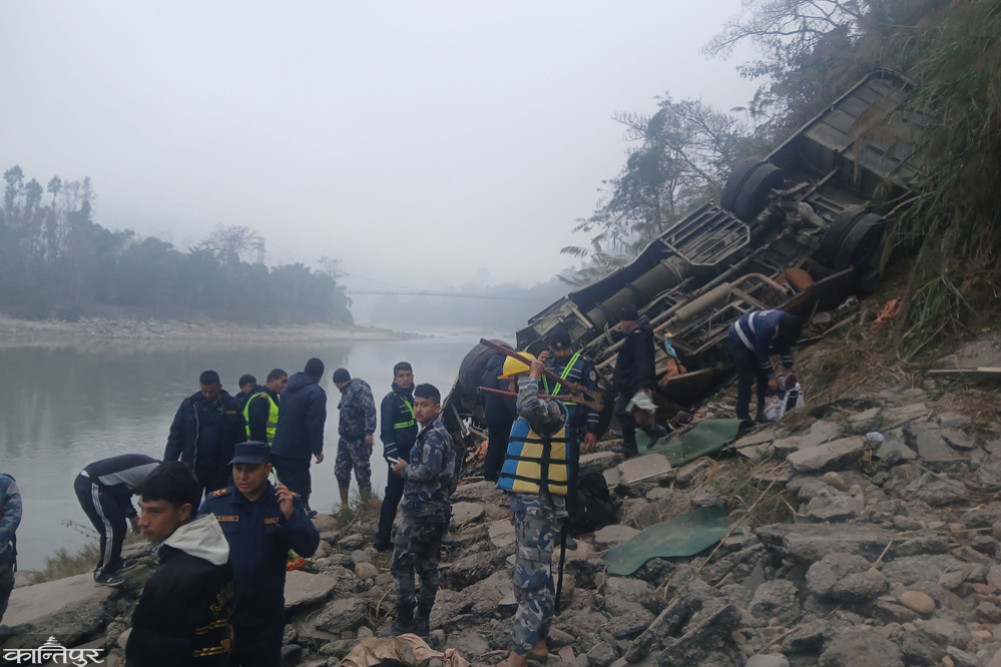
The increase in road accidents in Nepal is not a coincidence but a result of institutional corruption, weak monitoring and unaccountable structures. Road accidents cannot be reduced unless the entire network of licensing systems, road construction, vehicle testing and traffic enforcement is transparent, accountable and corruption-free.
We use Google Cloud Translation Services. Google requires we provide the following disclaimer relating to use of this service:
This service may contain translations powered by Google. Google disclaims all warranties related to the translations, expressed or implied, including any warranties of accuracy, reliability, and any implied warranties of merchantability, fitness for a particular purpose, and noninfringement.
On February 10, a passenger bus coming from Pokhara to Kathmandu crashed in Benighat, Rorang Rural Municipality, Dhading, killing 19 people. That was not just an exceptional incident. Just 13 days before that incident, on February 12, 12 people died in a car accident in Ramechhap. Five days before that, on February 22, 13 people died in a bus accident in Baitadi.
A look at the number of deaths in three accidents in a month presents a frightening picture. Road accidents are increasing day by day in Nepal. According to a Nepal Police report, an average of 97 road accidents occur in Nepal every day, and an average of seven people die every day due to accidents. In the last 12 years, the number of deaths in road accidents has exceeded 28,000 (see table).
The table shows that road accidents have become the most serious health crisis in Nepal. Various agencies have also studied the causes of road accidents. According to a study conducted by the Traffic Management Division in 2076, the biggest cause of road accidents was driver negligence (43.7 percent). Similarly, 18.7 percent were due to excessive speeding, 9.8 percent due to overtaking, 9.5 percent due to pedestrian negligence, 6.2 percent due to drunk driving, 6.1 percent due to mechanical malfunction of the vehicle, 5.2 percent due to overload, 0.4 percent due to road accidents, and 0.4 percent due to other reasons. Similarly, a study by the 'Vehicle Accident Reduction Study Subcommittee' formed by the Development and Technology Committee of the House of Representatives in 2077 BS showed that vehicle accidents are increasing due to mechanical problems of vehicles, road conditions, problems with drivers, and problems in law enforcement.
The reasons shown by the study alone do not seem to cover the 'overall causes' of road accidents. If we study carefully, the root of road accidents is also deeply linked to the structural corruption that has grown in road management and regulatory bodies. However, ironically, the study of the causes of road accidents has not included the relationship between ‘corruption’ and ‘driving’.
Driving license: Not skill, but a game of money
The first condition for road safety is a skilled, disciplined and responsible driver. However, in Nepal, the driver’s license distribution system has long been entangled in corruption. No matter how strict the written exam, trial test and biometric process may seem on paper, in practice, ‘setting’, broker networks and financial transactions are widespread. The practice of brokers openly present inside and outside the trial center ‘giving’ licenses to failed examinees for money is widespread.
This problem is not limited to irregularities. It is striking at the very backbone of road safety. When a person who does not know basic skills such as traffic signs, priority rules, overtaking methods, emergency brake control, and risk prediction is given a driving license for the greed of a few bucks, accidents become inevitable. Corruption in the licensing process is directly linked to accidents and deaths.
Bribery is widespread in the driver's license distribution process, trial exams, etc. After one after another fake licenses were found, the department itself formed an investigation committee on November 21, 2080 under the coordination of Mukesh Regmi, Director of the Department of Transport Management, to investigate such licenses. When the committee studied the fake licenses issued from November 2072 to 2080, 122,711 licenses were found to be fake. The study showed that even people who failed the trial and were not present at the trial process had obtained licenses by paying bribes. On the one hand, corruption worth Rs 10 billion had taken place, while on the other hand, licenses had reached the hands of people who did not even have basic driving skills.
Similarly, the Commission for the Investigation of Abuse of Authority conducted a survey among 3,400 service recipients across the country in BS 2075. 39 percent of service recipient respondents said that they had to pay bribes to middlemen or employees to get work done at the transport office. There are also many cases where the CIAA has investigated and filed cases regarding corruption in the Transport Management Office. In 2076 BS, a case was filed against 38 people, including 3 deputy secretaries of the Transport Management Office, Ekantakuna, Lalitpur, in a special court. The CIAA alleged that 1,284 people had tampered with the driving license test results there. Similarly, on 2082 Magh 13, the CIAA had seized 17 employees, including the head of the Transport Management Office, Chabahil, and 25 mobile phones of the traffic police and investigated them. The CIAA had confiscated their mobile phones after it was found that Chabahil employees and policemen were taking bribes of 5 to 10 thousand rupees in collusion to make those who failed the written license test pass.
The CIAA has filed a case against 44 people, including the law secretary of Lumbini Province, in a special court on February 14, on charges of issuing 5,500 licenses in bribes at the settings of transport employees, traffic police, and driving centers. The investigation, which began a year ago after the CIAA took four people into custody, has found that the Nepalgunj Transport Office was distributing driver's licenses in an organized manner by taking bribes. According to the CIAA, the gang had committed irregularities by fixing the bribe rate according to the category of license. Of this, 24,000 were taken as bribes for trucks/buses/lorries, 22,000 for dozers/rollers/cranes/excavators and minibuses/minitrucks, and 17,000 for cars/jeeps/vans. Similarly, 12,000 for tempos/autorickshaws and motorcycles, and 10,000 for scooters, according to the CIAA charge sheet. The CIAA claims that out of 27,773 licenses issued by the Transport Office, 20 percent of the examinees who participated in the exam passed by taking bribes. The CIAA found that 84.34 million rupees were collected while issuing licenses to them. Similarly, in the last five years, more than 50 employees of the Transport Office have been caught red-handed by the CIAA while taking bribes from service recipients.
Since then, various studies by Transparency International have mentioned the syndicate in Nepal's public transport as a form of politically protected corruption. Similarly, a study by the National Vigilance Center showed that illegal transactions worth millions of rupees are being made daily in the transport office.
A large proportion of road accidents are said to be linked to 'human error'. However, that error is not only individual but also systemic. If the state itself fails to implement strict standards for the competence of drivers, then the responsibility for the accident lies not only with the driver but also with the state itself. Before the driver's error, the existing errors in the license distribution structure and the corruption that is rampant there are the main causes of accidents. The corruption that exists in the process of distributing driver's licenses has put the steering of vehicles in the hands of incompetent people who do not have a general knowledge of traffic rules. Thousands of families are losing their livelihood every year as the pockets of transport office employees and middlemen are filling their pockets.
Limited to paper, road construction standards
According to the report ‘The Many Faces of Corruption’ published by the World Bank, up to 30 percent of the budget is being corrupted in developing countries by changing designs, increasing cost estimates, and compromising on the quality of construction materials. This results in poor quality roads, which is contributing to road accidents.
Corruption in the Road Department, the body responsible for road construction and quality assurance, is also increasing road accidents. While constructing roads in rural areas, roads are being dug under the whims and pressures of local factions without meeting any technical and engineering standards. According to a statistic from BS 2077, out of the 80,000 kilometers of roads constructed in Nepal, 42,000 kilometers are completely unfit for driving. Only 17 percent of the roads across the country are fit for driving. Buses and minibuses are being allowed to operate freely on roads unsuitable for vehicle operation by exchanging bribes.
The biggest problem with road quality is unhealthy competition, especially in the contracting process. There is a widespread trend of taking contracts at unnaturally low rates in the name of working at minimum cost and later compromising on quality to secure profits. When technical inspections are limited to formalities instead of strict quality testing of construction materials, roads are being built without strong structures. Due to the lack of impartial evaluation of performance and independent technical testing, construction companies are easily paid even if the standards specified in the contract are not met. In this way, when economic interests dominate rather than the safety of citizens at the center of development projects, road accidents have become a risk area.
Vehicle testing limited to paper formalities
Regular technical testing of vehicles is an important basis for reducing road accidents. Regular scientific testing of aspects such as brake systems, tire conditions, steering controls, lights, suspension, seat structures, emergency doors contributes to road safety. According to the World Health Organization, a large proportion of road accidents in low- and middle-income countries are linked to technical weaknesses and inadequate maintenance.
The system for testing the mechanical condition of vehicles in Nepal is also not free from corruption. The Transport Management Office employees have been distributing certificates of operability even to old and dilapidated vehicles for a few bucks. This has increased the number of accidents due to technical glitches. Due to syndicates and political patronage, old vehicles have not been replaced. Accidents on the roads are increasing as the regulatory bodies focus only on revenue and fines.
The physical infrastructure, equipment and skilled technical manpower of the Transport Management Office are limited. Some offices lack testing equipment. In such a situation, the testing process is limited to formalities. Most of the public vehicles operating on rural roads in Nepal are more than 15 to 20 years old. Operating such vehicles without regular and technical testing increases the risk of accidents. Emission testing is also limited to the formality of sticker renewal for most vehicles. Allowing public transport to ply on substandard roads without rigorous technical testing is increasing the rate of road accidents.
Traffic loves bribes more than rules
The first step to ensuring road safety is strict implementation of traffic rules. Vehicle inspections, speed controls, overload checks, alcohol testing, inspection of safety equipment such as helmets and seat belts, and fines are all part of the discipline of vehicles. However, these processes have not been implemented effectively and systematically in Nepal. In many places, traffic police are turning a blind eye to those who do not comply with the rules in exchange for bribes. About 8 percent of the sting operations conducted by the Authority in the past 5 years have involved traffic and public road police.
The impact of corruption in the implementation of traffic rules is widespread. Some traffic police turn a blind eye to the illegal actions of drivers in exchange for a ‘transaction’. Bribery at vehicle checkpoints seems to be a common practice. Drivers of public transport, private vehicles, or large trucks are bribing traffic police to make illegal actions ‘legal’. As the situation increases, drivers are exempted from fines or punishment by paying some money even when they violate the rules, it is leading to accidents. According to a World Bank report, widespread corruption in traffic police increases the rate of road accidents. ट्राफिक नियम कार्यान्वयनमा समेत भ्रष्टाचारको छाया देखिन्छ । जरिवाना टार्न अनौपचारिक लेनदेन, प्रभावशाली व्यक्तिहरूलाई छुट तथा नियमित अनुगमनमा कमजोरीले कानुनको प्रभावकारिता घटाउँदै दुर्घटना बढाइरहेको छ ।
अबको बाटो
सडक दुर्घटना केवल व्यक्तिगत चालकको कमजोरी होइन । यसमा संगठित प्रणालीगत कमजोरी र भ्रष्टाचार मुख्य कारक छन् । यसको समाधानका लागि केही सुधार आवश्यक छन् । पहिलो, लाइसेन्स वितरण प्रक्रियालाई पूर्ण रूपमा दक्षता परीक्षणमा केन्द्रित गर्दै पारदर्शी र दलालमुक्त बनाउनु जरुरी छ । लिखित परीक्षा, ट्रायल परीक्षण र प्रशिक्षणको सम्पूर्ण तथ्यांक सार्वजनिक डिजिटल प्लाटफर्ममा राख्ने प्रणालीको विकास गर्नुपर्छ । दलाल तथा पैसाको खेलले उत्पादन गर्ने ‘अयोग्य चालक’ लाई रोक्न सरकारले प्रभावकारी नीति बनाएर अपरेसन चलाउनुपर्छ ।
दोस्रो, सडक निर्माण र मर्मतमा तेस्रो पक्षबाट प्राविधिक परीक्षण अनिवार्य गर्नुपर्छ । ठेक्का प्रक्रियामा पारदर्शिता, निरीक्षणको नियमित अनुगमन र गुणस्तर मापदण्ड कडाइका साथ कार्यान्वयन आवश्यक छ । यसले सडकको दीर्घकालीन स्थायित्व सुनिश्चित गर्छ । यो सडकको भौतिक मजबुतीका साथै यात्रुहरूको सुरक्षा सुनिश्चित गर्न पनि अनिवार्य छ । तेस्रो, सवारीसाधन परीक्षणमा आधुनिक उपकरण र स्वचालित रेकर्ड प्रणाली लागू गर्नुपर्छ । ब्रेक, टायर, सस्पेन्सन, धूवाँ उत्सर्जन लगायतका सबै परीक्षण स्वतन्त्र, वैज्ञानिक र नियमित हुनुपर्छ । डिजिटल रेकर्डले वास्तविक परीक्षण गर्न र अनियमितता कम गर्न योगदान गर्छ । ट्राफिक नियम कार्यान्वयनमा सडकमा क्यामरा आधारित निगरानी, डिजिटल जरिवाना प्रणाली र स्वतन्त्र अनुगमन आवश्यक छ ।
चौथो, यातायात व्यवस्थाको सम्पूर्ण चक्रमा विद्यमान भ्रष्टाचारको अन्त्य गर्ने प्रस्ट रणनीतिक योजना तय गरिनुपर्छ, अन्यथा सडक दुर्घटना घटाउन सकिन्न । यातायात व्यवस्था कार्यालय तथा सडक निर्माण र ट्राफिक नियम कार्यान्वयन गर्ने निकायसम्म विद्यमान भ्रष्टाचारको अन्त्य सडक दुर्घटना नियन्त्रणको एक अनिवार्य पूर्वसर्त हो ।
अन्त्यमा, नेपालमा सडक दुर्घटना बढ्नु संयोग नभई संस्थागत भ्रष्टाचार, कमजोर अनुगमन र गैरजवाफदेही संरचनाको परिणाम हो । जबसम्म लाइसेन्स प्रणाली, सडक निर्माण, सवारी परीक्षण र ट्राफिक कार्यान्वयनको सम्पूर्ण सञ्जाल पारदर्शी, उत्तरदायी र भ्रष्टाचारमुक्त हुँदैनन्, तबसम्म सडक दुर्घटना घटाउन सकिँदैन । यस्ता निकायमा जकडिएको भ्रष्टाचारको जालो नतोडेसम्म सडक दुर्घटना हाम्रो विकासको स्थायी छाया बनिरहनेछ ।