The responsibility for the safety of Nepali citizens employed abroad lies with the individual and their families.
We use Google Cloud Translation Services. Google requires we provide the following disclaimer relating to use of this service:
This service may contain translations powered by Google. Google disclaims all warranties related to the translations, expressed or implied, including any warranties of accuracy, reliability, and any implied warranties of merchantability, fitness for a particular purpose, and noninfringement.
Everyone knows that Nepal is a country driven by remittances, and the government knows it even better. In the first 6 months of the fiscal year 2082/83 alone, Rs. 162.93 billion in remittances have been received through formal channels.
Although the amount received through informal channels is also very large, it has not been accounted for. A large part of this amount has been sent by workers who have gone to Gulf countries and Middle Eastern countries.
Data from the Department of Foreign Employment shows that the number of Nepalis who have currently gone to Middle Eastern countries, including the Gulf countries, with work permits in search of work is about two million, of which more than 11 percent are female workers. Some have gone without work permits or are undocumented.
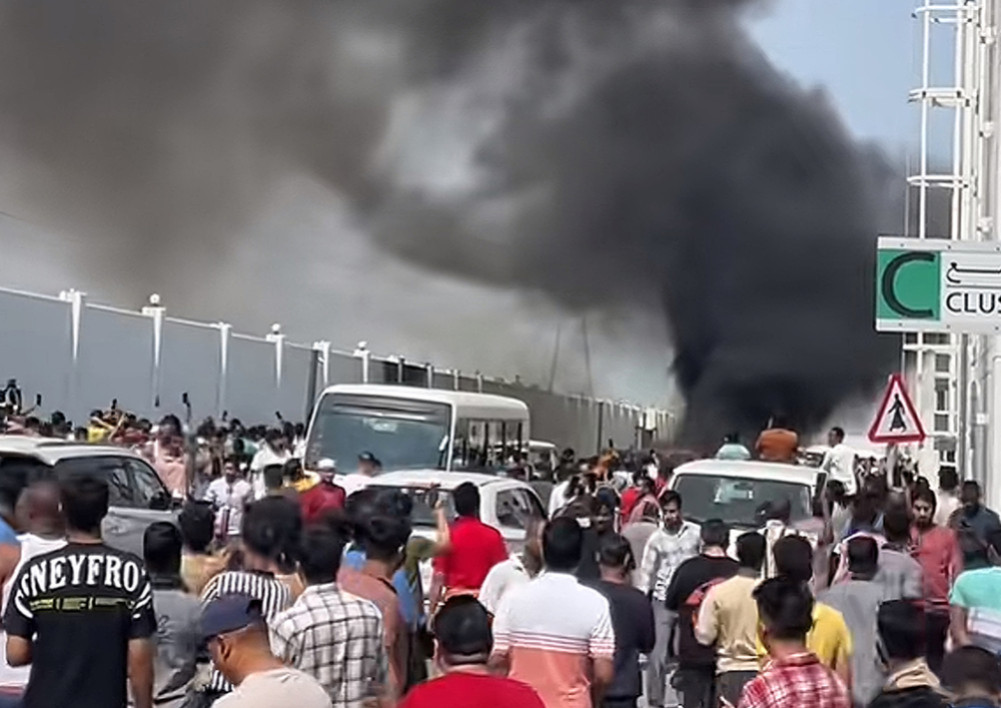
After the US and Israel attacked important locations, including Iranian military training sites, on February 28, an atmosphere of fear and panic has spread throughout the world. In retaliation, Iran is attacking US bases in the Middle East, including the Gulf countries. In addition, airports, US embassies, oil refineries, and other places have also been attacked.
Even in difficult situations, those countries have paid attention to the safety of foreign workers as much as possible. Given the nature of the war, it is not possible to say that this situation will end soon. If the situation becomes complicated, the risks will increase and there may be a possibility of returning empty-handed or being laid off from work and being stranded without even having the opportunity to return home.
Many workers and their families had to endure similar horrors during COVID-19. At that time, an emergency rescue mechanism was created, albeit belatedly, but its effective implementation was not found to be very effective.
Moreover, workers who left without obtaining a work permit and whose work period had expired were given priority. After all, they are also Nepali citizens and the state is using the remittances they send with pride. Let's hope that such a situation will not happen this time.
This time, it seems that the Nepalese government has taken positive steps in a timely manner. The day after the war began, i.e. on March 1, the Council of Ministers meeting held on March 1, made some important decisions:
– To temporarily suspend work permits for workers to go to Gulf and Middle Eastern countries.
– Nepali embassies in the relevant countries will be instructed to pay special attention to the safety of Nepali workers there.
– The government will remain prepared to take necessary steps in case of an emergency.
– Continuously monitor the condition of workers.
The government has also formed an emergency security and rescue task force. In this way, the government seems to be presenting itself in a responsible manner. However, the effectiveness of the decision implementation remains to be seen.
The state can reduce the fear, panic and anxiety of workers and their families and give them the feeling that ‘the government is there’. But this issue will be confirmed by the security guarantee felt by Nepali citizens at risk.
If the current security challenge worsens and Nepal has to rescue millions of its citizens abroad for foreign employment and study, the country may have to spend many times the amount of remittances received. Therefore, the government should be very vigilant and planful preparations to deal with such a possible situation from now on. It would also be appropriate to start coordination and cooperation with neighboring countries. The state should prioritize not only those who have access or work permits in the rescue process, but also everyone who is at risk.
Sometimes, people associated with the state and others express concerns like, ‘If all the Nepalis who have gone abroad for employment return home, an emergency situation will arise in the country, how will it be managed?’ If such a situation arises, they should be able to come up with a policy to create employment in the country using the skills and technology they have brought from abroad. If this happens, it will contribute to a long-term solution to employment.
The responsibility for the safety of Nepali citizens employed abroad lies with the individual himself and his family. Family members should keep track of which country, what job, and where their people are. Similarly, it is appropriate for people abroad to keep their information about themselves to family members and at least four to five friends. Doing this can make it easier to get help in an emergency.
During COVID-19, some workers lacked such information. Some families were found to not even know in which country and which company their members are working. Similarly, Nepali embassies need to keep clear records of Nepali workers in the relevant countries—how many Nepalis are involved in which company and what job?
In this seemingly small but important aspect, the state, supporting organizations and individuals themselves should learn lessons from the past. This can help to some extent in keeping citizens safe during such crises in the future. Only then does the state, which prides itself on remittances, seem to realize its responsibility towards its citizens abroad in times of emergency.