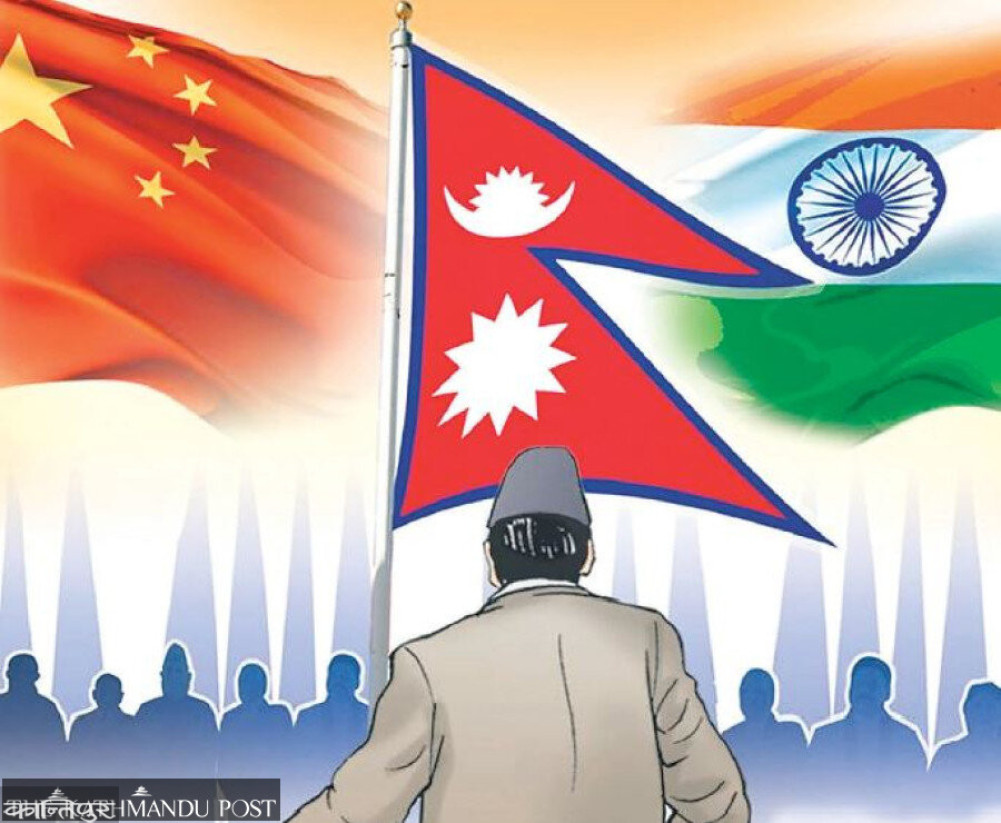
If foreign policy becomes a mere matter of sloganeering, long-term national interests may be undermined.
We use Google Cloud Translation Services. Google requires we provide the following disclaimer relating to use of this service:
This service may contain translations powered by Google. Google disclaims all warranties related to the translations, expressed or implied, including any warranties of accuracy, reliability, and any implied warranties of merchantability, fitness for a particular purpose, and noninfringement.
The importance of foreign policy increases during elections because electoral competition is not limited to the domestic agenda. It also indicates relations with neighboring and international powers. On such occasions, foreign powers pay special attention to Nepal's political direction, potential leadership, and policy priorities.
Being located between powerful neighbors like India and China, Nepal's political parties' statements, alliance views, and approach to external aid or projects are viewed from the outside. If foreign policy becomes a mere matter of sloganeering, long-term national interests may be weakened.
Therefore, during general elections, it is necessary to present foreign policy on the basis of national consensus, continuity, and balance, above partisan interests, so that Nepal's international credibility and strategic stability are maintained even after a change of power.
Geopolitical Game: The Dilemma and Survival of Small Power States
Throughout history, small or medium-power states located between great powers have faced the same difficult question - how to protect their sovereignty in the face of competition from powerful neighbors? Geography puts them in a sensitive position, but geographical location alone is not the decisive factor. Internal political unity, institutional strength, economic self-reliance, and diplomatic acumen are crucial.
When these elements are weak, the influence of external powers intensifies. When these are strong, even small states can secure their place in a complex balance of power. Therefore, the dilemma of small states is not only an external threat, but also a test of internal capacity.
Nepal is facing a similar geopolitical situation today. In Nepal, between India and China, the United States and European countries are also watching the South Asian balance of power with interest. Although Nepal's situation is unique in the specific context of the 21st century, some examples from history help us understand its risks and possibilities.
Nepal's challenge is not only to maintain a balance between two neighbors, but also to manage its multifaceted diplomacy - diversifying economic partnerships, sensitively addressing security concerns, and maintaining internal political consensus. If Nepal can clearly define its national interests and adopt a long-term strategy, its geopolitical position can become a strength, not a weakness.
Nepal: A 'buffer state' reality
'Sandwich', 'Tarul' or 'Bridge', whatever you call it, in the language of international relations, a 'buffer state' refers to a state located between two powerful or competing countries, whose geographical presence somewhat separates those great powers from directly confronting them. Simply put, a 'buffer state' is a 'country in between' two great powers, whose existence plays a role in the balance of power. Such a state sometimes becomes a center of pressure, but with the right strategy, it can also create opportunities. Nepal, located between both the large and influential nations of India and China, is often called a 'buffer state'.
Nepal's two neighbors have border disputes and a competition for territorial expansion. Being located in the Himalayan region, Nepal's strategic importance is much greater than its size. Tibet is a sensitive issue for China, so Nepal's territory is important from its security perspective. On the other hand, Nepal is deeply connected to India through trade, transit, employment and cultural ties.
Thus, Nepal has to balance relations with many powers at the same time. This balance is the main challenge of its foreign policy.
Being a ‘buffer’ is not just a geographical location, but also a diplomatic responsibility. If Nepal shows excessive inclination towards one power axis, a sense of imbalance may arise on the other side. Similarly, showing excessive caution or inaction may lead to the loss of economic opportunities. Therefore, balance for Nepal does not mean passive neutrality, but active, realistic and long-sighted diplomacy. Here, national interests are clearly defined, the core security concerns of neighbors are understood, and multilateral relations are managed as complementary rather than competitive. This is also true non-alignment from any military alliance.
The issue of how states like Nepal have conducted their foreign policy and internal affairs in history can be an important historical lesson. There are examples of other small powers maintaining a balance between powerful neighbors, strengthening internal unity and adopting diplomatic caution. Therefore, studying such experiences can also provide useful guidance for Nepal in managing the current challenge.
Important examples from history
No two situations in geopolitics are exactly the same. Each situation develops in its own historical, cultural and strategic context. However, certain patterns and trends can be observed across different events. And, from them, important lessons can be drawn. By carefully studying such patterns, states can understand risks, anticipate challenges and make more informed and prudent strategic decisions. The following four examples are taken into account:
1. The Polish-Lithuanian Commonwealth is a relevant example of internal weakness and external interference. The Polish-Lithuanian Commonwealth of the eighteenth century was a vast state located between Russia, Prussia and Austria. It was not a weak state in terms of area and population, but its main problem was its internal political structure more than geography. Due to the elected monarchy and the ‘liberum veto’ system, any one member of parliament could block the entire legislative process. This made effective governance and reform almost impossible. The state administration became sluggish, fragmented and factionalized.
This structural weakness was used as a golden opportunity by neighboring powers. Russia, Prussia, and Austria provided economic and diplomatic support to internal political factions, influenced influential figures, and sometimes even used military pressure. When constitutional reform was attempted in 1791, neighboring powers saw it as against their interests. As a result, the state was partitioned in three stages in 1772, 1793, and 1795. And, ultimately, Poland disappeared from the map of Europe.
This incident teaches a profound lesson. The weakness of any state does not arise solely from external aggression. When there is internal political fragmentation, indecision, and institutional weakness, it is easier for external powers to intervene. Internal division increases external pressure qualitatively. Therefore, when internal weakness and external ambitions are active at the same time, not only the sovereignty of the state but also its very existence can be in danger. Poland and Lithuania re-emerged as independent states in 1918 after World War I. After World War II, Poland and Lithuania came under Soviet influence, but were re-established as fully sovereign democratic states in 1989–1991.
2. Belgium is another relevant example of the limitations of international guarantees. In the nineteenth century, Belgium was established as a ‘buffer state’ between French and German territory. After its independence in 1830, to ensure its stability, the major European powers guaranteed its permanent neutrality through the Treaty of London of 1839. This meant that Belgium would not join any military alliance and that other powers would respect its territory. In theory, this arrangement seemed balanced and secure.
However, when World War I broke out in 1914, Germany used Belgian territory under the ‘Schlieffen Plan’ to attack France. This directly violated Belgium’s neutrality. The United Kingdom then entered the war against Germany, citing its treaty obligation to protect Belgian sovereignty. During the war years, Belgium suffered great human and material losses – cities were destroyed, industries were destroyed, and civilian life was disrupted. However, after the war, its independence was restored and the state survived.
This incident illustrates two important points. Namely, international treaties and legal guarantees alone do not ensure security. In times of crisis, political will is needed to implement those paper commitments. And, the interests of great powers are decisive in the security of small states. Only when treaty violations affect their strategic interests are they prepared to actively intervene. International treaties are only effective when powerful countries are willing and able to defend them. Neutrality can only remain on paper.
3. Finland can be considered a relevant example of cautious neutrality. During the Cold War, Finland faced an extremely complex security environment with a long border with the Soviet Union. After World War II, Finland signed a treaty with the Soviet Union, pledging to refrain from direct confrontation and not to allow its territory to be used for any anti-Soviet military activity. It distanced itself from the Western military alliance but did not fully integrate into the Soviet sphere of influence.
Under this strategy, Finland preserved a democratic political system, free elections, a free market economy, and economic ties with the West. However, it was extremely cautious in its foreign policy – it did not make decisions that directly conflicted with Soviet security, and even adopted a policy of maintaining balance in public statements.
This experience shows that a small state can manage difficult geopolitical challenges based on realistic thinking, national consensus, and institutional stability. Due to the changed security environment after the Cold War, and especially after the 2022 Russo-Ukraine war, Finland reconsidered its long-term policy and joined NATO in 2023. This proves that the strategies of small states are not static, they can change according to circumstances and national interests.
4. Let's look at the history of Czechoslovakia. In 1938, Germany pressed for the Sudetenland to be annexed. The United Kingdom and France signed the Munich Agreement to avoid war, which excluded Czechoslovakia and gave the Sudetenland to Germany. This weakened the country, and in 1939, Germany occupied the remaining territory and created a separate state, Slovakia. The country was reunified after World War II, but after the Velvet Revolution of 1989, political and economic differences between the Czechs and Slovaks increased, and in 1993, it was peacefully divided into two countries. This incident shows that both external pressure and internal disagreements can affect the stability of a state.
The main risk for Nepal
A greater risk for Nepal today than direct military attack lies in the interaction of internal political divisions and external power competition. Today's international structure does not seem to be oriented towards direct territorial division as it was in the eighteenth century. But the potential to weaken the autonomy of small states through influence, pressure, economic dependence, diplomatic polarization, and policy influence remains.
If Nepal's political polarization is directly linked to the India-China or US-China rivalry, the country could become more of a competitive arena than an autonomous decision-maker. History has shown how risky such a situation can be. For example, in the Polish-Lithuanian Commonwealth, internal factionalism opened the door to intervention by external powers. When political forces depended on external support, the national decision-making process itself became weak. Similarly, in the context of the Munich Agreement of 1938, Czechoslovakia relied on external guarantees. Ultimately, the great powers chose their own strategic priorities.
In contrast, Finland maintained a careful balance during the Cold War based on internal consensus and realistic diplomacy. It preserved its political system by yielding to external pressure. Although Belgium declared neutrality, its security guarantee ultimately depended on the active support of external powers.
These examples provide a clear indication of the Nepalese context. If internal political forces are highly linked to external polarization, policy-making may be guided by external influences rather than national interests. In such a situation, the sovereignty of the country may be weakened in practice, even if it is legally established. However, if there is a strong institutional structure, national consensus, transparent decision-making process and a clear strategic vision within the country, this risk is reduced. Internal unity is the first line of defense against external pressure. The most effective security mechanism for small states is not only the army – institutional stability, political maturity and a shared national vision.
Geography is not fate
Historical experience shows that the fate of small states is not determined by geography alone. Being located among powerful neighbors can be risky, but the decisive factors are internal unity, strong institutions and a clear strategy. Support from external powers can be useful, but it is always linked to one's own interests. Therefore, it is not safe to rely entirely on it. Small states often have to choose between balance, neutrality or alliance, and each option carries some risk.
In the case of Nepal, the solution is not to choose one power, but to maintain a prudent balance with all. Only on the basis of restrained diplomacy, economic diversification, institutional strength and national consensus can independent decision-making capacity be preserved even among the great powers. Ultimately, geography may provide pressure, but the direction is determined by the internal strength and leadership of the state.
Nepal's non-aligned foreign policy of staying away from any military alliance has proven to be a viable strategy given the changing polarization of geopolitical power alliances. Today's world is not like the bipolar structure of the Cold War.
It is gradually moving towards a multipolar structure. While the United States is still the dominant military power in the global balance of power, China is rapidly expanding its military, economic, and technological capabilities. Russia is playing an influential role based on military power and nuclear capabilities, while European countries are active through collective security mechanisms. Countries like Japan, India, and Australia are also becoming important in the security architecture in the Indo-Pacific region.
Such a multipolar military structure sees a politics of competitive balance, expansion of regional influence, technological superiority, and strategic partnership rather than direct confrontation. Nuclear deterrence, cyber capabilities, maritime, and space technologies have further complicated the balance of power. In such an environment, it can be risky in the long run for small states to be completely absorbed into a single military axis.
For a country like Nepal, non-alignment is not passive neutrality, but rather a strategy of maintaining balanced relations with all by understanding the changing power structure. In a multipolar world, competition is permanent, but alliances are also changing. Therefore, for Nepal, non-alignment based on prudent diplomacy, diversified partnerships, and clear national interests can be a practical way to maintain stability amidst the changing military and power structure.