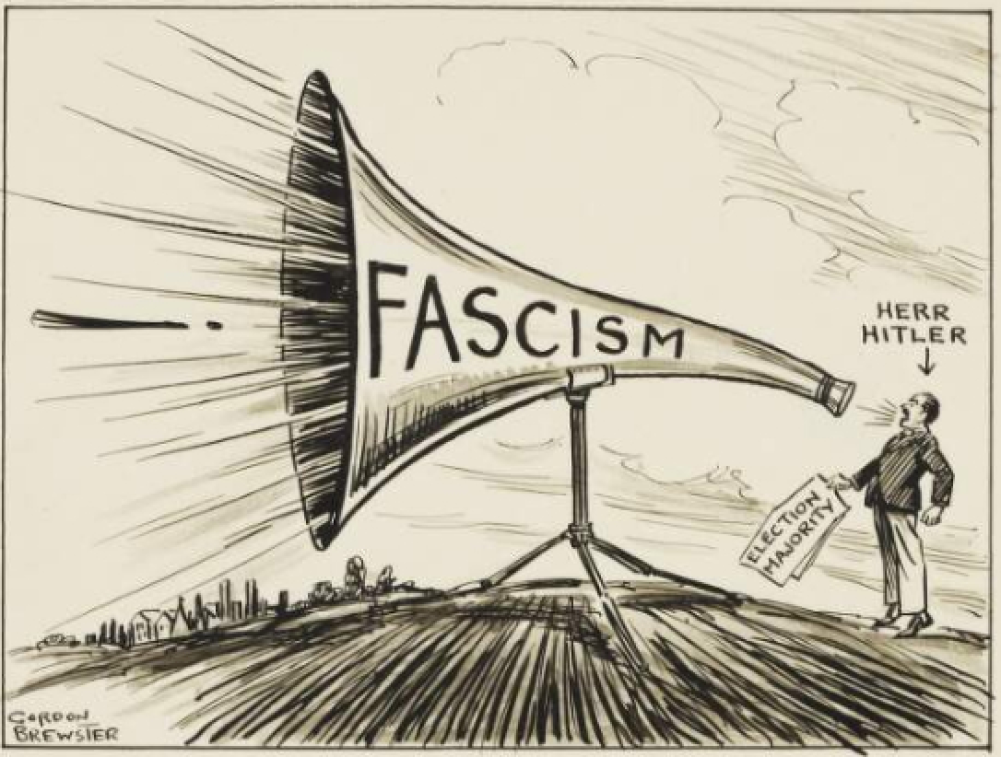
We tend to blame a dictator or ruler or dictator for all forms of tyranny, dictatorship, and fascist tendencies. Is this approach correct? Does it adequately address the problem?
We use Google Cloud Translation Services. Google requires we provide the following disclaimer relating to use of this service:
This service may contain translations powered by Google. Google disclaims all warranties related to the translations, expressed or implied, including any warranties of accuracy, reliability, and any implied warranties of merchantability, fitness for a particular purpose, and noninfringement.
Many of us may think that dictators come to power through military coups. Dictators and dictators become powerful by oppressing the people. The reality of history is different from our understanding. For example, Hitler is considered the greatest dictator.
It may be hard to believe that he is also the chancellor elected by the people. It is not only Hitler of the twentieth century, but also one by one dictators of the twenty-first century have come to power by winning elections. A large number of dictators have seized power by participating in a democratic process like elections and gaining the votes and trust of the people. And yet, we tend to blame a dictator or ruler or dictator for all kinds of autocracy, dictatorship, dictatorial rule, and fascist tendencies. Is this method correct? Does it properly diagnose the problem?
We must also ask ourselves – if Hitler is a lunatic, what are the German people who voted for him? If Mussolini is a lunatic, what would you call the state of mind of the Italian people who voted for him? We should also ask ourselves – if Hitler is a freak, what are the German people who voted for him? If Mussolini is a lunatic, what would you call the state of mind of the Italian people who voted for him? Can we ignore the diagnosis and treatment of the problems seen in the vast masses of followers along with the leader? This means that we must study not only the state of mind of dictators like Hitler and Mussolini, but also the state of mind and direction of the voters who brought them to power. For that, we must brainstorm – if Hitler or Mussolini are corrupt rulers, who will win them over?
Wilhelm Reich, an Austrian psychoanalyst of the generation after Sigmund Freud, has the answer – Fascism or Nazism is not the idea, product or action of any particular person or nation or nationality. Criticizing the narrow view of fascism, which is associated with the German or Japanese nation or nationality, he challenges us to understand it as an international phenomenon and to see it as part of human society in all nations. Not only that, he also tried to invalidate the purely economic-political factor of fascism as explained by Marxists.
Wilhelm Reich has shown in his book ‘The Mass Psychology of Fascism’ that Hitler did not deceive or mislead the German people, but rather the German people themselves were ready to welcome Hitler. If we ignore the voters who voted for Hitler or any other dictator, the crowds who followed them, and the mentality of the people who supported them in every way, we see the problem only in the individual, and even in the whims of the individual, which is not the right way.
Based on his clinical experience with people of different classes, races, religions and nations (castes), Reich presents a special view of fascism, which is a harmful idea that still exists in large and small forms all over the world. He breaks the illusion that fascism is the ideology of only a particular race-nation-nationality or political party. He also proves false the claim that this ideology is imposed on innocent people by force or political maneuvering. He says, ‘Fascism is the organized political expression of the character structure of the common man. It is the basic emotional tendency and the mechanical-mystical life view of the people who are suppressed in our totalitarian mechanical civilization.’
Does everyone have fascist thinking somewhere or the other?
Reich writes, ‘What I have concluded from a deep analysis of human nature and behavior is that every person has fascist feelings and thinking somewhere or the other. Fascism as a political movement is different from other reactionary ideas and parties because it is a movement supported by a large group of people. Therefore, claiming that the militarism of a ruler, the dictatorship or totalitarian rule of a leader cannot be easily called fascist, he links this theory to the movement of the common people, which makes it different from other ideologies. He argues that –
Wherever fascism appears and at any time, it is a movement carried by the masses within the common people. Therefore, it reflects all the characteristics and contradictions existing in the character structure of the members of the crowd. Wherever fascism appears and at any time, it is a movement carried by the masses within the common people. Therefore, it reflects all the characteristics and contradictions existing in the character structure of the members of the crowd. It is generally believed that – it is only a reactionary movement. In fact, it is not only a reactionary movement, but rather a mass movement with a mixture of rebellious feelings and reactionary social ideas.
This means that even if there is a mass movement, if the general public participates in the movement, if the rebellious spirit of the crowd pours out on the streets, it is not certain that any movement or rebellion will be people-oriented, radically transformative and rational. If there is no mass movement that goes to the root of the unspeakable and intolerable social structure and seeks rational treatment, the anger, passion and frenzied countless hands that arise in such movements or rebellions can suffocate the roots of the fascist rebellion, even if those hands carry the red flag, they can spread indiscretion, illogicality and blindness. The slogans raised by those hands can seek misleading solutions to complex social problems. For example, in Germany, when the root of all problems was sought in the alienation of different races, in the demonization of other races and communities, racial and communal theories gained prevalence, which trampled on reason, criticism and conscience and turned the German people into a frenzied mob in the direction of Jewish cleansing.
According to Reich, racial theories that carry prejudice against other races and races are not a product of fascism. Rather, fascism is a product of racial hatred and its politically organized expression. The conclusion that can be drawn from this is that there can be many versions of fascism produced by racial hatred. Fascism can appear in many forms and colors, wearing national costumes or national masks. In this sense, it is not certain that fascism has only a German form, it can also have Japanese or Italian, Spanish, Anglo-Saxon, Jewish or Arab forms. Reich claims that racist ideology is simply a ‘biopathic’ expression of the character structure of a person who is completely incapable of orgasm. ‘Biopathic’ is a condition in which life-energy (prana-energy or sexual-energy) cannot flow, resulting in distortions in the body and mind. This causes both physical and mental diseases, and character structures ranging from cancer to fascism are also expressions of biopathy, he claims.
Reich’s point is that Hitler was not born only in Germany, as a Nazi dictator. Hitler is a symbol or tendency that can be born in any country, in any institution or party or state. There is no guarantee that Hitler will not be born just by naming an institution or organization or party progressive or democratic or leftist or communist. His true interpretation is worth considering: ‘Hitlerist or fascist ideology is not limited to the Nazi Party or Germany, it also penetrates into labor organizations and spreads into liberal and democratic circles. Fascism is not a political party, but rather a specific outlook on life, a specific attitude towards people, love, and work.’
Fascism is basically the theory of a new social movement led by the middle class that emerged during the development of capitalism. The largest base of the fascist movement has historically been the lower middle class and the working class, which European Marxists also consider to be the ‘base of the proletarian revolution.’ With an analysis that this view and understanding are flat and superficial, Reich writes –
Due to the lack of knowledge about crowd psychology, Marxist sociology pitted the ‘bourgeoisie’ and the ‘proletarian’ against each other. This is wrong from a psychological point of view. Character structure is not limited to the capitalists, it is also found in workers of all professions. Some capitalists are liberals, some workers are reactionaries. There is no such thing as 'class distinction' in the matter of character. Therefore, instead of the division of 'bourgeoisie' and 'proletarian' according to the purely economic concept, concepts like 'reactionary' and 'revolutionary' related to human character were used. The main reason that forced us to make such a change is: the fascist epidemic.
Can the 'oppressed' also have an 'oppressor' in their minds?
Reich, who also considers ideology as a material force, has emphasized, based on the example of workers voting for fascists and members of the middle class voting for the left in the 1932 elections in Germany, that ‘in practical politics, not economic, but ideological or ideological hierarchy is decisive.’ If we consider the harsh truth that fascist ideology dominates even the classes called workers, laborers, and proletariat, the importance of the ideological, cultural, or mental aspects along with the economic class becomes clear. This means that if someone becomes a worker in terms of economic life or class status, there is no certainty that he will develop worker consciousness, culture, and ethics and will be active for the rights, interests, and liberation of the poor class. As Paulo Freire said, whether the oppressor lives within him or the oppressed lives within him or both the oppressor and the oppressed live together, this will determine which class and ideology he will be biased towards.
Therefore, Reich considered fascism to be an expression of the irrational behavior, state of mind, and character of the common people, whose primary and physical needs and tendencies have been suppressed for centuries by institutions such as the totalitarian family and the church. After studying in depth the fundamental role of the totalitarian family and the church in this suppression, he said – Fascism is a part of organized mysticism. Organized mysticism is the result of the unsatisfied sexual and pleasure-oriented desires of the common people. Based on this conclusion, he linked the issue of freedom of libido to the core issue of political democratic freedom.
When thinking about the origin and development of fascism, there is an aspect that even Marxists did not pay much attention to - what kind of families and individuals are produced by a totalitarian society? While thinking about the origin and development of fascism, there is an aspect that even Marxists did not pay much attention to – what kind of families and individuals are produced by a totalitarian society? These aspects are missed when we only focus on the state, the party, and their leadership, and on its economic and political aspects. Reich, in the 1930s of the twentieth century, tried to draw attention to the family structure produced by a totalitarian society, and the individuals produced by such families, which were rejected and excluded by the 'official Marxists'.
What is the structure and culture of the family, an institution as old as history, shows how democratic or autocratic the institution called family is, and determines the basis for what kind of person and society is born or will be born. Reich believes that we can definitely call the family the source of producing the most reactionary and conservative people. Since it develops in a specific type of autocratic social process, it also works to maintain its autocratic pattern or structure. Therefore, it is difficult to understand the minds, thoughts and behaviors of the common people without clarity about the basis and influence of society and family in the formation of the common people. The fascistized minds and opinions of the common people are being revealed in favor of large families, treating women as reproductive machines for giving birth to children, controlling women's sexuality, idealizing and deifying motherhood, and opposing family planning.
Standing on a different ground from the perspective or analysis that considers fascism as a political issue or an economic-political issue, Wilhelm Reich also goes on to dissect the structure and culture of the family. Reich's opinion is that -
Totalitarian society reproduces itself in the lives of the masses through the totalitarian family, it protects the family as the basis of the state, culture and civilization. It is helped in its propaganda by the deeply irrational state of mind that is deeply rooted in the common people.... In political propaganda that is carried out with the common people in mind, no one talks about the immediate economic process, but rather tries to address the human structure. This understanding is what makes people's minds. If it fails, it can cause great disruption in the psychology of the common man. Revolutionary sex-politics can clarify the totalitarian family to a great extent. If sex-politics is to succeed, it can guarantee not only the happiness of life, but also the happiness of love.
Reich's analysis of the psychological aspect of fascism is worth considering. Instead of boycotting it like the German and Austrian government communist leaders of his time, it may be prudent to reconsider it sympathetically. His theory of sex-economic sociology and its politics is controversial, but it cannot be ignored. Reich's noteworthy statement is that -
Sex-economic sociology was born from an attempt to reconcile Freud's deep psychology and Marx's economic theory. Human existence is determined by instinct and socio-economic processes. But we must reject the abstract attempt to arbitrarily connect ‘instinct’ and ‘economy’. Sexual-economic sociology eliminates the contradiction that caused psychoanalysis to forget the social aspect and Marxism to forget the animal origin of man... Psychoanalysis is the mother of sexual-economics, sociology is the father. But the child is not just the sum of its parents, it is a new, independent being—the seed of the future.