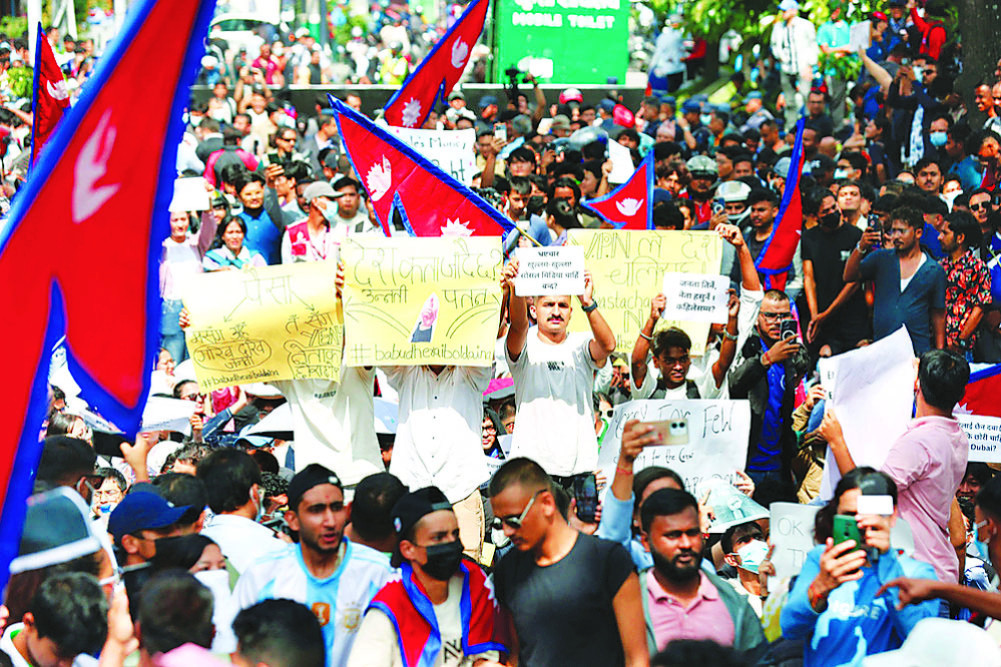
When democracy is limited to formal processes and periodic elections and fails to bring about meaningful change in people's lives, then rebellions and resistance continue to arise, even within the confines of democracy, to question its practice.
We use Google Cloud Translation Services. Google requires we provide the following disclaimer relating to use of this service:
This service may contain translations powered by Google. Google disclaims all warranties related to the translations, expressed or implied, including any warranties of accuracy, reliability, and any implied warranties of merchantability, fitness for a particular purpose, and noninfringement.
Is Nepal a factory of rebellions and movements? Why does every decade see new explosions of discontent, led by the youth? Their sacrifices have written the agreements that have followed every movement to this day. How many more youths will have to shed their blood and sacrifices before this endless series of rebellions can come to an end?
Or is such rebellions and periodic explosions of discontent our destiny? Can these rebellions be seen only as the anger and passion of an age group, or are the Nepali state constantly raising its head due to all the structural issues that have yet to be resolved within society?
The question is straightforward, but the answer is complex. Now the answers to these questions must be sought not only in old history books, but also in the dimensions of the changing Nepali society. Neither the world order is the same, nor is a young generation trying to make itself a curse on smartphones, the Internet, and AI. On the other hand, the aspirations of Nepali youth who are facing discrimination at every door of society are the same. Something is always changing, something new is happening, but there are some complex tendencies that will never change, will never change. It seems that new paths must be found by looking at the aspirations of a large number of people who are unable to see new dreams and are looking for a future abroad, amidst the character of the state and the mechanism that can make any new revolutionaries, with the exception of exceptions, the same.
The picture seen in the airport and transit
is a recent thing. While going by bus from the transit at Doha Airport in Qatar to the Qatari plane that was about to fly to Nepal, a Nepali in a bus full of many Nepalis and some foreigners was saying, ‘It has been twelve years since I came to Qatar, even though I could not do anything else, I sent my son to Portugal.’ Some young people sitting with me were telling me the sorrow of how much money they paid to the broker and reached Romania. The group that had been living in Romania for almost 4 years and had come to Nepal for a holiday was hearing the sorrows of paying between 1 million and 1.6 million rupees to Romania.
Inside the plane, on one side were young people who had recently passed away and had traveled from London to Nepal to work as a shopkeeper. Two recent ‘Mongolian faces’ sitting next to me were talking – working on iron all day was difficult, now we have to find another company, we were worried that the manpower and broker would ask for up to 3 million rupees. On the other side was a young woman who had just drunk water and arrived in Nepal. As the plane approached Nepal, she kept looking out the window and wiping away her tears. Was she mourning the loss of someone close to her, or was some other unexpressed sadness flowing from her eyes?
A picture of Nepal is seen in airports and transits like these these days. The elderly who have returned from celebrating Dashain with their sons-in-law (or daughters-in-law) or after caring for a newborn, the young people who have returned after sweating it out in the Gulf for three or four years, the middle-aged who have spent their youth in the Gulf and are breathing a sigh of relief by sending their sons to Portugal, and hundreds of Nepalis who have shed their blood and sweat from Korea, Japan, London, Romania, Malta to the corners of Africa, return to Nepal every day with some happiness, some hope, some relief, and anger towards those who govern. The very day they return to Nepal, another question arises—how long will they stay in Nepal?
Two years ago, I met a Tharu youth working in a restaurant in the Kurdistan region of Iraq, who had been living in Iraq illegally for 4 years. The Tharu youth, who were in a dilemma of ‘Should I return to Nepal or stay in Iraq’, used to say, we have our own family in Nepal, but the country is not for us, it is only for those who have access. The latest Gen-G movement sought itself within the country and the country within itself. In essence, it is saying, ‘Make this country livable for us.’
The balance sheet of the past 20 years
What has this country not experienced in the past twenty years? Armed rebellion, its descent, two elections to the Constituent Assembly, movements by Madhesi, Tharu, minorities, etc., the journey from democracy to a democratic republic, a major earthquake that killed thousands, the creation of a new constitution, the blockade and the latest Gen-G rebellion, which took the form of the world’s shortest rebellion that shook the power and changed the government.
However, even if we take government data as a basis, it seems that 9 million more Nepalis have obtained work permits to go abroad in these 20 years, although there may be a number of those who have re-approved. During this period, it seems that an additional 800,000 Nepalis have gone for foreign studies. Even if we look at the figures of the Nepal Rastra Bank for the last three years alone, almost 400 billion rupees have been spent for foreign studies after the last parliamentary elections alone. If we add the number of Nepali workers who work abroad on visit visas and go to third countries via India, a shocking picture emerges before us.
Similarly, other indices are also not healthy, Nepal is ranked 108th in the corruption index, 146th in the human development index, 115th in the gender inequality index, and 109th in the innovation index, which shows the pitiful fact of where we stand compared to other countries in the world.
It is today's irony that out of the approximately 600,000 youth who enter the labor market every year in search of a new way to earn a living, domestic consumption is not even thirty thousand. Even today, the unemployment rate is more than 20 percent, making it worse than other Asian countries. The contribution of remittances to the gross domestic product was about 14 percent in 2005-2006, but today it has doubled to about 27 percent.
The above figures only speak the facts. Traders of hope or despair may search for their own logic in these figures, but realists have no choice but to stand on the ground today and contemplate these facts.
Even if we look at the fact that almost 70 percent of Nepali households have one person leaving, more than 10 million new children were born in these two decades. This new generation born in this way is forced to satisfy itself by looking at their mother or father or uncle or aunt online. It is not unnatural for anyone to feel anger towards the government when they are forced to search for the compulsion of their close family or relatives to go abroad. A generation that has remained silent for a long time should have demanded an account of this separation. The new generation, angry with the government that separated their parents and relatives from them, is also a phenomenon where the state is being held accountable – the Gen-G rebellion. There has been no shortage of scandals in the past 20 years – Widebody, Pokhara and other airports, Giribandhu, Bhutanese refugees, Yeti, Omni, and many examples of privatization of government land through the purchase and sale of health supplies continue to resonate in the Nepali mind.
Dark clouds within the demographic dividend
Approximately 42 percent of the population is in the age group of 15 to 40. However, data from the International Labor Organization and the Nepalese government also show that a large portion of the 15 to 24 year old group is out of social, educational and economic activities. The population of youth who are not involved in education, training or employment is 35 percent higher than the ratio of 23 percent in India. In this regard, we are still in the red zone. The benefits of Nepali demographic dividend are not only being enjoyed by Nepal but also by Gulf countries like Malaysia, Japan, Korea and other countries.
A large section of the youth group, who are suffering from economic, social, geographical and regional inequalities due to structural discrimination, have become permanently angry with the government. On the one hand, the lack of opportunities and on the other hand, the dissatisfaction of such a group, which is suffering from the double impact of social and economic discrimination, is also one of the reasons for the ongoing movement.
Continuous erosion of institutions
After the establishment of the republic, there was a great opportunity to transform the Nepali governance system, state structures, bodies and institutions and make the institutions people-oriented and strong through laws and regulations. Two governments with two-thirds majority were formed. However, it was not the reform and strengthening of the institutions that were taking place, but the gradual politicization and partisanship of the institutions that made democracy more 'party-based'. A global phenomenon that occurs with the exception of the first and second parties forming the government together in parliamentary politics was seen in Nepal. In politics that is not based on ideas, methods, or justice, but on power, the many compromises made for power were weakening democracy from within. The result of the gradual partisanship and weakening of existing institutions, methods, and systems was that within 24 hours of the Gen-G uprising, it was felt that we had to search for ‘which institutions are still alive?’
In Nepal, small-scale movements are not uncommon. There were protests by farmers who did not receive fertilizer on time, who threw their produce on the streets because they did not get the price of milk and vegetables, against meter-billing victims, women who were victims of violence, the landless, and those who asked for money to send abroad, and so on. An international organization has recorded that more than three thousand small-scale movements have taken place in Nepal in the last two years alone. However, rather than finding sustainable solutions to small-scale movements and their demands, it seems that the process of confusing and entangling such movements has led to a growing distaste for the state and the parties that run the state in the general public’s mind.
‘ The Biological Factor’
It is incomplete to explain the past and present Gen-G movements in Nepal only through social, economic and political lenses. These movements are also linked to structural problems and failures of the state system, as well as biological causes. This is why the recent movements appear different, intense, angry and sometimes destructive.
Political scientists James Wilson, Richard Warangal and renowned neuroscientist Robert M. Sapolsky have analyzed the anger expressed by young people as a result of the lack of creative consumption of the energy generated by the hormones that young people develop. According to them, high levels of testosterone in youth make people ready to react violently when they feel injustice.
In this context, the concept of ‘young man syndrome’ proposed by American political sociologist James Q. Wilson is noteworthy. According to Wilson, young people between the ages of 15 and 30 have high physical energy, a tendency to take risks, and a relatively high courage to question authority. When this age group experiences unemployment, lack of opportunities, and structural injustice, that energy can easily be transformed into street protests and direct resistance.
German sociologist Gunnar Heinsohn's 'Youth Bulge Theory' also seems relevant to understanding this situation. According to Heinsohn, when the number of young people in a society is large but opportunities for employment, social advancement, and respectful participation are limited, the potential for discontent, rebellion, and political movement naturally increases.
Whatever political scientists say, employment arrangements and livelihood opportunities are not the perfect solution to all youth discontent. The primary needs of young people are certainly employment and economic opportunities, but they are not just looking for jobs, they aspire to a listening state, responsive governance, and a respectable future. When democracy is limited to formal processes and periodic elections and fails to bring about meaningful change in people's lives, then youth continue to question its practice even within the confines of democracy.
On the one hand, the new generation that has grown up in the digital age is seeing other societies and systems of government in the world, on the other hand, millions of youth working in third countries are asking why this has not happened in our country, seeing the 'system' of that country. For this reason, the basis of some youth movements is more than ideology, their daily experiences, feelings, emotions, aspirations, and the search for self-respect. Therefore, the search for ideological slogans, any principles, or arguments may not be easy in all movements, and in the context of youth movement rebellions, emotions and feelings may also prevail over ideology.
Considering the past 20 years of party rule, the increasing youth population and unemployment situation at the same time, and the miserable state of creative participation of youth, the new generation movement that took place last Bhadra is not an accidental event. This is a crisis that has arisen from the combination of biologically active, energetic youth, structural failure, frustration, digital access, socio-economic awareness and a deep desire for self-respect. To dismiss this as just a sudden impulse of young people is to invite another possible storm in the future. If these grievances are not addressed or meaningfully addressed, the country risks falling into a whirlpool of even deeper dissatisfaction in the future.
Elections are not an option
Periodic elections are normal in a democracy. However, there is a suspicion that new results can be achieved by keeping all laws and structures intact. Many may be forced to directly or indirectly connect with parties, leaders and party structures to straighten out their differences or arrange food and water. दलीयकरणले थलिएको नेपाली समाजमा त्यसो हुनुलाई सामान्य नै लिनुपर्ला तर चुनावको चक्रहरूबाट केही पर रहेर एउटा तप्काले गम्भीर भएर सोच्नुपर्ने हुन्छ– धराशायी भएका संस्था र संरचनाहरूलाई जनपक्षीय, जवाफदेही, काबिल र समावेशी बनाउन गर्नुपर्ने संवैधानिक, कानुनी र अन्य व्यवस्थाहरू के–के हुन् ?
राज्यका निकायहरू बलिया भएनन् भने सुशासन सम्भव हुन्न, सुशासनबिनाको समुन्नति र समृद्धि असम्भव नै हुन्छ । जापानमा गएको ५ वर्षमा ४ जना प्रधानमन्त्री भए । त्यसले त्यहाँ सामाजिक र आर्थिक संकटहरू सिर्जना भएन तर अफ्रिकाका र पश्चिम एसियाका कैयन् मुलुकमा एकै दल वा व्यक्तिको शासकीय निरन्तरता छ त्यहाँ सार्वजनिक संस्थाहरू बलिया छैनन् । हाम्रो ‘स्थिरता’ र ‘नीतिगत निरन्तरता’ को बहस कुन दल वा व्यक्ति प्रधानमन्त्री हुने भन्ने साँघुरो र व्यक्तिकेन्द्रित बहसबाट खास पर जान सकेको छैन ।
अहिलेलाई चुनावी माहोल छ । नेपाली निर्वाचन प्रणाली, निर्वाचनको व्यवस्थापनमा गर्नुपर्ने कैयन् सुधारलाई अलपत्रै पारेर हुन लागेको चुनावले एक थान नयाँ सरकार दिने मात्रै हो, यो नवयुवा आन्दोलनको म्यान्डेट होइन । संस्थाहरूलाई धराशायी बनाउन जिम्मेवार एउटा तप्का नयाँ खरानी घसेर फेरि भोट माग्न घरआँगन घुमी हिँडेको नेपाली समाजले हेरिबसेकै होला ।
तर, माथि उल्लेख गरेजस्तै समाजको एउटा क्रिटिकल मासले नेपाली समाजका संरचनात्मक सवालबारे चिन्तन गर्न छाडेर यो वा त्यो दल भन्ने बहसमै हराए हाम्रो नियमित आकस्मिकता जस्तै बनेका निरन्तरका आन्दोलन र विद्रोहको उपचार हुँदैन । दलको विकल्प हुन्छ, तर देशको हुन्न । देश र समाजमा थप विग्रह नल्याउन गर्नुपर्ने तयारीहरू गर्न ढिलो भइसक्यो । जोखिम के छ भने प्रत्येक नयाँ विद्रोहहरू पहिलेभन्दा झन् विध्वंसात्मक हुँदै गइरहेका छन् । आगामी विध्वंसहरू थप अनियन्त्रित र भयावह हुन सक्छन् ।