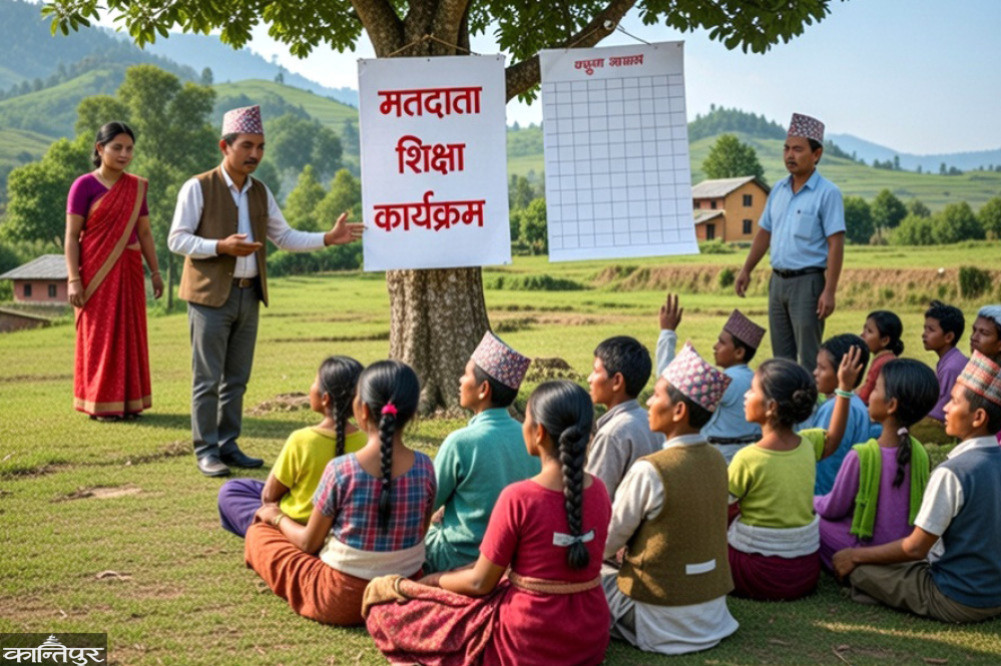
The main need now is to create voter awareness, ensure correct voting practices, and minimize invalid votes in a short period of time for the House of Representatives elections to be held on Falgun 21.
We use Google Cloud Translation Services. Google requires we provide the following disclaimer relating to use of this service:
This service may contain translations powered by Google. Google disclaims all warranties related to the translations, expressed or implied, including any warranties of accuracy, reliability, and any implied warranties of merchantability, fitness for a particular purpose, and noninfringement.
Elections are a beautiful, long-awaited and decisive moment of democracy. The high rate of invalid votes in elections where every vote counts is a serious problem that continues to recur in Nepal's elections.
In the context of Nepal, it is inadequate to think that the problem of invalid votes is ‘only technical or numerical’. This highlights the lack of voter awareness, the complexity of the election process, the lack of institutional preparation from the Election Commission to political parties and the Government of Nepal, the impact of the political environment, and the weakness of citizen or voter education.
The main need of the moment is to make voters aware in a short time for the House of Representatives elections to be held on Falgun 21, to conduct proper voting practices, and to minimize invalid votes. Although the democratic system adopted by Nepal is comparatively good in South Asia, if we fail to reduce the percentage of invalid votes, millions of votes will go to waste. Invalidation of votes is a process that weakens the foundation of democracy, has a serious impact on electoral legitimacy and representation, and weakens the overall political system.
Invalid votes in past elections
Although Nepal’s electoral history is beautiful in terms of participation, freedom, and security, the rate of invalid votes has become a matter of concern. After 2062/63, the number of voters increased in the enthusiasm for change. However, due to insufficient information about the method and rules of using ballot papers, invalid votes remained at around 6 percent, which is a high and serious issue in terms of election acceptability.
There was some improvement in the second Constituent Assembly in 2013 – invalid votes decreased to 4.96 percent. However, invalid votes of around five percent out of a hundred are not a happy aspect for democracy. While the average for the direct election in the first federal election in 2074 was 5.18 percent, in the proportional election of the provincial assembly, 14.51 percent of votes were invalid due to the complexity of the ballot papers and coalitions. Four separate ballot papers for direct and proportional, a long list of candidates, the signature verification process, and voter confusion led to such an embarrassing situation. In a democratic country, invalid votes of around 15 percent are a serious question of the legitimacy of the election results themselves.
In the federal and provincial elections of 2079, invalid votes were 5.9 and 6.55 percent, respectively. While it reached 13 percent in some places in the local elections, Nepal has not made progress in eliminating invalid votes.
A statistic says that in 2079 alone, more than 900,000 votes were invalidated. 'Alliance in elections' keeps voters confused. Alliances before elections are also the main reason for more invalidated ballots. The influence of unholy coalition governments after elections has increased dissatisfaction among voters. Due to bias in ticket distribution by political parties, alliance games, questions about the credibility of manifestos, and lack of accountability of leadership, voters feel left with no choice. In such a situation, they have been found to have voted incorrectly or deliberately invalidated. It seems that some voters have used invalid votes as a means to show their dissatisfaction with the party or candidate.
Why are votes invalidated?
There are more technical reasons for invalid votes. First, the polling officer's signature is missing from the ballot paper in a hurry. The signature on the right corner of the ballot paper is mandatory, otherwise the ballot paper is invalid. Second, some voters use other marks (such as a sticker, writing with a pen, or making other marks) on the ballot paper instead of the swastika mark, which also invalidates the ballot paper. Third, a common problem is affixing the swastika mark outside the room or box, touching the line, or in the wrong place. Fourth, many ballot papers are found with two or more candidates or parties stamped on the same position or ballot paper. Fifth, if the swastika mark is unclear, blurry, heavily inked, repeatedly applied, torn, or not visible properly, and if the ballot paper is not folded properly, the ink from one mark can get on the other and invalidate the ballot paper. Sixth, ballot papers with additional writing, marks, or marks on the ballot paper are also found during the counting process. Seventh, ballot papers are also invalidated because they are too long or complicated, causing confusion and deliberate opposition.
These problems are more common among communities with low voter education and first-time voters. This is why the quality of democracy has been reduced.
How to reduce invalid votes?
First, let's check the signature of the polling officer while collecting the ballot paper. Second, let's only put the swastika stamp without using a lappet or any other symbol. Third, let's put the automatic stamp completely inside the room without touching any line. Fourth, let's put only one stamp on a single position. Fifth, if you are confused, ask the polling officer. Sixth, let's practice by looking at the sample ballot paper distributed by the Election Commission. And, let's increase the quality of the election by reducing invalid votes on Falgun 21.
Civic education, electoral education and voter education not only increase voter participation, it also explains the importance of elections and reduces invalid votes. Comparing the data from the 2036 BS referendum to the 2079 BS general election, the situation is worrying.
Issues such as resource management for voter education, the problem of 'covering' a large geographical area within a limited time, making monitoring and inspection costs effective, and mobilizing NGOs are recurring in every election. Past elections were not free from these challenges. In 2074 and 2079, voters complained that they had difficulty identifying their chosen symbol. For example, in local elections, ballots that required voting for seven candidates in six columns on a single sheet created confusion, leading to an increase in invalid votes.
In the 2074 and 2079 elections, the fact that there were four ballots for electing federal or provincial members for direct or proportional elections and the presence of many candidates was also the main reason for the increase in invalid votes. Only effective voter education could have solved this problem.
With the time remaining for the Falgun 21 election, it is necessary for the local level government and the concerned political parties to coordinate with the District Election Office to expand access to election education. The lack of voter education is the reason why basic issues such as using the swastika seal, not using thumbprints, and not using two candidates as seals are not known.
Who will do what to reduce invalid votes?
First, the Government of Nepal should provide adequate budget to the Election Commission. Effective implementation of voter education policy, mandatory inclusion of civic and voter education in school and college curricula, legal reforms such as simplifying ballots and using electronic voting machines should be implemented along with policy formulation. If polling stations can be made organized and secure with security and administrative support, voters can vote confidently and invalid votes will decrease.
Second, the main responsibility of the Election Commission is the nationwide voter education campaign. The Commission should be able to take the lead in formulating content and policies for voting education. Printing and distributing sample ballots across the country, virtual and live programs, use of radio and television, publicity campaigns on social media, running programs at school and community levels, and monitoring the code of conduct should also be continuous.
Third, political parties also play an important role in voter invalidation. Parties should provide voter education to voters, workers, and supporters. And, the tendency of deliberate invalidation should be stopped. Parties should increase cooperation with the Election Commission.
Fourth, traditional or digital media should play an important and powerful role in voter education and awareness campaigns. Voter education materials, interviews, video materials, and social media content should be created. Misinformation, false propaganda, and personal abuse should be stopped on social media.
Fifth, voters are the most important characters in reducing ballot invalidation. Voters should understand the correct method of stamping from those in the know. They should ask the election officer about the voting process or ask if they have any doubts. After receiving the ballot, they should check it and vote thoughtfully without rushing.
Development partners' indifference to voter education
Many development partners in Nepal have been providing support in voter or civic education in elections for a long time. However, support for the Falgun 21 election is almost zero. The Nepalese government is also not as active as before in mobilizing donors. It seems that the Election Commission itself is trying to do a lot of work. This risks lowering the level of voter education campaigns, reducing the 'focus' on rural and youth, and increasing false and misleading information, leading to an increase in invalidation rates. Now the Commission needs to effectively collaborate with the media, local governments, parties, and communities.
What is the situation with invalid votes in other countries?
If we look at America, which has made the use of technology and voter education a way of life, sometimes there are sporadic invalid votes due to technical errors, while in India, the use of electronic voting machines has reduced the invalid votes to almost zero. In Sri Lanka, due to simple ballots and voter education, there are 1-3 percent invalid votes. If Nepal can also use electronic voting machines, not only can invalid votes be zero, but also the counting of votes can be made faster and more effective.
The role of the government, the Election Commission, parties, and the media is important in reducing invalid votes. With 52 percent of the total voters aged 18-40 and about one million young people added as new voters in this election, it is necessary to conduct voter education, especially focused on new and young voters.