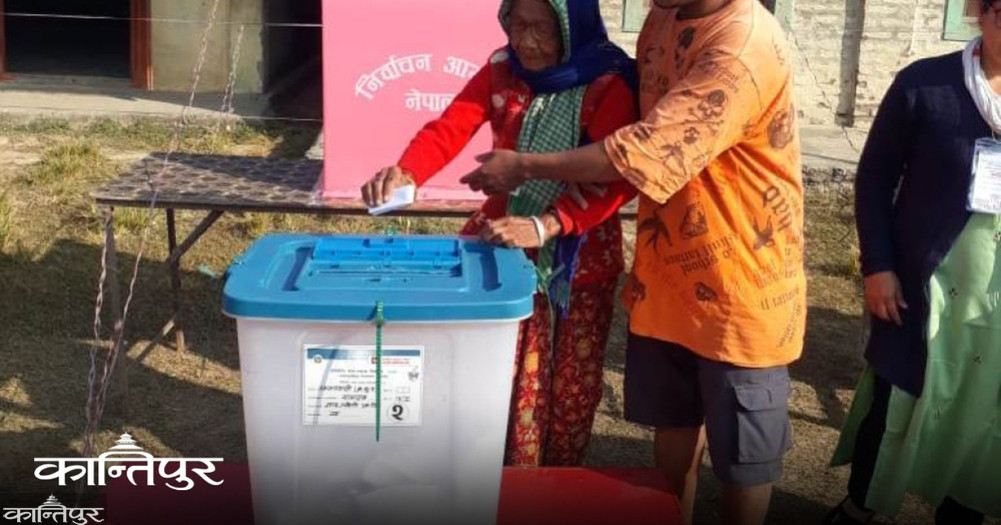
Therefore, their involvement in the electoral process is important. However, a study conducted in collaboration with Kantipur and Sharecast Initiative found that 63.8 percent of those involved were in the 18-20 age group whose names were not on the voter list.
We use Google Cloud Translation Services. Google requires we provide the following disclaimer relating to use of this service:
This service may contain translations powered by Google. Google disclaims all warranties related to the translations, expressed or implied, including any warranties of accuracy, reliability, and any implied warranties of merchantability, fitness for a particular purpose, and noninfringement.
Turning 18 is the minimum age to be eligible to vote. Therefore, the choice a citizen makes in an election is also the first political decision they make for their future. Since it is a confluence of enthusiasm, responsibility, and expectations, decisions made at a young age can also be interpreted as how they want to see the future of the country.
Therefore, their involvement in the electoral process is important. However, a study conducted in collaboration with Kantipur and Sharecast Initiative found that 63.8 percent of those involved were in the 18-20 age group whose names were not on the voter list. This data does not provide official and complete information because it is only a study based on a certain number and is a thought-provoking description. However, it is not right for any eligible person to not be on the voter list. This is not a matter of small or large numbers, but rather an indication of weak interest in the election process and administrative complexity. Improvements are needed in all these aspects.
In the survey on ‘Citizens’ Perceptions on Contemporary Social, Economic and Political Issues in Nepal’, about 2,905 people were interviewed directly from across the country. 116 wards from 102 municipalities in 45 districts were selected for the survey. For that, 38 enumerators were mobilized from Poush 17 to Magh 17 in 19 groups of 2/2 people.
In which, according to age group, 63.8 percent of the respondents were 18-20 years old, 29.4 percent were 21-29 years old, 9.2 percent were 30-39 years old, 4.1 percent were 40-49 years old, 1.2 percent were 50-59 years old, and 1.3 percent were above 60 years old. This percentage may or may not be exactly the same as the official data of the government and the Election Commission. But it shows that people who have completed their age are being left out of the voter list. Groups whose names are not on the voter list or who are not interested in the election process even though they are there are found elsewhere in society. Therefore, a large group that is outside the voting process is established as a challenge in the context of Nepal's elections.
Article 84 (5) of the Constitution states that every Nepali citizen who has completed the age of eighteen years has the right to vote in one of the constituencies in accordance with the federal law. The state is responsible for facilitating the implementation of this right. It should facilitate the process. Administrative hassles should be reduced. Voters tend to be indifferent to this due to the hassle of registering their names.
After it was seen that many young voters would miss out on the 21 Falgun election, the Election Commission extended the deadline for voter registration at the last minute. Later, arrangements were made for those who had already made a national identity card to register their names by filling out an online form from home for voter registration. However, for the purpose of this election, that period was very short. As a result, many people were unable to register their names even if they wanted to.
However, this practice has made it clear that the traditional method and process for voter registration are no longer mandatory. A method can be adopted where citizens can automatically register their names in the voter registration list if they have reached the age limit by taking any document received from the government. By doing this, there is no need to make special efforts to register their names just before the election. Rather, it becomes a regular process.
Among the respondents involved in the study, 69.2 percent of the respondents on the voter list said that they would definitely vote. This percentage seems relevant when compared to the votes cast every year in Nepal. However, it is also necessary to analyze the reasons why more than 30 percent of the remaining respondents said they would not vote with confidence. In the
study, 14.4 percent said they would probably vote, 6.4 percent said they had not decided, 3.2 percent said they would probably not, 6.4 percent said they would not, and 0.4 percent said they did not know/did not want to say. 50.6 percent of men said they would definitely vote, while 67.8 percent of women said they would. Women's determination towards voting is a notable aspect. Overall, since the percentage of those who are undecided about whether to vote or not and have decided not to vote is also large, it is necessary to explain the importance of each vote to such a population and motivate them to vote.
The data highlights some aspects of improvement. The number of names registered in the voter list cannot be increased in this election alone. However, improvements can be made for the upcoming elections. However, instead of focusing on it only during the election, a continuous registration system should be developed. In addition, motivating citizens to vote as much as possible can be a success for this election or the upcoming elections.