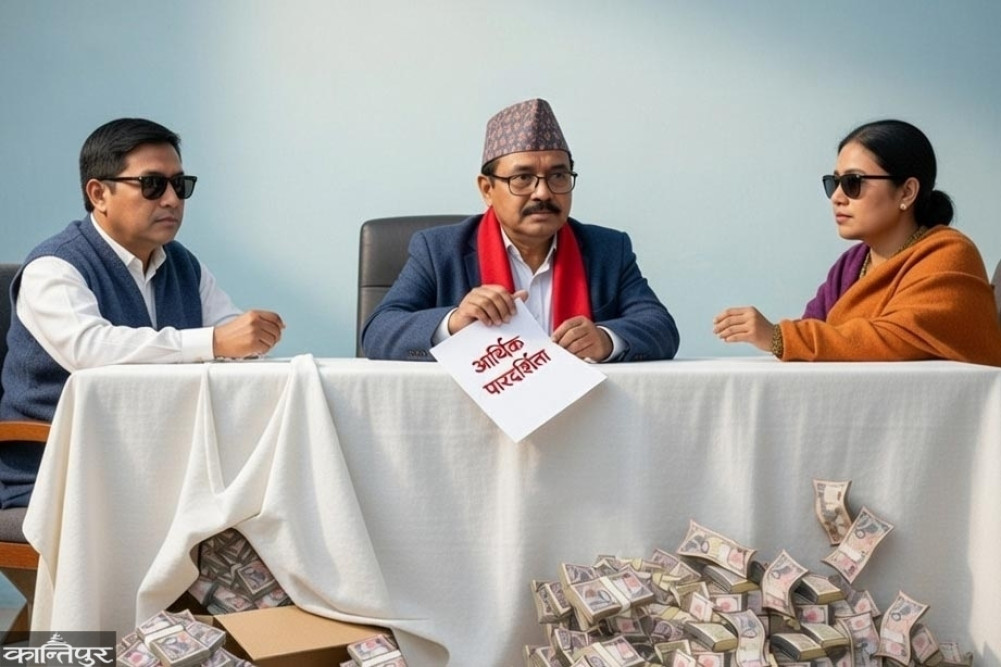
It has been clear from studies and public statements that winners and runners-up spend far more than the limits set by the Election Commission. This situation has not only made elections expensive, but has also served as a breeding ground for corruption.
We use Google Cloud Translation Services. Google requires we provide the following disclaimer relating to use of this service:
This service may contain translations powered by Google. Google disclaims all warranties related to the translations, expressed or implied, including any warranties of accuracy, reliability, and any implied warranties of merchantability, fitness for a particular purpose, and noninfringement.
Elections are a time of great expense not only for the government, but also for political parties and candidates. The government spends money through the Election Commission to purchase necessary items to organize the elections and through security agencies to ensure security.
Parties and candidates, on the other hand, spend money on publicity, transportation, and mobilizing workers to claim their superiority to the voters. Budget disbursement and expenditure from the government are basically under public scrutiny and are examined by authorized bodies.
However, the expenditure made by parties and candidates is opaque. It has been clear from studies and public statements that winners and runners-up spend much more than the limit set by the Election Commission. Such a situation has not only made elections expensive, but has also served as a seed for corruption. Therefore, political parties and candidates should support the efforts of the Election Commission to regulate the expenditure of political parties and candidates.
There are two dimensions to election expenditure. First, the expenditure limit. The expenditure limit is essential to prevent elections from turning into a competition of money rather than issues. If the expenditure limit is not fixed, only those who have enough money will get the party's candidate ticket. In elections where expenditure is skyrocketing, force, terror, and temptation are encouraged. What kind of environment will those who win through such elections create in parliament? Where will they focus their activism? Of course, they are more concerned about the money they have spent than parliamentary traditions, constitution, laws, regulations, values, and obligations.
They are active in recovering it and raising funds for the upcoming elections. On the other hand, leaders who have been through political struggles, are committed to their beliefs and ideas, understand the issues of the people, and can navigate the international environment will be deprived of tickets or will not show interest in elections where money is a struggle. The parliament of a country where such leaders find it difficult to enter parliament cannot lead the people. It cannot lead the country towards a beautiful future.
Second, transparency. Transparency is the soul of democracy. Elections are also called the soul of democracy. Therefore, transparency is the soul of elections. It is the responsibility of every candidate to spend within the limits set by the commission. At the same time, it is their responsibility to transparently inform the commission and the people about the sources of such income and details of expenses. Parties are currently advocating good governance and development.
However, good governance and development can be possible only by following the constitution, laws, and regulations. Parties and candidates who spend more than the prescribed amount and hide their sources of income and expenses do not have the moral strength to support good governance and take initiatives after winning the election, nor do they have the intention to do so. Therefore, winning is not everything, only an election won based on an agenda with financial transparency helps to enrich democracy.
The Election Commission has set a spending limit of a minimum of 25 lakhs to a maximum of 3.3 million for candidates for the House of Representatives election. In addition, the Commission has also instructed candidates to open new accounts for fundraising and expenditure purposes. This issue is also covered in the election code of conduct. Most candidates have refused to do this effort to make election expenses economical and transparent.
According to the data as of Monday, only 21 percent of candidates have opened new accounts for election purposes. Out of 3,406 candidates, only 671 have opened accounts. The main reason for this reluctance is that income and expenditure should remain opaque. However, the parties had committed to fully complying with the election code of conduct when they approached the commission and the candidates during their nominations. Therefore, consistency in public commitment and behavior is expected from them.
The reason why parties want to hide their expenses is clear. Doing so allows them to spend more. According to a study conducted by the International Foundation for Electoral Systems (IFES), 57 percent of candidates in the 2074 House of Representatives elections spent more than the specified spending limit. A study conducted by the Election Supervision Committee also showed that the average expenditure of the winning candidate in the 2074 House of Representatives elections was 20 million 13 million.
The study shows that candidates who spend more money in elections are more likely to win. Candidates themselves have also stated formally and informally that they had to spend a large amount of money during the elections. Effective and constructive measures are necessary for immediate and long-term reforms.
First, it is the job of the commission to make the spending limit practical and binding for compliance. The commission should have the courage to take action against the candidates who violate it. For this, while reform in the law is necessary, arrangements should be made to make the upcoming elections successful. For that, the government and political parties should take the initiative. Second, political parties themselves should adhere to transparency. Words should be put into practice. Candidates who carry the people's agenda and political commitment should be made candidates rather than those with money. Third, the people should also reject candidates who show their money interests rather than their agenda. That alone will help bring about reform.