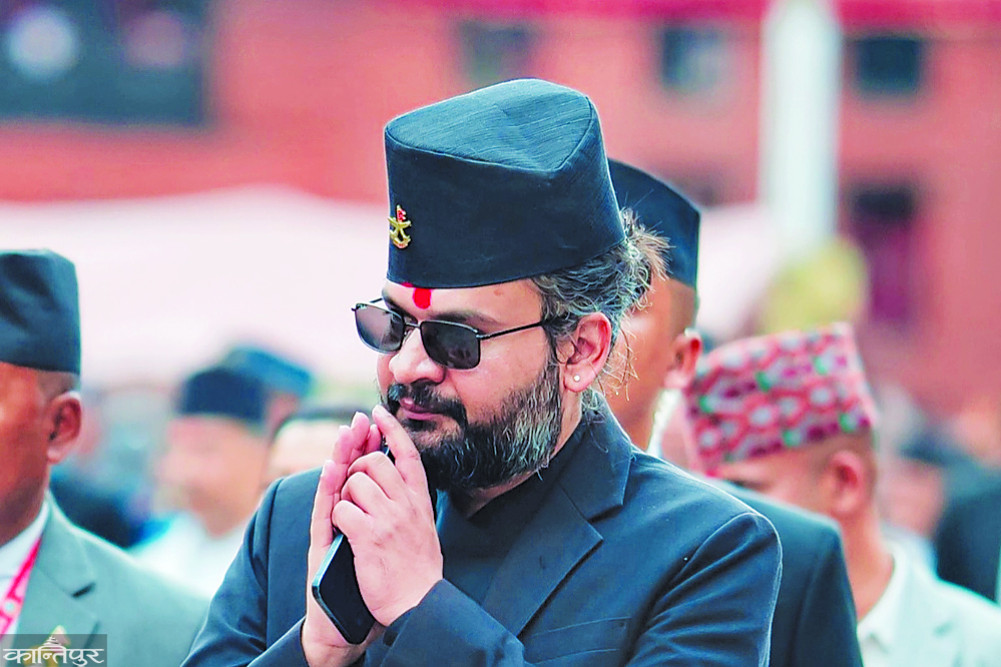
Various developments show that Balendra, who led the youth in the Gen-G movement to incite and incite, sabotage the rebellion, and push politics into the orbit of non-political organizations, is just as responsible as Oli, but in a different way.
We use Google Cloud Translation Services. Google requires we provide the following disclaimer relating to use of this service:
This service may contain translations powered by Google. Google disclaims all warranties related to the translations, expressed or implied, including any warranties of accuracy, reliability, and any implied warranties of merchantability, fitness for a particular purpose, and noninfringement.
For the past two weeks, the Nepali media and social media world has been very busy with proposals and questions about holding a public debate between the future prime ministerial candidates. Although it was not proposed and passed institutionally within the party, Pushpa Kamal Dahal and KP Sharma Oli cheered up and announced through various media outlets that they were ready to become prime ministers, with the atmosphere of forming a government under the leadership of UML and NCP.
While Vice President Bishwaprakash Sharma was saying that they are ready to send the Congress candidate to Tundikhel for the public debate, President Gagan Thapa also responded that this is a good concept and platform to present the mission, vision and goals of the leadership and convey it to the public and that he will use it to the fullest if such an opportunity arises. However, Balendra Shah, the candidate from the Rashtriya Swayamsevak Sangh (RSS), wrote that he would not sit on the same platform with the terrorist Oli, who killed 76 people, regarding which the Election Commission has also sought a response from him.
Debate on theoretical grounds
There is an aspect that declaring the executive leadership and going to the election is not a parliamentary system and tradition but an imitation of the practice of presidential competition, which is close to the format and practice of the American presidential debate. It is natural to say this, considering the belief that all elected MPs generally have an equal opportunity to win a majority in parliament and lead the government. In India's parliamentary history, Chandrashekhar, a leader with less than 10 percent support in Parliament, has become the Prime Minister, and in the Jharkhand Assembly, a single independent member has become the Chief Minister. In a parliamentary system, anyone can become the Prime Minister, MPs are deprived of the competition to lead a parliamentary party, the Prime Minister's candidate can lose in the constituency, and in this situation, MPs other than the Prime Minister's candidate can become the leader of a parliamentary party.
But the established belief is that in some cases, practical practices become theories over time, while some propounded theories are put into practice in practice, otherwise they are discarded. In Britain, which is considered the mother of the parliamentary system, and in India, which is considered the world's largest democracy, the practice of declaring the Prime Minister's candidate and going to the parliamentary elections has developed in recent decades.
Since there is a high possibility that the leadership of a party and the government may be different people in a democracy, it is believed that if there is a popular, reliable and trustworthy personality outside the party leadership, it is beneficial for the party, the country and the countrymen to have him lead the government.
This also has its positive and negative aspects, but if the leadership of the party and the government is different, it is said that irregularities are reduced to a large extent, and the principle of separation of powers and checks and balances is implemented in accordance with the essence. Similarly, if the objectives, ambitions, methods of work and interests of the party and the government are at odds, such leadership will not receive support from the government and the House, the work and results will be a distant matter, and a lasting situation will not be created.
Intentions and practices of the Prime Ministerial candidate
It is not seen that in the communist party or system, a person other than the party leader will go to the government as the executive head, such a practice is basically common in democratic parties. In the 2056 BS election, by putting forward Krishna Prasad Bhattarai as the candidate for the future Prime Minister, the 83 seats obtained by the Congress in the previous election increased to 111. UML and RPP decreased from 88 and 20 to 71 and 11 seats respectively.
At that time, the politics of parliamentary maneuvering had begun, the palace was in turmoil, and leaders including Girija Prasad Koirala, who had joined the government, had failed to inspire public confidence, and the people had turned to the Congress in the hope of forming a government led by a calm and ideal leader.
The current situation is different and serious from that time. Although the leaders of the old big parties have lost public confidence, the organizational structure remains intact, the leaders of the new parties that are familiar have also been discredited in almost the same proportion, and the newly registered parties have not yet been able to develop their parties into a competitive situation. The belief that the alternative to the party is strong parties and that the alternative to leadership should also be sought from within the parties has also led to the parties correcting themselves, if they cannot correct themselves, they include a new leader in the party, if that is not possible, the leadership is re-approved from within the party, and if that is not possible, they unite with other parties and gain recognition as leaders.
Among the old parties, Gagan Thapa came to the leadership of the Congress through a special general convention. Kathmandu Mayor Balendra Shah was inducted into the Rashtriya Swayamsevak Sangh (RSS) as a senior leader. KP Oli was re-approved in the UML. The NCP was formed by uniting with some communist parties and Pushpa Kamal Dahal continued in leadership. There was also unity and polarization in other small and regional parties.
New parties were also opened under the leadership of people like Kulman Ghising and Hark Sangpang, who were ‘personality-based’. After 2056, there has been a systemic change in Nepali politics, now not only the executive Prime Minister, but also the head of state/president is elected by the parliament.
There is an electoral system in which 40 percent of the MPs are elected to the House of Representatives through proportional representation. Its constituency is nationwide and that vote plays a decisive role in the selection of the Prime Minister. Therefore, it cannot be said that going to the election by announcing all the aforementioned candidates for the post of Prime Minister in advance is impractical or against the parliamentary system or unnatural.
Justification of public debate
This general election is not regular and normal but is being held in special circumstances and background, so there is no longer a situation where we can just sit and wait for the new parliament to give us a prime minister. All the distortions in the parliamentary system, from the selection of parliamentary party leaders to the formation, operation, dissolution and reorganization of the government, have led to irregularities, opacity, injustice and extreme prevalence. The main leaders misused parliamentary power and structure to enter and remain in government only to fulfill their personal aspirations, inherent inaction and attachment to power.
As a result, leader-ship was born, partisanship spread at every level of the state, corruption occurred in structures. Politics became a subject of disrepute and hatred. Economic growth and development declined. New employment opportunities did not open up. Internal and external migration increased, the population became unbalanced. Agricultural work declined. The services and facilities available to citizens shrank.
The limited resources of the state have increased in politics due to their access to politics, which has led to a widening gap between the rich and the poor in society. For the same reason, dissatisfaction and rebellion have increased. But the result of the state not being sensitive is the latest citizen and Gen-G movement. To address the above example, what are the thoughts, plans and projects of each party's prime ministerial candidate, their ideological views?
What are the policy program framework and the means, resources and basis to achieve it? A development blueprint with commitment is expected. The idea is that the people can vote to choose the leadership by looking at the issues, path and destination of the prime ministerial candidate, rather than being representatives of certain old or new parties, and later be held accountable.
‘Ba’s’, Balendra and rebellion
Although it is impossible to measure the attachment to power of the ‘Ba’s’, Deuba’s greed, Oli’s arrogance/inaction/arbitrariness and Dahal’s extremely unstable/unbalanced character are basically responsible for the entire apolitical vicious cycle. Since they have a communist background and the leadership of the party is in their hands, the prime ministerial candidate of those parties is clear if they win the election.
In that, it is not excusable for Oli, who should be responsible and accountable for turning the Gen-G movement into rebellion and destruction, to point the finger elsewhere and try to become ‘Harishchandra’ himself. But in the context of Deuba’s departure from the party among the three who have been repeatedly tested and proven incompetent and are considered the main instigators and promoters of the recent political catastrophe, it is also important to note that Oli and Dahal should not be given public recognition as the immediate prime ministerial candidates by the civil level, at least after the change.
But while Balendra said he would not share the same platform with Oli, he did not say he was ready for a debate with Gagan, Hark, and Kulman. This is not considered a moral, logical, or credible basis for anyone who considers Ravi Lamichhane, the owner of many cases of corruption, widespread financial mismanagement, and fraud on the state and nationality, to be a leader.
Balendra, who led the youth in the Gen-G movement to incite, incite, turn the rebellion into destruction, and bring politics to the back of non-political organizations, is just as responsible as Oli, but in a different way, as shown by various events. Both of them did not even console the injured, did not show respect for the martyrs, did not share the sympathy and pain with the victim's family. They did not even take the initiative to control the destruction and its consequences. In other words, Balen did this destruction behind the scenes and Oli did it in the government. Far from atoning for their deeds and asking for forgiveness, they are committing political dishonesty in a race to kill votes by blaming each other.
Difference in words and deeds
Hark and Kulman, who have not formed an organization in all constituencies across the country and have not even been able to field candidates, have little chance of becoming the Prime Minister. Therefore, the entry of Shah, an independent politician who won the mayoralty of the capital city by popular vote and became a model among the youth, into the Rashtriya Swayamsevak Sangh (RSS) party seems more strategic than political and ideological. He went on an east-west tour, but waved, greeted, shook hands with the people who wanted to see and meet him from inside the car, and rang the bell at the area prepared by the party.
But there is no end in sight except in Janakpur, where discussions, conversations, and meetings took place. Having become a 'Madheshka Chhna' in Janakpur, he never pronounced Madhesh in Kathmandu. Not only did he evict the majority Madhesi working carters, carters, and street vendors from their jobs, he never stood by them in the problems of sugarcane farmers, meter-billers, and Chure. He humiliated himself by rejecting or boycotting the provincial ballot papers he received with the support of Madhesh.
Under the constitution that assumes the principle of self and share rule, harmony, coordination, understanding and cooperation with the federal and counterpart governments are necessary, which he did not do and participated very little even in intergovernmental structures. He remained out of reach of other citizens and the media, except for his small group. When he sought votes for the post of mayor, his commitments on issues like valley traffic, waste management, fertilizer production, and promotion of agriculture did not work. He deployed the city police in a domineering style and interfered in squatters, street shops, and legal and illegal structures, but did not think of solving the problems by building alternative structures.
He could not spend a large part of the budget productively. After seeking votes for five years, he resigned before completing 33 months, and did not apologize for betraying the people in the middle. He did not even address the city residents in public. He could not create an atmosphere in his own office to thank his colleagues and associates, bid farewell, and discuss and listen to what he had done and what he had not done.
When things did not go as planned, when the law had to be followed and when someone questioned him, he reacted terribly on social media, incited well-wishers, and even deleted documents when he could not control himself. He continued to irresponsibly attack not only the major parties in the country, but also neighboring and powerful countries. Although his participation in politics, tenure, and status in the hierarchy were different, Balendra, like Oli, Deuba, and Dahal, appeared tested, unsuccessful, unreliable, irresponsible, and unaccountable.
‘New’ commentary and confusion
When many other parties were registered for the first time and participating in the elections, the Rashtriya Swayamsevak Sangh (RSS) was no longer new, it was the youngest of the old parties. It is the same to say that the RSS could not do well because the people did not give him a majority and that what he did as Prime Minister five times was not equal to a full term. Even though it has a large majority, the excuse that it could not work without a vote in the National Assembly is going to be used again for the RSP.
The experience after 2047, when it was not possible to form a stable government even after gaining a majority, and the current parliamentary structure with a low probability of gaining a majority, now requires a leadership that can work with the trust and confidence of not only other parties, but also various factions of its own party.
Most of the RSP members, who have become like a 'cow herd', have their original homes. On the other hand, it is not easy for anyone within the party to satisfy and balance the few who have come here without getting opportunities or who want the RSP to find an alternative to corruption and who wants to find an alternative to corruption, and to keep the key to all kinds of opportunities in the country.
The question is not about the youth-RP, the new-old and the big-small parties, but which candidate the voters will choose, why and on what basis. One basis is personal background and track record. त्यस्तै, अबको घोषित नीति कार्यक्रम, योजना, प्राप्त गर्ने आधार, हिँड्ने पथ र पुग्ने गन्तव्य र लाग्ने समय सीमाको सिलसिला र समष्टिगत अवधारणा नै हो ।
संविधानको पूर्ण कार्यान्वयन, आवश्यक संशोधन र नागरिक स्वशासित हुने संघीयताको मर्मअनुसार अधिकार बाँडफाँट, सञ्चालन र संस्थागत हुन पनि संघीय नेतृत्वको चेत, चिन्तन र चरित्र महत्त्वपूर्ण हुने त भइहाल्यो । साथै लोकतन्त्रको पूर्ण प्रत्याभूत गर्न र आर्थिक, सामाजिक, सांस्कृतिक र राजनीतिक दिशाबोधका साथै भूराजनीति र अन्तर्राष्ट्रिय सम्बन्ध पेचिला मुद्दा हुन् । त्यसैले आन्तरिक र बाह्य राजनीतिको समझ भएको संयमित, सन्तुलित, समझदार र सभ्य वा जथाभावी नबोल्ने र राष्ट्रिय मुद्दामा नझुक्ने नेतृत्वको खोजीमा देश छ ।
अहिले बालेन्द्रको समझ र सक्रियताबिना रास्वपाका संस्थापन नेताहरू घोषणापत्र लेखिरहेको सूचना बाहिर सुन्दा नीति रास्वपा संस्थापन समूहको, नेतृत्व बालेनको जस्तो देखिएको छ । उम्मेदवार स्थानीय मतदाताबाटै छानिनुपर्ने अवधारणामा काम गरेको तर आफैंले लागू गर्न नसकेको कांग्रेसको नीतिको असफल कार्यान्वयन गरेर ‘नयाँ’ देखिएको रास्वपाको घोषणापत्र लेख्ने जिम्माचाहिँ स्वर्णिम वाग्ले र मनीष झा, जसले यसअघिको कांग्रेसको घोषणापत्र लेखेका थिए, लगायत पूर्वकांग्रेसीहरूले लेखिरहेको देखिन्छ ।
अनि त्यो घोषणापत्र अहिले सुधारिएको कांग्रेसभन्दा कति विलक्षण, बुनियादी, व्यञ्जनात्मक र व्यावहारिक आउला ? अनि त्योचाहिँ नयाँ कसरी होला ? यी यावत् दृष्टान्तलाई आधार बनाएर सञ्चार जगत् र आमनागरिकले सार्वजनिक बहसमार्फत बालेन्द्र शाहको आफ्नै सोच र प्रतिबद्धता खोजेको छ । उल्लिखित यावत् कुराको सफाइ, अबको गन्तव्यको रूपरेखा, साँचो प्रतिबद्धता सोध्नु र खोज्नु छ, बालेन्द्रलाई ।