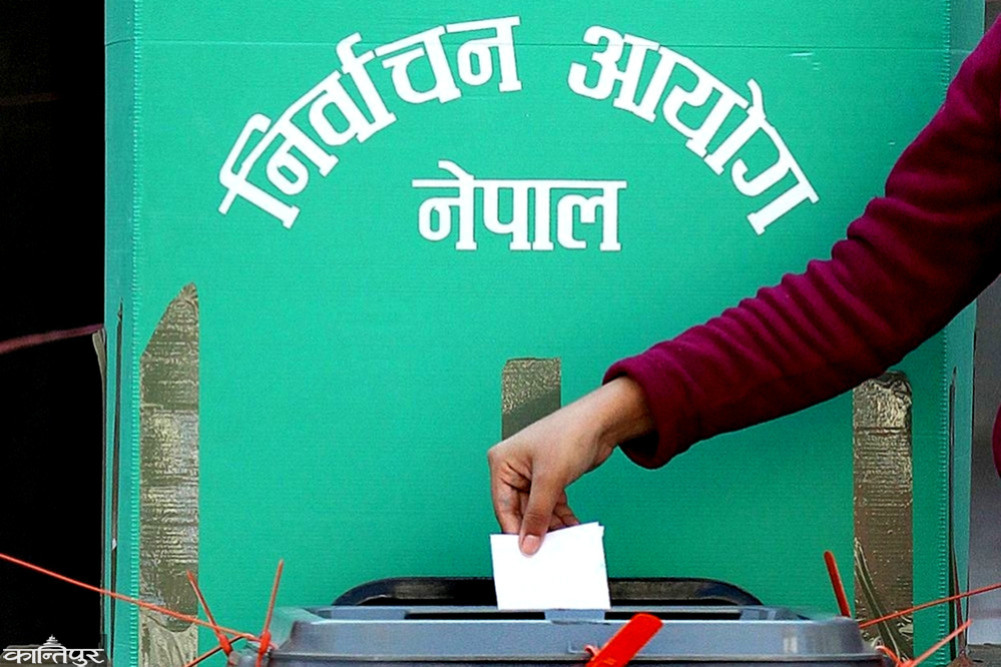
Veena Jha writes – Amidst the loud noise and din of the election, one important issue is fading away – conscious and prudent voter decision-making. There is no alternative to choosing the right candidate amidst the election frenzy.
We use Google Cloud Translation Services. Google requires we provide the following disclaimer relating to use of this service:
This service may contain translations powered by Google. Google disclaims all warranties related to the translations, expressed or implied, including any warranties of accuracy, reliability, and any implied warranties of merchantability, fitness for a particular purpose, and noninfringement.
Nepal has entered a sensitive and decisive election phase again today. The tussle between the old political parties and the new political forces seems to be intensifying. From the streets, tea shops, social media to the toll booths and homes, debates are rampant, there are accusations and counter-accusations, emotional slogans, free speeches and songs are echoing. However, in this noise, one very important issue seems to be fading away - conscious and prudent voter decision-making.
Since the role of voters in democracy is important and decisive, the priority of every political party before the election is to please the voters. However, if the voters are swayed by emotions, fear, hatred, revenge or greed, then the spirit of democracy becomes weak. Therefore, the intellectual personalities and leading groups of the society should move forward to empower the voters impartially, so that they can help the voters make the right decision. And, the possibility of choosing the right person through elections should increase.
One thing is clear: a country cannot be built through hatred and revenge. There are many examples shown by history - the politics of hatred, revenge and fear cannot give long-term peace and development. The Maoist movement in Nepal also started against oppression, inequality and state repression. The movement, which started with the spirit of fear, hatred and revenge, attracted many sections of society. The hope of change, the dream of equality and the assurance of justice received great support. However, when that movement entered the power and state structure, then gradually familyism, factionalism, power-centered politics and opportunism became dominant, reaching the current situation. This has taught a profound lesson that politics that started with hatred and revenge, if it is not transformed into self-criticism, morality and responsibility, will eventually turn into despair.
In this context, the example of Nelson Mandela is very relevant. Mandela had to spend 27 years in prison while fighting against the apartheid regime in South Africa. If he wanted, he could have engaged in the politics of revenge after gaining power and authority because he had enough reason to hate. However, he did not do that, instead he chose reconciliation, not revenge. He said, ‘Hate does not remove hatred, only love and understanding do.’
To build any country, love is needed, not hatred. Love between citizens, love between citizens and country! Mandela chose the path of resolving past crimes through dialogue and confession by forming the Truth and Reconciliation Commission. As a result, South Africa was able to move towards national unity and democratic transformation, not civil war. What this example teaches us is that the real test of leadership comes only after gaining power. The politics of hatred and revenge are easy, but they are fleeting. Country building requires boldness, dialogue, and long-term thinking.
What did the old political parties miss? The new ones should learn from that, and the old ones should also undergo a harsh self-examination. The old political parties of Nepal—the Nepali Congress and the NCP, which were the carriers of change in history—have become so entangled in internal factionalism, struggle for position and prestige, lack of communication with the lower classes of society, and groupism in recent years that they could not see anything about the conditions, challenges, and opportunities of the lower classes of society. The culture of open dialogue was weakened to such an extent that different ideas were considered the enemy. The questions of activists and civil society were suppressed as inconvenient. The result of this is clear today - public anger has increased, public trust has decreased, and the youth are disgusted with the old political parties. And, politics seems to be limited to the strategy of winning elections.
It is natural that the growing disappointment with the old parties will lead to an increase in attraction towards new political parties and leadership. New enthusiasm, new commentary and new style inspire hope. However, enthusiasm alone is not enough. Youth is a potential, which is equally important to be alert, creative and sensitive. The question is also whether political parties that lack long political experience do not become victims of external signals? After reaching power and strength, do they not become insensitive to the originality, sovereignty and integrity of the country?
On the other hand, in today's era of globalization, a deep understanding of the world economy, diplomacy, technology, climate change and international balance of power is also necessary. If new political parties fail to transform emotions into policies, criticism into self-criticism, and enthusiasm into institutional capacity, they too must be aware that they may soon become a repetition of the old problems.
For example, in Bangladesh, the long-standing politics of revenge and extreme polarization have weakened the democratic institutions there. With the change of power, the culture of revenge has divided society. There are increasing scenes and news of chaos reaching its peak, and leaderless crowds have destroyed humanity.
There are many examples of ‘populism’ seen in many countries of the world, with loud slogans that become instantly popular, baseless quick solutions, and emotional provocations, which have had a negative impact on the economy, social harmony, international credibility, and relations in the long term.
In such a situation, it is equally challenging not only for political party candidates, but also for voters to choose the right candidate. Because voting in elections is not only a common right, but also a responsibility towards the future. Although there may be some differences in the basis for choosing the right candidate depending on the place, environment, and situation. However, the risk of choosing the wrong candidate can be reduced when the general public evaluates the candidate mainly on the following basis.
1. Past conduct – How responsible are they? Are what they say and do consistent or not? How sensitive are they to social diversity, inclusion, and social justice?
2. Policy and vision – How clear and far-reaching is the plan than catchy slogans?
3. Communication ability – Do they only speak for themselves, give instructions, or listen to criticism? Is there tolerance for assimilation, facing questions, and believing in open dialogue?
4. Ethics and transparency – How responsible are they to the direct questions related to ethics and transparency? Are they free from nepotism and factionalism?
5. National and international awareness – Is there awareness to understand and appreciate today's global environment and national internal capacity?
The cycle of hatred and revenge is more deadly than the cycle of poverty. Nepal's future should not be determined by the politics of hatred, fear and revenge - it should be determined by wisdom, dialogue and long-term thinking. We must learn from the mistakes of old parties, and the possibilities of new parties should be tested judiciously. This year's election is not just a process of forming a government, it is also an opportunity to improve political culture. This election is also an opportunity to change the way we think about politics in a way that communicates hope in society by setting the right examples.
If citizens can choose the right candidate, the reward will not only be five years of rule - a responsible, inclusive and prosperous Nepal. Nepalis living abroad will also be deprived of casting their votes in this year's election. Voters living in inter-district areas will also be less likely to participate fully due to various circumstances. However, this election is an opportunity to test not only the candidates but also the voters. Therefore, there is no alternative to choosing the right candidate amidst the election turmoil.