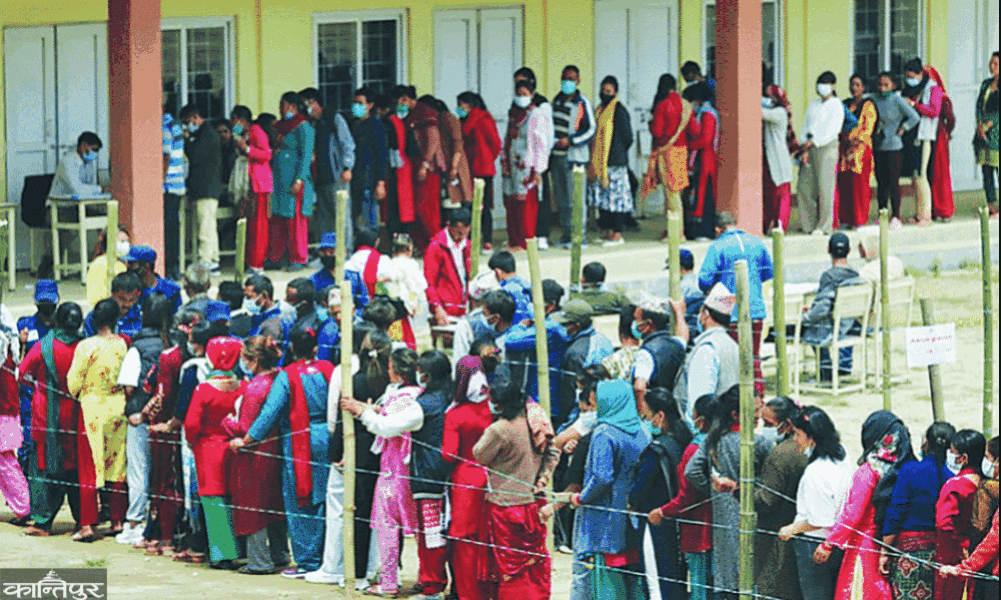
During elections, we should not be satisfied with just faces; we need to pay attention to what those faces are saying in terms of institutional reform, transparency, and protecting civil rights.
We use Google Cloud Translation Services. Google requires we provide the following disclaimer relating to use of this service:
This service may contain translations powered by Google. Google disclaims all warranties related to the translations, expressed or implied, including any warranties of accuracy, reliability, and any implied warranties of merchantability, fitness for a particular purpose, and noninfringement.
No one wants to vote secretly anymore. In a business society that needs cash for everything, there is no benefit to voting secretly. Just as there is no benefit to citizens from secret voting, it is also difficult and expensive for the state to make voting secret. Therefore, voting can now be done openly. The reason I am saying this is that values, ideals, and confidentiality no longer have much meaning in society. At least these issues have become meaningless at the present time. The Nepali society seen in the mirror is not only economically poor but also socially ugly. Such a poor and ugly society hopes to not only become rich after one election, but also become civilized.
Before 1856, elections were completely public. Voters had to declare their votes openly. Or, say, use colorful party tickets. Which made their choice known to everyone. This electoral process began to cause many problems. Wealthy landlords and owners could easily find out how their workers or tenants voted. If someone voted for the ‘wrong’ candidate, they were afraid of being fired or evicted from their homes. Similarly, candidates influenced voters by distributing free alcohol and food in local taverns. This led to mass drinking, rioting and rioting. The vote count was posted publicly every hour, which incited the mob to attack rival voters. In 1843, two people were shot and killed during the election in Sydney and Melbourne.
To end such chaos, fear and violence, the ‘Australian ballot’ system was introduced in Australia. This not only made the vote secret, but also marked the beginning of three important reforms. First, the use of official ballot papers printed by the government. Before that, political parties printed their own ballot papers. In the new system, the government provided a uniform, official ballot paper with the names of all candidates. Second, secret ballots were arranged. For the first time, voters could cast their votes in a separate, secret booth. This made the voter's choice completely secret. Third, the standardized marking method began. The reform was introduced where voters marked the name next to the name of the candidate they wanted. This reformed method later spread around the world.
This experiment in Australia was so successful that it was soon adopted by major powers around the world. Britain implemented this system by passing the Ballot Box Act in 1872. This significantly reduced the cost and violence of elections. The US state of Massachusetts first adopted this system in 1888.
The secret ballot system, which began in Australia, brought transparency, fairness, and freedom to the electoral process. Voters' choices became secure and confidential, which strengthened the foundation of democracy. Today, the secret ballot system has been adopted in most countries around the world. Australia's small reform has had a profound impact on democratic practice around the world. It is a significant turning point in the history of elections, freeing voters from fear, pressure and violence.
This historic change showed that citizens' freedom and privacy can be protected by rising above cheap popularity, fear and violence. The secret ballot system took not only democracy, but also the self-respect and rights of citizens to new heights. This is why the Australian ballot system of 1856 is considered a 'revolution' in the history of electoral administration. But with time, re-elections have now started to look like a frenetic drama.
There have been a total of eight general elections in the history of Nepal. Including those elections, the country has had 39 prime ministers. Hundreds of ministers became ministers. Thousands of parliamentarians became members. All these people made millions of promises. All those promises remained just promises. Not only that, the people who were once considered leaders are no longer worthy of being leaders. Society sees them in any other form. We are now pretending that we no longer need our right to cast a secret ballot, hoping that the one prime minister, a few ministers and a few MPs who will be elected will do what has been impossible for dozens of prime ministers, hundreds of ministers and thousands of MPs. Society is becoming so polarized that it is being presented as if anyone is ready to vote openly.
What a Nepali youth born in a poor family needs is normal employment. For that, economic development is necessary. But no leader in contemporary Nepali society has been able to explain where that will come from or how it will happen. There is no effort in that direction. Because when society is searching for a hero, there is no benefit in formulating a strategy for an economic revolution. That is why parties and leaders are giving slogans that will appeal to the society. The Nepali people, civil society, media and experts and academics are silent on what message those slogans are giving and where we are going in the future. This silence has been taken over by a noise. There is no clarity on who is creating that noise, what message is inside it. That is why we are in a state of confusion. Since the first priority of the day is to complete the election on time, everyone has the benefit of doubt that everyone is focused on it.
If everything remains the same, the election will be held on 21 Falgun. The results of the election will give representation in the parliament of the sovereign state of Nepal. Those representatives will form a government. That government will be led by the Prime Minister. What kind of politics that Prime Minister practices, what path he takes for the economic revolution, and what kind of relations he maintains with the country's two big neighbors and other friendly countries are important to us. You may say that all these things come in the manifesto. Yes, many issues come in the manifesto. All the main and detailed issues come. But what does not come is the practical behavior and professional integrity of the leadership we have elected. For the issues written in the party manifesto to be implemented, leadership with good behavior in practice, professional integrity, and philosophically high moral ground is needed. In a country with a living democratic practice, it is not possible for a single leader, activists and self-interested groups to advance economic development, establish good governance, control corruption and give the society the right direction and momentum. How this is possible needs to be discussed. Or, at least, the leadership should be able to explain.
What we are looking for is a double-digit economic growth rate. There is no confusion about this. How can it be achieved? What are the structural complexities of our economy? Where do we start? How do we work hand in hand with India? We need to cooperate with India reliably at all levels. In doing so, what do we cooperate with China on? How can we work with other friendly countries at an equal distance? These issues need to be discussed. It is not possible to answer back what is in the manifesto. The manifesto is a basic issue. Political parties are free to write everything in it and can. But the main issue needs to be clearly stated.
Political parties are in the election process. But what they are forgetting is that the cry of this country and the compulsion of the youth are not just election slogans. Therefore, those who cannot take concrete initiatives and put forward a clear blueprint for the country's development will not be able to overcome this time. In many countries that are progressing economically in recent times, there is some form of political unity. There is no division of power between the executive, judiciary and legislature. One does not work in a way that balances the other. Nepal is in a completely different situation in that regard. Without assimilating this reality, our journey of development cannot be long-term. In this situation, we do not need a leader who politically polarizes society in terms of projects. We need a political leadership that works based on the international norms and philosophies that Nepal has been adhering to.
Looking closely at the political scenario of recent years, issues such as freedom, democracy and civil rights are only written in the constitution in the country. They are not being practically implemented. As Daron Acemoglu and James Robinson say in ‘The Narrow Corridor: States, Societies, and the Fate of Liberty (2019), freedom is neither a natural state nor an achievement that is automatically achieved with progress. It is possible only in a continuous balance between the state and society. Which, according to them, is a narrow corridor. Elections are held within that narrow corridor. We get the opportunity to elect new political leadership. Every election held in Nepal brings a wave of new hope and expectation. The emergence of new political forces and political leadership in different periods makes the desire for change stronger among citizens. However, the society we seek cannot be built by changing the face or bringing in new forces alone. Nor can economic development occur. Freedom is not secure. The state is not strong. To achieve all these things, we must be able to constantly monitor and control the new forces and leadership that have emerged.
Elections chain the state. Citizens get the right to choose, monitor, and punish leaders. However, elections and a constitution alone are not enough. If society cannot organize itself freely, formal democracy is only a superficial cover. Many countries, despite holding periodic elections and protecting the constitution, are depriving citizens of being truly free. Despite this, some countries, such as those in East Asia, guarantee employment and income to their citizens by developing economically. In Nepal, although state bodies, commissions, and legal structures appear strong on paper, in practice citizens are frustrated by personal relationships, recommendations, and chaos. Our state appears democratic on paper, but is incapable of providing services and implementing laws. Citizens vote, but corruption, complexity, or chaos return them to where they were.
Elections are not just a process of choosing leaders. They are a tool for citizens to hold the state accountable. Due to caste, region, or personal interests, citizens are not able to demand transparency and accountability in the country. The state is weak, but the various components within the state are complex and powerful. Society must vigilantly monitor such toxic components. Therefore, building a developed society and developing a strong state is a continuous struggle of citizens. Even in a mature democracy like the US, if you start turning the electoral system in your favor, it is even more challenging in a poor country like Nepal.
Sometimes people's movements empower society. The Gen-G movement seems to be doing the same thing in the country now. It increases the demand for diverse and new representation in society. The emergence of new forces in Nepal in recent years has brought awareness among citizens. There has been an increase in the desire to find alternatives to the old parties. But if we emphasize more on face-changing than institutional reforms, we may face another risk. There is a need for a strong role for an independent judiciary, a free press, and other institutions that can keep the state under surveillance by working hand in hand with citizens.
In today's digital age, technology has empowered citizens. Social media and digital platforms have made it easier for new movements to demand rights. These same technologies can also become weapons of surveillance and control for authoritarian states, which can tilt the balance of power in favor of the state. The use of technology has brought awareness among citizens, but the risk of misinformation, division, and surveillance has increased. This is another risk in our journey to build a civilized society. Which we need to watch carefully.
Society's activism, awareness, and participation are essential to safeguard freedom. During elections, we should not be satisfied with just faces. In terms of institutional reform, transparency, and protecting civil rights, we need to pay attention to what those faces are saying. Civil freedom is a delicate relationship between an ever-balanced, vigilant citizenry and an accountable state. The future of our freedom and democracy depends on collective awareness, participation, and institutional reform. If work does not move forward in the direction of empowering civil society, making the state accountable, and building inclusive institutions, we may not be safe in the long run. We need to pay attention to this.
We need to be aware of elections, new forces, and the use of faces and technology. We need to consciously evaluate these issues, which depend on citizen activism, institutional flexibility, and continuous balance. Only then will we and our society be safe. Only in a safe society can we open the door to economic potential.