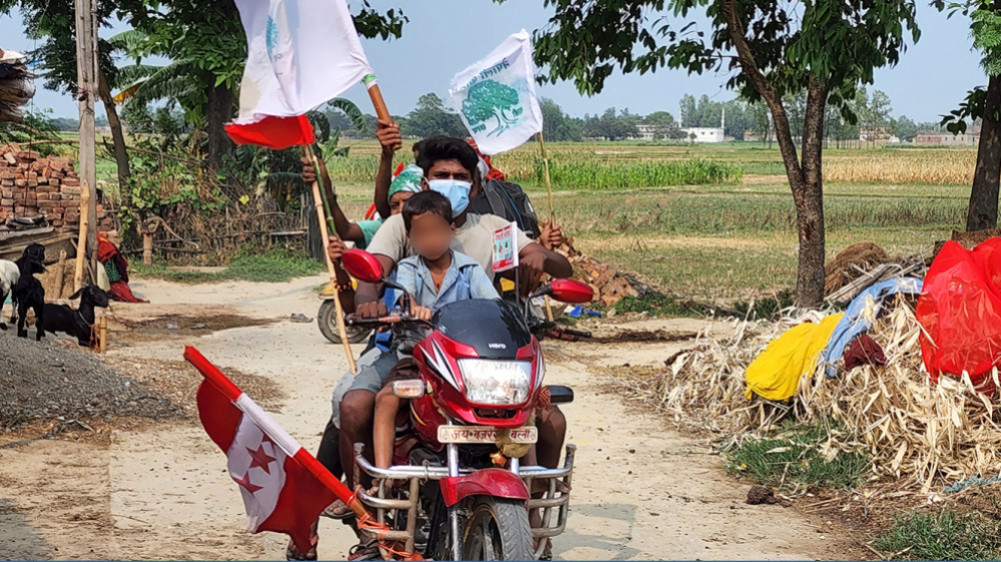
Children are not aware of the principles and manifestos of political parties, nor are they able to form personal opinions through self-awareness of political philosophies. Therefore, minors should not be used in election-related propaganda for the benefit of adults.
We use Google Cloud Translation Services. Google requires we provide the following disclaimer relating to use of this service:
This service may contain translations powered by Google. Google disclaims all warranties related to the translations, expressed or implied, including any warranties of accuracy, reliability, and any implied warranties of merchantability, fitness for a particular purpose, and noninfringement.
Election activity is increasing in the country at the moment. The government is preparing for the upcoming election to the House of Representatives on Falgun 21.
In this context, the Election Code of Conduct, 2082, has been approved and implemented to conduct the elections in a clean, free, impartial, transparent and fear-free environment, effective from Magh 5, which prohibits the use of children in elections.
Children are innocent and sensitive. Everyone has the same responsibility to protect and promote their rights in the family, social and institutional levels. When there is still turmoil in the political and social environment, special sensitivity must be adopted. Political parties organize campaigns, gatherings, public meetings, processions and rallies during elections. Political parties should be restrained and aware of whether such programs are against the interests of children or whether they affect them.
Section 4 (g) of the Election Code of Conduct, 2082, under the ‘Conduct to be followed by everyone’, states that children should not be used or caused to be used in election campaigns. Similarly, under Section 4, ‘Conduct to be followed by political parties, candidates, fraternal organizations of parties and concerned persons’, Section 13 (1) (k) states that children should not be used or caused to be used in election propaganda, public meetings and rallies. Along with this, Section 4 (c) provides that in order not to harm the study and teaching of children, the grounds of universities, schools or colleges should not be used or caused to be used for election-related gatherings or propaganda.
Children are not aware of the principles and manifestos of political parties. They cannot form personal opinions through self-understanding of political philosophy. They cannot even participate in the selection of candidates through the exercise of their franchise. Children do not have full legal rights, and their parents have a protective role over them. Therefore, minors should not be used for the interests of adults in election-related propaganda activities. During this period, political parties should be even more sensitive in protecting child rights.
Section 66 (2) (g) of Chapter 8 of the Children's Act, 2075 BS has made it an offence against children to organize children for political purposes or to use them in strikes, bandhs, picket lines, dharnas or processions. And, if such an act is committed, a fine of up to 75 thousand rupees and imprisonment for up to 3 years has been made.
This has made the use of children in political activities punishable not only during elections but also at other times. Children are used to fulfill political objectives by lining up in processions, dharnas or meetings in school or college uniforms. However, past experience shows that due to the lack of monitoring by the concerned bodies and the readiness to bring them under the legal ambit, the situation is going on in one direction and the other.
Such practices are being carried out despite the fact that such practices are considered illegal, such as making students dance to the propaganda songs of political parties, giving them the responsibility of miking, and making them march in slogan rallies to make the crowd look bigger. Political party leaders themselves promise not to use children. However, they are taking children studying in schools away from their studies and involving them in political activities. School families should also be aware of such activities and keep the school environment child-friendly.
Most of the polling stations for elections are set up in schools. Children's final exams are approaching. The work from preparing polling stations to counting votes creates obstacles in their regular studies and extracurricular activities. Therefore, children should be involved in their studies in a safe environment as soon as possible after the voting is completed.
Children should not be involved in preparing campaign materials through the use of social media. Since there is a ban on the production, sale and distribution of physical materials bearing the election symbols of political parties, social media is used more in campaigning. The materials used on the network should also be child-sensitive. Playing on children's emotions to attract the attention of parents and solicit votes is also against the code of conduct. Awareness of this is very important.
The election is not going to be a regular periodic election but a result of a movement. As the culture of insistence, prejudice, blame, abuse and criticism is growing among political parties, there is a possibility of clashes, conflicts, attacks and violent activities during the campaign and children are at risk of physical risks such as accidents, injuries, and amputations. Children cannot remain alert and restrained according to the situation. Therefore, political individuals, parties and families should pay special attention to their protection.
Political activities can have a negative impact on child psychology. There is a risk that negative thinking or feelings of anger and hatred may develop in them. Slogans, rallies, threats and the use of abusive language can increase fear, panic, anxiety and stress, which can lead to mental and psychosocial problems in them. Therefore, it is essential to ensure children's rights, including education and health, in a safe environment by keeping them away from election activities.
Since the use of children for electoral interests is considered illegal, it is everyone's responsibility to protect them from exploitation, violence, abuse and risks. Children are not clear about their responsibilities, duties and rights, and cannot even play such a role.
Therefore, no one should use children to achieve political objectives by tempting, pressuring and influencing them. Children are the future capital of the country. In every situation, it is necessary for all stakeholders to pay attention to the protection of their rights by investing in security, education and all-round development.