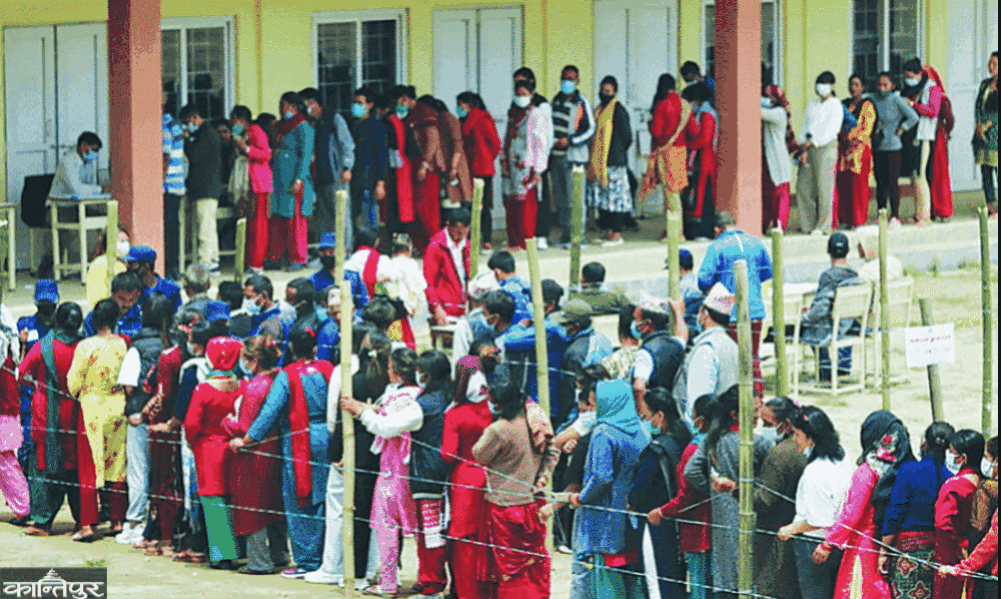
In some cases, elections herald a new era, tearing down the walls of tradition, which are rooted in tradition and are harmful to the people. They also usher in a new society, a new culture, and new values. But what is happening this time? Are elections becoming an undertaking to legitimize the corpse of democracy?
We use Google Cloud Translation Services. Google requires we provide the following disclaimer relating to use of this service:
This service may contain translations powered by Google. Google disclaims all warranties related to the translations, expressed or implied, including any warranties of accuracy, reliability, and any implied warranties of merchantability, fitness for a particular purpose, and noninfringement.
In a democracy, elections have become a means through which the powerful have sought to maintain the status quo and maintain their grip on power. The electoral history of recent decades is full of examples of the skill and skill of such individuals.
Sometimes the power of the vote shakes the state. Like plates that finally make a place after an earthquake, it makes it possible for the powerful to regain control over the pieces again and again.
In some cases, elections herald a new era and tear down the gigantic walls of traditional, decaying and anti-people power. They also usher in a new society, a new culture, and new beliefs. But, what is happening this time? Are elections becoming an undertaking to legitimize the corpse of democracy? In elections where principles begin to weigh heavily, the burden of parliament begins to appear.
When the House of Representatives was dissolved after the Bhadaure lightning strike, there was no resistance from the common people, because the effectiveness of parliament had been eroded. A gap was seen between the people and the parliament. The parliament was finding itself helpless to express the pulse of the Nepali people, and in such a situation, when it was forcibly dissolved, it did not make any difference.
The upcoming elections may provide fresh representation, but what will be the form, character, and opinion of the potential House of Representatives? This election is not an election of the people, but of the people's memory. If voters remember their recent past once, the light of liberation will spread on its own. Otherwise, the government will change, the character of the government will remain the same.
Who did the parties nominate as candidates? How much opportunity for representation will women and Dalits get? How were the tickets distributed? What and how are the questions being raised in the election debate? Are the comments being imposed from above or are the statements expressed from the ground being raised to the top? What are the election methods?
Are the old tendencies still alive among those who call themselves new? Does the meaning of 'experienced' only mean forgetting the promises of multiple elections? Unemployment is not a 'number', it is a question of dignity. Who is saying that corruption is not an 'exception', but structural injustice? How credible is that? Is the language of protest value-based or not? Is value only high in rhetoric, but lost in practice?
This is just propaganda. Such politics may make it easy to ascend to power, but it also makes it fall quickly. Who will investigate? If this election is not made a celebration of values, democracy will soon become a hostage to numbers in the possible scenario.
No matter how much they try to draw an equation between the new and the old in this election, it is not happening. The reason is the behavior of those who claim to be 'new' themselves, seen in a short time. Because they gradually turned the election into a fair to collect votes rather than a grand festival of choosing ideas. What are they saying? 'I will fight for you' or 'I will be accountable to you by staying in power.'
They are communicating less with the people and more with the camera. Where logic starts to weaken, the presentation ends up with the flag of patriotism. It is clearly visible that the election competition has been made into a business of 'image management'. In today's elections, the candidates are not leaders, but actors are being given more of a spotlight.
Social media embellishes the truth that suits them and the presentation turns democracy into a spectacle. This social media is no longer just a means of propaganda, in a short period of time it has become a laboratory for the character building of 'Agams'. In political drama, each and every thing - stage, mic, camera, body language - starts to look 'scripted', then when did the voters turn into poor 'spectators'? They do not even get that. The meaning of this trend is to be pushed away again and again.
Whatever is being reflected in the scenario, it is only the 'rotten' (rotten) within the society that is becoming visible. In this sense, this election is an X-ray of society. The density of opacity in election spending has increased. Therefore, this election is not a test of democracy, but a confession of society. In elections, caste, religion, language, and region were seen as tools for gathering votes. Identity is seen, manipulated, and affectionately embraced as a vote bank, but it is not made the basis for policymaking. In the glare of favoritism, a ‘game’ is being played to transform representation into personality by establishing ‘I am the people’.
An atmosphere of emotional frenzy is currently being created by showing it in language and gestures. In this election, the Madhesh movement and the Janajati movement are being suppressed. Theoretically, it can be said that elections are the moment when society decides about itself. However, those who rush forward saying ‘I will speak’ are considered pawns of the dominant parties, and the deprived aspirations are pushed to the sidelines. Thus, in this election, the risk of perpetuating social division in the name of a fresh mandate is high.
From a sociological perspective, elections are not an equal opportunity process. This time, whoever has the means, the favor of power, media management and the power to incite the crowd, whoever has created that system, they regulate this election discourse. Elections highlight what values society is trying to organize itself by? Will society remember the past through voting or will it try to listen to the incoming footsteps? Are voters prioritizing ideology, roadmap, process and eligibility or caste, language and regional identity? Elections are an opportunity to reveal the relationship between social consciousness and power structures and to build a new grammar, but are we moving in that direction?
There is no sign of the center of the system of the dominant class collapsing somewhere. Because the votes of the poor and the deprived are equal, but the voices are not going to be equal. In the election competition, symbols linked to the nation, fear, pride and memories of the past are eager to touch the collective emotions through projection. When emotions start to become the main basis of politics, democracy gradually turns into mob rule.
In its own right, the deprived community has sought equality. A territorial structure with rights, a diverse nationality, proportional representation in every organ. These issues raised belong to everyone. However, despite being decisive in elections, the deprived community is going to suffer the fate of under-representation in power. This is the essence of the contradiction.
Even though elections provide the opportunity to participate in voting, they will keep voters away from power sharing. The sociology of ticket distribution is revealing the same. Elections are indispensable for the promotion and protection of diversity.
When diversity is accepted in ticket distribution, the community feels a sense of identity. In such a situation, how does this election shake the status quo? How do the evolving aspirations of the common people find a positive place in the electoral discourse? What power is nurtured when electoral politics changes to mindless competition to emphasize all the old nonsense? It is easy to say that the old ones were wrong, but what are we different about and can we do better? Are the parties and candidates able to tell us that?
As much as the localization of the issue is necessary, the nationalization of the vision is inevitable. This time, it was worth mentioning that two faces of the Prime Minister - Balendra Shah, proposed by the National Independent Party, are in the race from Jhapa, where the majority of the hill community is present, and Gagan Thapa, the president of the Nepali Congress, is in the race from Sarlahi, where the Madhesis are densely settled. In the past, national leadership aspirants have been entangled around specific constituencies and community-based strategies.
Some were stuck in Dadeldhura, while others were stuck in Jhapa. What happened was that the elected leadership always showed extra affection for their constituencies. They distributed resources unevenly. They rained opportunities on their own areas. Despite being the party leader of a big party, he created the image of a regional commander. Instead, Prachanda kept roaming the hills and Madhesh. There was also criticism that aspirants of national political stature did not rise above the election-centric or community-specific hypnosis.
But, this time the sequence has been disrupted – Gagan Thapa’s presence in Sarlahi and Balendra’s presence in Jhapa is a ‘brilliant’ decision. This courage, foresight, desire for belonging and determination to fly high are commendable. If the political experiment of hill leaders going down to Madhesh and Madhesh leaders going up to the hills can be developed into a party trend from individuals, then the parties’ claim that ‘republic is a bridge connecting the country’ can be firmly established.
Elections are an opportunity for experimentation. Courage is an opportunity to be approved. This is a time to break narrow circles. It is the responsibility to draw the grammar of national relations on the ground of reality. But not by pretending to be ‘Ganga went Gangadas, Jamuna went Jamunadasa’.
It is not about entering Madhesi society and showing off by wearing a cap among the hill communities. Elections are not about acting, but about faith in the power of diversity. It is a practice to respect the beauty of diversity and to lead everyone towards a common future, not a flashy compliment. This is not a magical game. It is to make it a basic competition based on logic, vision, and dreams to win public trust. Those who give slogans to build a country must be aware of these small things.
Even though we do not have a tradition of taking up such positive challenges, when someone puts themselves forward for such use, they are portrayed as 'insider-outsider' or 'this community-that community'. Some people call the natural claimants, the opponents there as fugitives. This is not to be viewed in a narrow frame. We have become so narrow-minded that we do not even look outside our circle.
The Constitution of Nepal gives citizens nationwide political rights. Becoming a candidate from any province establishes this – a citizen is first Nepali and then provincial. This trend challenges narrow regionalism. It elevates the leadership above provincialization or communityization. It encourages discussion, questioning and interaction on national policy, regional balance and comprehensive development model. It motivates voters to think towards comparative rather than emotional choices. If democracy is not about inheritance but competition, then the tendency for anyone to contest elections from anywhere should be welcomed.
It helps connect the spirit of a province with the mainstream. It can make it possible to get out of the quagmire of lack of options. When a person from one province gets a mandate from another province, then it should be accepted as a victory of common democratic consciousness. This is right. The importance of local understanding, language, culture and struggle should be maintained. However, making only birthplace a qualification narrows democracy. Inter-provincial candidates make democracy free from borders, enriched with ideas and strengthened with citizenship. Therefore, not being looked down upon as an outsider, but rational competition reveals the real power of the Nepali republic.