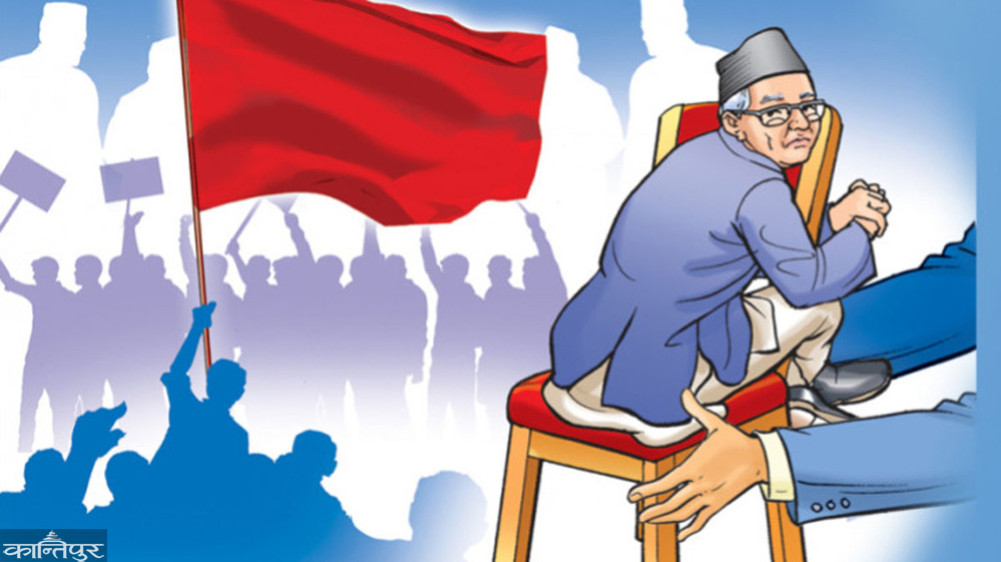
How long will we live as porters for those who make politics a means of livelihood? How long will the youth continue to trade tomorrow's future for the benefit of two days, becoming the pawns of leaders? When will understanding, conscience, and self-respect awaken?
We use Google Cloud Translation Services. Google requires we provide the following disclaimer relating to use of this service:
This service may contain translations powered by Google. Google disclaims all warranties related to the translations, expressed or implied, including any warranties of accuracy, reliability, and any implied warranties of merchantability, fitness for a particular purpose, and noninfringement.
Is politics a service or a profession? This is a serious question in today's Nepali politics. The practice seen in the last decade suggests that politics is gradually becoming a 'profession'. Power, convenience, and personal gain have become the main motivations of politics.
Therefore, politics is not a means to change people's lives, it is becoming a private profession of some people. However, in reality, politics should not be a profession, no. It is a responsible means of transforming society. Only by taking this as a short-term responsibility by doing other productive professions will politics take the right path.
It is a misconception that social change is always possible only by reaching power. Yes, it is certainly easy to make policies and lead the nation on the right path when reaching power. However, everything is not just about politics and power. History has shown that society can be changed from outside power.
Citizen movements, social campaigns, intellectual interventions, conscious citizen groups and alternative practices have prepared the basis for major changes from outside power. Many issues such as women's rights, Dalit rights, land rights, environmental protection were established due to voices raised outside the center of power. Power is the last stage, the real power of change lies in society.
Some consider violent movements as a way to change quickly. However, experience has shown that the victory achieved through violence is often temporary. Violence can change power, but it cannot change trends. Guns can overthrow a regime, but they cannot democratize thinking, culture, and power structures. Therefore, most of the changes brought about by violent movements carry the risk of falling back into the same vicious cycle. It is sad to see the same fate repeating itself in Nepal at this time.
The biggest need in today's context is widespread social awareness. Political change is not sustainable without an aware citizen and their awareness. As long as the people are not aware, organized, and able to question, the trend will remain the same no matter which power comes to power.
The reality of Nepali politics, where the trend remains the same even if the characters change, is linked to the lack of widespread awareness. As long as the aware citizen is not aware, the leaders change, the parties change, but the style of using power, corrupt practices, and indifference to the people remain the same. Therefore, widespread citizen awareness and prudent decisions are the need of the hour.
In the upcoming elections, it is very important to rise above the party flags and slogans and look at the candidate's character, commitment, past practices, and accountability to the people. Accepting wrong practices in the name of a party is an act that weakens democracy. Without an informed voter, democracy becomes hollow.
Social change is not the responsibility of any one party, one leader or one movement. It is a long-term process, which is based on public awareness, moral politics and continuous citizen pressure. Sustainable change is not possible without the understanding that politics is not a profession and the confidence that society can be changed from outside the city, power and widespread awareness. Reflecting on this truth is both the biggest challenge and opportunity of today's Nepali society.
The families of the youth killed in the Bhadra 23 movement have not been able to free themselves from unbearable pain even today. On one hand, there is the pain of the death of a promising youth, on the other hand, the priceless property built with the country's history, struggle and sacrifice has been destroyed. The country built with our sweat, blood and hope was vandalized indiscriminately. Ultimately, for whose interest?
When I saw the new leadership that emerged after the movement, I felt that day - now justice will speak, truth will prevail and the country will walk on a new path. However, with time, reality taught a bitter lesson – changing the face of power is not the solution, the system itself needs to be transformed. More than that, the mindset of those who reach power needs to change.
How long will we live as porters of those who make politics a means of livelihood? How long will the youth continue to trade tomorrow's future for the benefit of two days by becoming the leader's bag? When will understanding, conscience and self-respect awaken?
Big speeches, garlands and empty promises full of false pride disappear in the air in an instant. We the people, who elected them and brought them to the throne, are today bowing our heads at their feet and making ourselves slaves by calling ourselves 'big men'.
The reality of how unemployed we are is made clear by the crowds seen at the seminars, general conventions, general meetings and party offices that begin 6 months before the elections – there is no work, but there is plenty of time and energy to carry the flag. The question is getting deeper – when will we be free from this political mess? When some new faces won in the 2079 elections, there were glimmers of hope, and there was a belief that something would change now, but today, when we see two or four of them jostling for positions and chairs, the proverb ‘whoever comes, his ears are torn’ becomes a reality. No matter who the leader comes, the question on the surface of society is the same – how long will our young families continue to suffer in the 40-degree Arabian sun to make ends meet?
While blaming leaders, I also want to ask myself – why can’t we exercise common sense during voting? When will our habit of repeating wrong decisions break? Until the people learn to make the right choice between self-respect, hunger, and common sense, we cannot become innocent by blaming only the leaders. Because the continuation of the wrong system is the result of the wrong support we have given.
If we were more proud of the country's flag than we are of the party's flag, we would see unity and prosperity in the country today. Exchanging tomorrow's dreams for today's small gains is a terrible loss. We need to stand on our own thinking and labor, not under the flag of any party.