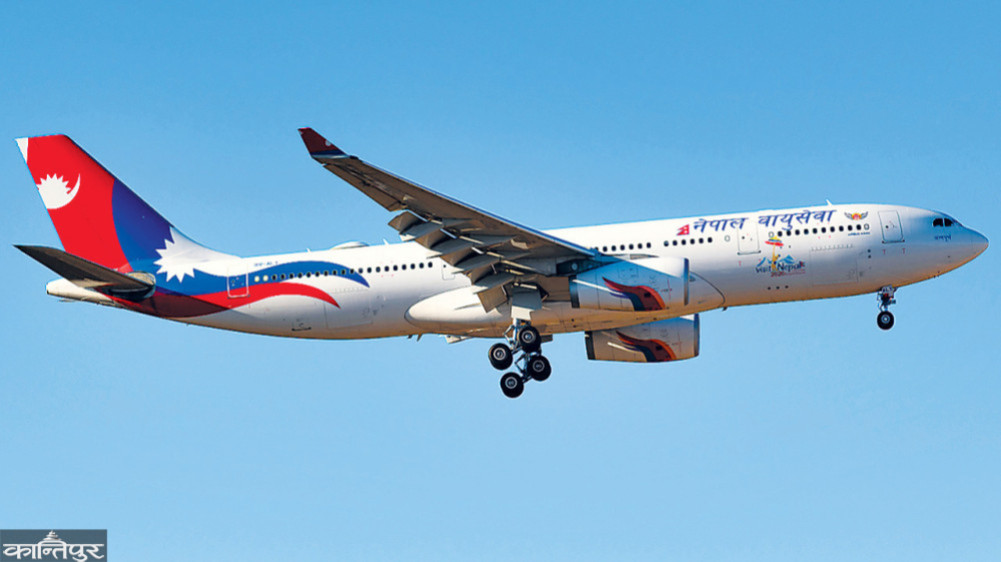
Taxpayers, who are also tied to the corporation's debt and management costs, have also pointed to the organization as a burden. Currently, both of its narrow-body aircraft have been grounded.
We use Google Cloud Translation Services. Google requires we provide the following disclaimer relating to use of this service:
This service may contain translations powered by Google. Google disclaims all warranties related to the translations, expressed or implied, including any warranties of accuracy, reliability, and any implied warranties of merchantability, fitness for a particular purpose, and noninfringement.
Nepali citizens rarely hear positive news about Nepal Airlines Corporation, as incidents such as corruption, incompetence, mismanagement, flight delays, and flight cancellations have often brought the corporation to the center of the news.
As a result, domestic and foreign passengers traveling using the corporation's aircraft have to face daily inconvenience. Taxpayers, who are also involved in the corporation's debt and management expenses, have also pointed to this organization as a burden. Currently, both of its narrow-body aircraft have been 'grounded'.
As a result, passengers who had booked advance tickets to travel abroad and to Nepal from various countries on those aircraft are stranded. The corporation has had to manage the passengers as best they can in the last minute. However, considering the inconvenience caused to passengers, the negative perception created towards the corporation, and the reluctance to travel on the corporation's aircraft in the future, it is clear that the corporation is not only suffering from immediate but also long-term harm.
The corporation's narrow-body aircraft 'Sagarmatha' was 'grounded' due to technical problems after returning to Kathmandu from Bangkok on Friday night. The problem also occurred in 'Sagarmatha' while the other narrow-body 'Lumbini' was in Israel for engine replacement on 14 Pus. This has firstly added to the suffering and confusion among the passengers. For example, 105 passengers who were going to Guangzhou, China, on Friday night from ‘Sagarmatha’ had to be returned to the hotel from the airport at the last minute.
The passengers were angry and even abused and assaulted the employees of the corporation, saying that the flight was canceled even after they had entered the final waiting room (sterile hall) of the airport after ‘check-in’. The corporation only made the passengers who were supposed to go to Guangzhou fly on Saturday after 12 hours.
In Guangzhou, 130 passengers had to be accommodated in a hotel at the corporation’s expense. Due to the lack of aircraft, the ticket amount of 88 passengers who were supposed to go to Hong Kong and 76 passengers who were supposed to return to Nepal from there had to be fully refunded.
The passengers will be disappointed and it will lose international reputation. The corporation will also have to bear financial losses. There are two aspects to this. First, when the aircraft is ‘grounded’, even the flights that were scheduled should be canceled. The corporation has already canceled flights to Bengaluru after 26th December, Hong Kong on 29th December, Bangkok and Dubai on 30th December due to lack of aircraft. The income generated by the flight is lost as soon as the flight is postponed.
Second, since there is no flight at the last minute, the passengers who have tickets must be managed. From staying in hotels for the time being, passengers must be sent to their destinations via other aircraft. On the one hand, income is lost, on the other hand, expenses increase.
The corporation has lost at least 1,000 passengers in both directions due to the cancellation of flights to Bengaluru, Hong Kong, Bangkok and Dubai. Due to this, the corporation, which is burdened with debt, has suffered a loss of about 100 million rupees. Meanwhile, the corporation already has a debt of 52 billion rupees due to the purchase of narrow-body and wide-body aircraft.
Since the narrow-body aircraft have been 'grounded', pressure has increased on the wide-body aircraft. Since the narrow-body aircraft are not operating, the corporation is forced to use both wide-body aircraft that fly long distances, including Japan, for short-distance flights. This has facilitated some passenger management, but it is also creating serious pressure on the wide-body engine.
Because, the total flight cycles of the corporation's wide-body aircraft are 6,000. Currently, only about 500 of the 'Alpha Lima Yankee' wide-body and about 800 of the 'Alpha Lima Zulu' wide-body are left. It is the turn of both aircraft to undergo engine 'overhaul' next month, i.e. extensive maintenance. Therefore, when using the wide-body on short distances, the flight cycle will end quickly. Which causes additional financial loss to the corporation.
Last year, in Falgun, three out of four aircraft had problems at the same time. At that time, the Sagarmatha narrow-body, which had reached China for 'Sea-Check', had problems with payment and was stuck there. The Lumbini narrow-body was stuck in Saudi Arabia after a problem was found in the front wheel. After returning after repairs with the help of Saudi Airlines, the corporation had to keep it at the airport's repair shop because the problem appeared again.
The wide-body Annapurna was stopped in Delhi for routine inspection, and even after being repaired from there, it was grounded due to fuel-related issues. The shortage of aircraft is one problem, and the situation of three out of four aircraft having problems simultaneously is another. Therefore, if the time for routine maintenance is not managed strategically, problems will arise repeatedly. The corporation needs to be sensitive in this regard.