We need a generation that is confident in their abilities, understands life and the world, and can immediately solve small problems, formulate and implement sustainable plans, and change the face of the country.
We use Google Cloud Translation Services. Google requires we provide the following disclaimer relating to use of this service:
This service may contain translations powered by Google. Google disclaims all warranties related to the translations, expressed or implied, including any warranties of accuracy, reliability, and any implied warranties of merchantability, fitness for a particular purpose, and noninfringement.
Nepali politics, which doesn't take long to heat up and cool down, seems to be heating up once again. The big question that remains with us is whether politics itself is heating up or just the leaders. According to political scientist David Easton, politics is the 'official distribution of social values'.
So, are the streets and social media of Nepal heated up around this issue? This complex question also remains. Apart from political parties, are other bodies and characters related to power also active or only the party leaders? The issue of whether they are only party leaders also demands serious consideration.
In any case, activities in the name of politics are increasing on the streets. Discussions about the relationship between the government, elections, political parties and their leaders are intensifying among the common citizens. The series of congratulations, support, accusations and counter-accusations on social media also seems to have increased significantly. Some regular practices of politics have resurfaced, which are further intensifying the public debate.
As politics heats up, citizens are engaging in politics with half hope and half worry. It may be a bit sad to hear, but it is more appropriate for citizens to be watching politics rather than engaging in politics. It seems that current Nepali politics only expects passive participation from citizens rather than active participation. In Nepali politics, we are fewer citizens and more voters.
The entry of new characters and the interest of a new generation in politics is the brightest ray of hope seen in the dark tunnel of current politics. But we are not completely free from the worry that the politics that is currently heating up will soon be over, repeating the old trend, and we will have to face another movement or wave of change on the same old issue in a few years. There is also an invisible fear that if politics heats up too much, national instability will arise and that will further weaken the democracy, economy, and society that is breathing heavily.
Here is another bitter reality that everyone involved in politics must accept. New political characters have appeared in politics, and although attempts are made to portray that there is a vast difference between the old and the new, the priorities of our political, economic, and social problems are predetermined. The changes in problems over the decades have made our options extremely narrow. Whether it is Hari Bahadur or Madan Bahadur, no matter who comes to power, there are some national issues that must be addressed, which we cannot move forward by jumping over, avoiding, or ignoring.
Honest discussion of all such issues, setting priorities, and policy dialogue and competition about them is the only way to good politics. We need regular, comprehensive, factual, theoretical, comparative, intelligent dialogues on society, economy, politics, and foreign relations. This article will discuss three such important socio-economic issues.
There is no other answer than economic growth
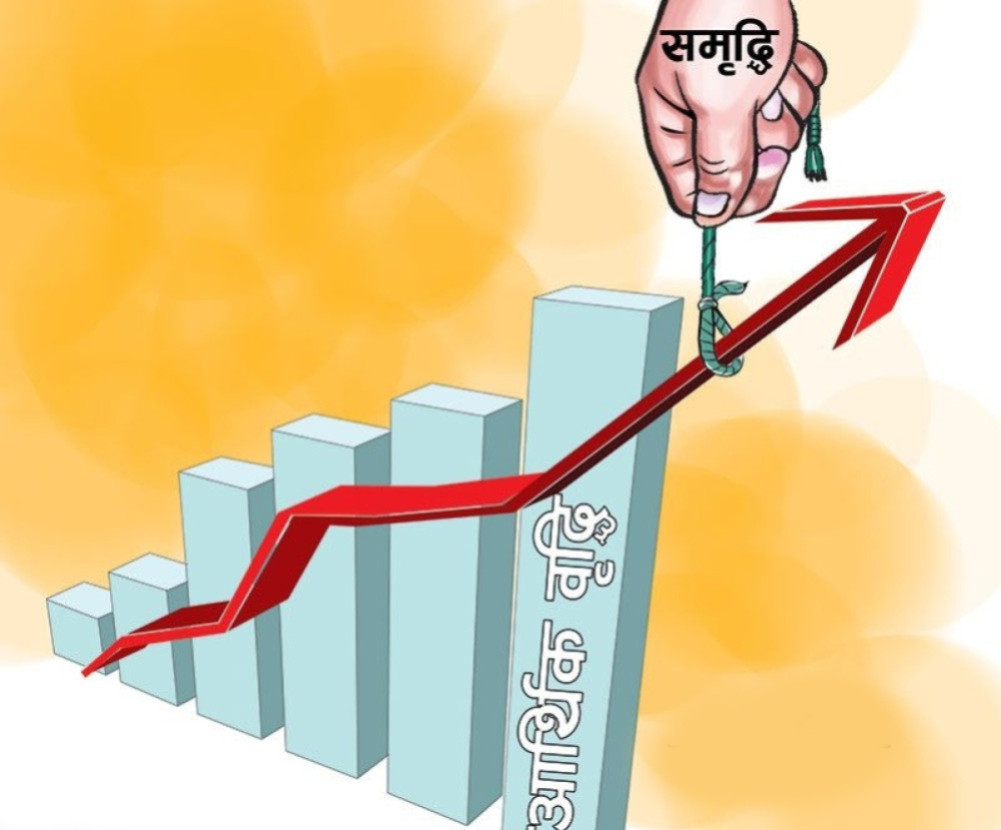
For a long time, the word ‘economic growth’ remained ignored in Nepali politics and society. The issue of economic growth had to face a three-pronged attack. On the one hand, the rhetoric that economic growth is an issue of crony capitalism, so discussing it is a social crime, remained as strong as religion. On the other hand, growth was overshadowed in the debates on reforms or changes that put issues of developed countries such as development, equality, and sustainability at the forefront, not growth. Not only that, there was also no shortage of those who sang the hymns of distribution while keeping the issue of growth intact.
While discussions about such arguments that are enjoyable to listen to have received priority, discussions about structural reforms in our economy have received less priority. And, all the problems of today have been created. And when we discuss the economy in the name of cutting expenses, we have reached a point where we have to use various words that shrink the national, regional and local economy and make do.
Since our economy is still very small, management or status quo policies like those of large countries can never be a timely answer. If we do not determine the area of growth, deploy special strategies in that area, create a large number of quality jobs and improve the revenue situation in that area, the complexity of our national treasury will increase. A cloud of great danger is looming before us that our public sector will pay a huge price and that will have a long-term impact on the future of the nation.
Yes, a balance of growth, distribution and economic stability is essential in the economy. All these are necessary and important assumptions. However, the state of the economy definitely determines which area to prioritize. For example, the changes made in the economic policies of countries that are considered the world's powerful economies during the Corona period are a vivid example of that. In the context of the 2006-07 economic crisis, the Corona period, and the subsequent economic recession, where the issue of growth has received high priority in the politics of even the so-called developed countries, are we in a situation where we are running away from the issue of growth in our country?
The issue of economic growth is not only linked to the economy. It is also linked to the citizens' trust in the state system. When Nepalis are concerned about the state's condition, it seems that they give higher priority to the quantitative, visible physical area rather than the qualitative.
For example, when explaining the word development, it seems that they often give high priority to big cities, wide roads, skyscrapers, etc. like those in foreign countries. The popularity of the comment about making Nepal a Singapore also shows that Nepalis are eager to follow the model of countries with rapid economic growth in terms of numbers. In this sense, the indicator of economic growth and the success of the state in it is the main tool for gaining the trust of the common citizens in the state and the system.
Economic growth is a stepping stone on the path to a socialist political system. The issue of economic growth is now a bridge, a confluence, between achieving our sustainable goals such as inclusive development on the one hand and gaining the trust of citizens in the state and state system on the other. Accepting this fact, our politics should be taken to the stage of competition regarding the methods of economic development.
There is a fact established from the history of economic growth of Asian countries since 1950 – when a country starts contributing 15 to 20 percent of its gross domestic product (GDP) to a new sector, it drives the entire economy as a new engine of economic growth.
In the case of Nepal, the 16th Periodic Plan currently in practice has set a target of increasing Nepal's gross domestic product to over one hundred trillion rupees by the fiscal year 2085/86. When the plan was made public, an economic growth target of 6 percent in the fiscal year 2081/82, 6.6 in 2082/83, 7.4 in 2083/84, 7.9 in 2084/85 and 7.2 in 2085/86 was set to achieve this goal. In the fiscal year 2081/82 and 2082/83, we have already fallen behind in this.
The identification of new contribution areas of 15-20 trillion rupees every year in the economy, which is currently around 61 trillion rupees, the path to developing its experimental strategy and management is the issue that today's politics must answer and compete with. Going beyond this, no one has the freedom to confuse the people on other issues by keeping it on hold. Discussions without answering the question of which area and how are not just speeches, but false assurances. This is also the issue that citizens and civil society should monitor and warn about.
It is now inevitable, let us question our own capabilities
It is up to us to do all these things ourselves. Our government is to formulate plans. Basically, there are elected public representatives and employees within the government. The government has three levels and the geography of work is the same. The need is for coordination. The academic sector is the one who provides decisive support in the plan. The government and the private sector are the ones who implement it. Therefore, it is the job of citizens and civil society to monitor and warn. Parties outside the government are the main civil society. Parties outside the government are responsible for informing citizens of more effective alternatives than the government and forcing the government to constantly follow the path of reform. The role of the media is important here.
When every sector and body of the state and society has the ability to fully exercise the role assigned to it, only then can other values and norms such as professionalism, transparency, and innovation be hoped and expected. But in our case, we are doing our best, but there are serious questions about the capacity in every sector. We have not been able to say it verbally, but our eyes have long started questioning our own and the capacity of the stakeholders. Even a close look at the current context where the country's major hospitals are closing health insurance programs indiscriminately, the level and condition of our capacity becomes clear.
When we accept such questions and engage in the development of the capacity of the state, the private sector, civil society and everyone, only then can we create the kind of country where China, Korea, Vietnam or other countries are experiencing rapid economic growth. But another bitter reality is that this also requires spending. To raise such spending, economic growth, strong treasury and dynamic markets are necessary.
We are in a never-ending game of character change in every place and region. But we need to reflect. There is no fundamental difference in the capabilities of our characters. We have experienced many examples of how even if there is some novelty at first, they too suffer from the same structural problems. Therefore, let us refine the practice that character change is the only option. If there is a capable, professional character who is capable of reaching that position rather than the current character, let us give priority. But let us also reflect on the fact that there is not much choice at the root or source of it.
Similarly, when we say changing characters, we mean taking a character who worked in one field to another and sending another character in his place. This game of barter does not produce decisive players. It is only temporary. What politics should think about and compete for is what kind of professional capabilities are needed for Nepal's economic growth, and how to quickly manage them. For that, the culture of regularly changing characters that is currently prevalent in the government and private sectors is never helpful. Long-term thinking and planning for the development of the capacity of the entire state are necessary.
This is a short-term plan. It will definitely take a few years to develop such capacity. But right now, we will crawl. We will move forward by developing capacity. We will create a psychology and environment that says, "It can be done." We will join hands. Nepal is not ready to run or fly economically. There are complex problems with our capabilities. Another essential area where our politics needs to guide and compete on policy is how to create a social environment where people can do the work they are doing with integrity, despite their limited capacity.
National resolution for the development of a new generation
All these are short- and medium-term plans. In particular, the only long-term solution to radically change the current situation of the country is to produce world-class human resources to lead at all levels and stages of society, economy, and politics. Innovation is necessary not only in politics, but in every sector of society. With the changes in the structure of our society and economy, to develop human resources who can lead the state, private sector, and society by analyzing the global context, restructuring is indispensable, not only in the education system, but also in the culture of learning and teaching. Building a special country means making the learning and teaching environment dynamic.
We need a generation that is full of confidence based on their abilities, who understands life and the world, who can formulate and implement sustainable plans, and who can change the face of the country by solving small problems immediately. The state must invest heavily for decades to develop such a generation. This is what we can learn from the experience of East and Southeast Asia, which has been economically transformed since the 1950s. Lee Kuan Yew built the National University of Singapore, and it made Singapore what it is today. Park Jung-hee reformed Seoul National University, and it made Korea what it is today. And the current Korean president is on a mission to build 10 world-class universities like Seoul University across the country.
A country is its citizens. A country with capable citizens is not weak. But let us all ask ourselves – are our classrooms filled with this kind of psychology? Is there any more important question than this in today's politics, which is conducted with the future of the new generation at stake?