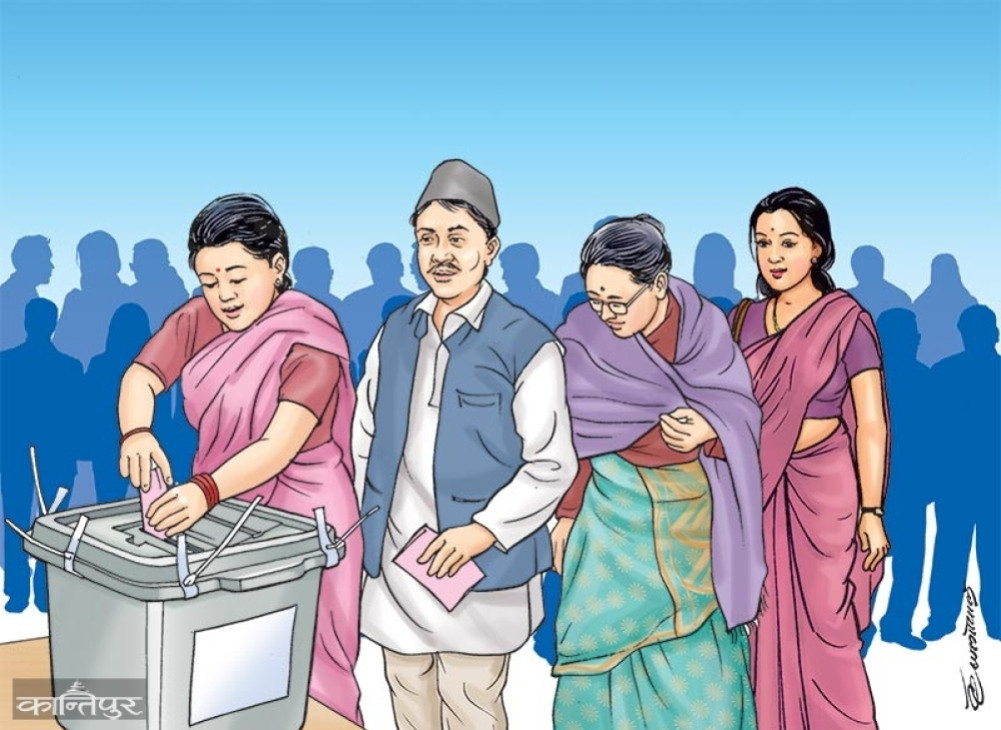
Those who are accused of corruption, who have not fulfilled their official responsibilities, who have left the promises they made in the previous elections, and who are gangsters cannot carry the agenda of good governance. They do not even have the strength to advocate for it. Even now, giving tickets to such people is to devalue the spirit and message of the Gen-G movement.
We use Google Cloud Translation Services. Google requires we provide the following disclaimer relating to use of this service:
This service may contain translations powered by Google. Google disclaims all warranties related to the translations, expressed or implied, including any warranties of accuracy, reliability, and any implied warranties of merchantability, fitness for a particular purpose, and noninfringement.
The parties are in the final stages of finalizing their direct candidates for the February 21 election. With the filing of candidacies for 165 seats from Tuesday to Thursday, the election atmosphere will heat up even more, and the election wave will spread to the constituencies. Since the election is being held against a specific backdrop, citizens are interested in the candidates that the parties will put forward.
Therefore, it is important for parties to understand the current special times and to be careful about whether they can carry the agenda it demands. There is a mixed response to the candidates finalized by the parties for some constituencies. Parties should be serious about this too.
If the parties give priority to new faces with a clean image, committed to democratic values, who have done justice to the positions they have held in the past, and who have potential, it will make the election healthy and transform it into a beautiful opportunity to exercise the sovereignty of the citizens.
The parties have already submitted the closed list for proportional representation on 13-14 Poush. At that time, there was a lot of criticism of the names on the list submitted by the parties. It was criticized that only old people, who have been MPs and ministers many times, who have been given opportunities by working in various bodies, who have been successful in their profession and have earned social capital and prestige, and who are financially and socially strong, were included in the closed list.
Not only old political parties but also so-called new parties submitted such lists. The perception was that all parties, old or new, were the same because of the priorities given in the list. Parties have an opportunity to correct their weaknesses at that time. If candidates are decided through democratic practices with clear methods and collective decisions within the party, improvements can be made. Party affiliation towards such candidates will also increase.
When parties nominate leaders who are gangsters, accused in various cases, who have failed to play a legislative role despite winning elections repeatedly, and who have misused the influence of their political positions, the enthusiasm for elections among the people is lost. The affiliation is low. An election without the enthusiasm and active participation of the people becomes just a technical program of democracy. Such elections only run politics, but do not increase the hopes of the people.
Therefore, parties should stay away from tainted ones. They should stay away from those who try to display extreme opportunistic character by changing parties just for the sake of tickets. They should stay away from those who do not have political issues but want to win elections under the guise of 'money' and 'muscle'. If political figures who have political issues, are clear in their ideas and principles, and are interested in policy and law-making get tickets, the upcoming parliament will be particularly strong as a legislature. People-friendly laws will be made. Monitoring of the government will also be strong.
Another aspect that parties should take into account is commitment to the provisions of the constitution and the democratic process. Federalism, republicanism, secularism, and proportional inclusion are the main pillars of the current constitution. If parties that agree with the constitution nominate people committed to these as candidates, the current system will be strong. On the other hand, there are political parties and individuals in society who disagree with the basic provisions of the constitution.
They will also participate in the elections. They should also have a strong presence in the federal parliament and believe that they can make the changes they want through the constitutional process. For that, those parties can adopt the formula of 'improving the constitution as they want through the constitutional process'. They can appeal to the people. If there is clarity about political issues and commitment to the democratic process, there will be transparent competition in politics.
Similarly, understanding the essence of the Gen-G movement is another indispensable issue. The Gen-G movement of 23 and 24 Bhadra has set the current political course. There are some fundamental issues of this movement. The movement has sought issues such as good governance, policy clarity, and political responsibility for the new generation. For this, the parties have two types of responsibilities. First, the candidate himself should be able to be selected in such a way that the people believe that he will be a warrior of good governance.
Those accused of corruption, those who have not fulfilled their official responsibilities, those who have left the promises made in the previous elections, and those who are gangsters cannot carry the agenda of good governance. They do not even have the ability to advocate for it. Even now, giving tickets to such people is to devalue the spirit and message of the Gen-G movement. In this context, the role of civil society is expected. They should monitor and warn the parties. If the parties send candidates indiscriminately by force, the people have the right to respond through their franchise.