From the perspective of good governance, the assumptions and strategies we have adopted so far have completely failed. The need of the hour is to analyze the theoretical and structural aspects of those failures and chart a new path.
We use Google Cloud Translation Services. Google requires we provide the following disclaimer relating to use of this service:
This service may contain translations powered by Google. Google disclaims all warranties related to the translations, expressed or implied, including any warranties of accuracy, reliability, and any implied warranties of merchantability, fitness for a particular purpose, and noninfringement.
Nepali political complexity has many dimensions. But now, the issue of good governance has become more prominent. In the form in which this issue has become prominent, it has not been able to have a deep and constructive discussion. Like many other slogans, this too has become just a slogan.
Forty years ago, the British introduced a concept – good governance means transparency, accountability, responsibility and participatory decision-making. This concept has been worked on a little bit globally. But when it came to Nepal, this concept only brought up the issue of financial transparency.
It is not that other issues were not raised. But all this process was made very technical. Its theoretical depth was not assimilated. Income and expenditure statements were posted and public hearings were held, that too technically. As a result, we did not add new dimensions to good governance. Our 30 years were spent in showing off and avoiding weeds.
Second-generation issues in good governance
Without addressing the first-level issues of good governance, we have come to the second-level challenges. Now, policy transparency has been interpreted as a major dimension of good governance globally. Policy transparency means providing a space for those who are affected by that policy to express their views and discuss them in a policy-based manner.
The second step is to move forward the policy-making process based on his words and by internalizing the perspective. But today, policy openness is considered a hassle, from small community groups to local governments to the federal government. Not only is it a hassle, but it is also said that ‘they don’t know’ to involve the authorities. When making forest policies, those who cut firewood in the forest are not given space.
It is said that it is not their job. First, policies are imported. Along with foreign donations, grants and loans, policies have been exported from outside and we have imported them. The space left by exports and imports has been taken by the bureaucracy and close intermediaries of the leaders. In this sense, the people are completely excluded from policy-making. The ‘signboard’ of participatory democracy has been put up by keeping the people out.
Corruption, good governance and citizen campaigns
Since we are plagued by corruption, we have placed corruption at the center of good governance. This is natural. But how can corruption be reduced when state institutions are in shambles? The Commission for the Investigation of Abuse of Authority or the Money Laundering Commission are like class organizations of the party. Soldiers loyal to the party and the leader have been appointed there. The parliament itself is not like the parliament.
It has become a place for insulting, overthrowing and forming the government. In such a situation, there is a need for loyal citizens. Who can socially boycott the corrupt. Neighbors should not go to the wedding of their children who show off with the money earned through corruption. Are there citizens who say, 'I will not eat a feast' with the money earned through corruption?
If citizens were prepared to lead and participate in the campaign against corruption from the civil level, the corrupt would be eliminated to a certain extent. But we are corrupting society itself. On the contrary, society respects the process through which money is earned.
Now there should be a campaign by parliament, parliamentary committees, state institutions and citizens to stop corruption. Without tough and loyal citizens who do not leave their neighbors without mourning the death of a corrupt person, good governance cannot be maintained by stopping corruption through the rigors of the state machinery. Now, the state has the decisive power in such a way that the corrupt are not even visible. Reversing this process is a political task, not a technical task.
Now, not only in Nepal but globally, the issue of bringing service delivery, policy-level relations, and self-respect to the reach of citizens is under discussion. In Nepal, this issue is extremely serious. Because, here, ordinary citizens cannot receive services at all. We have very little discussion on what policies should be arranged to easily deliver services to the doorsteps of the people.
Discussions that are not linked to policy on service delivery are just talk. For example, citizens are confused about receiving services from rural municipalities or municipalities. One reason is the centralized attitude of the employees, which has not been able to smooth the relationship between the state and citizens. Second, if the rights were slightly decentralized and taken to the wards, it would be easier for citizens, but there is no discussion about it. Within this structure and policy, the hassles in service delivery cannot be reduced.
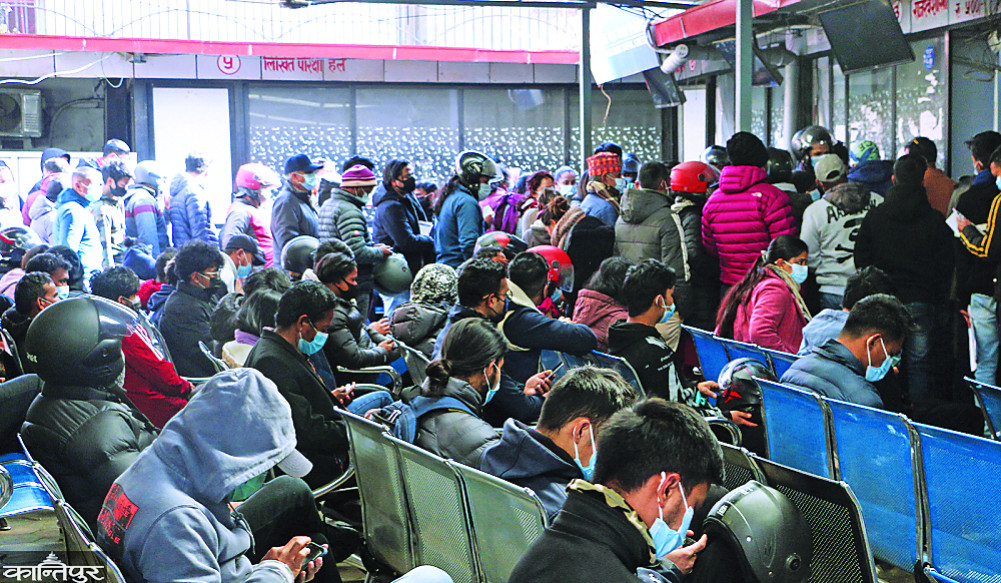
Now, services have become more complicated, and people have to feel that their self-respect has been hurt when they go to get services. Citizens should receive services with less hassle and with less self-respect. Otherwise, how will a so-called Dalit go to get services these days? How will they be treated if a tribal goes? How will they be treated if a person goes wearing torn clothes? What is the difference between a woman and a man? The main question is this.
People have lost self-respect in service delivery. During a research I conducted myself, I asked a mayor's private secretary - what percentage of citizens who come to the metropolis get angry and what percentage think they have lost self-respect? His simple answer was, '90 percent get angry and think they have lost self-respect. Because they have no one to talk to and no one to facilitate their work.'
If the metropolis, which is the closest government to the citizens as a local government, is in this condition, what will be the situation of federal offices? For a common man, going to a government office means being humiliated. The Nepali state apparatus has not yet assimilated the diversity and diversity-based psychology of Nepali society. That is why the character of the state has not changed even after major movements.
Multidimensionality of good governance
It is necessary to understand good governance in a broader sense. Good governance in schools means good education. Transparency of income and expenditure alone is not enough. Good governance in health posts means that patients get good health care. All the rest are technical aspects. In the case of agriculture, good governance is when the state protects small and medium farmers and increases production. But today, serious work has not been done in these and other areas.
Now, if we want to talk about good governance, we must question the entire governance system. Governance management and the way it is done must be changed. Taking the example of education, the current governance management is not suitable. There is a situation where many teachers do not even have to teach. It is our political parties that create a situation where teachers can get jobs without teaching.
Power should be distributed from the perspective of federalism. The local government should be made responsible to some extent in education. Those whose children have studied in that school. They are represented by the school management committee.
Parental ownership should be increased through the ownership of the school management committee. When discussing an important aspect of good governance from the perspective of federalism, all three levels of government should dance in their own backyards. The federal government should not dance in the backyards of the provincial government and local governments because it is bigger.
Everyone now knows that the subsidies given to agriculture are not received by the real farmers working in the fields. It is also known that the real farmers have not received them for a very long time. But there is little discussion about how they will receive them now.
There is an easy way, the local government will adopt a policy of classifying farmers and giving subsidies only to small and medium farmers. A policy of not giving subsidies to those whose families have government employees, teachers, army, and police. This policy is not difficult to make. It is not difficult to implement it after making the policy. But we have not been able to understand good governance in a broad sense.
Development, good governance and community
In Nepal, the development sector needs good governance the most. We have set aside the questions of what kind of development for whom, what kind of development in what place, and how development should be done. We have excluded the local context of what kind of development creates employment in what place.
We have made a universal definition of development. As a result, the local community has not been able to participate in the debate on development. Development has been imposed or pushed on it. Which has not been able to harmonize the community and development. Priorities have not been met. Now the issue of development must be churned out in terms of community spirit, community perspective, available natural resources, and local culture. Community leadership must be established in this churning. Only then will good governance be integrated into development.
To chart the path of good governance sought by the Gen-G rebellion on 23 and 24 Bhadra, we must restructure our state apparatus along with thematic issues. From the perspective of good governance, the assumptions and strategies we have adopted so far have completely failed. The need of the hour is to analyze the theoretical and structural aspects of those failures and chart a new path.
Governance behavior and arrogance cannot be changed by slogans alone. For this, appropriate beliefs, strategies, structures, and human resource management as per the needs should be implemented. When we talk about human resources, the issue of personnel management comes to mind in Nepal. For example, until the union sends employees to the local government, it is not accountable to the local government. That is why new management is needed.
The issue of sending employees from top to bottom is a continuation of the concept of collecting taxes from below and submitting them to the palace during the Rana period. In India, the East India Company used to send employees to the bottom to collect taxes. We have continued such colonial thinking in the federal system.
Changing governance behavior based on the foundation and dimensions of good governance is the main issue today. For this, the governance arrangement itself must be questioned and it is necessary to manage a new governance arrangement. This is the need of the hour.