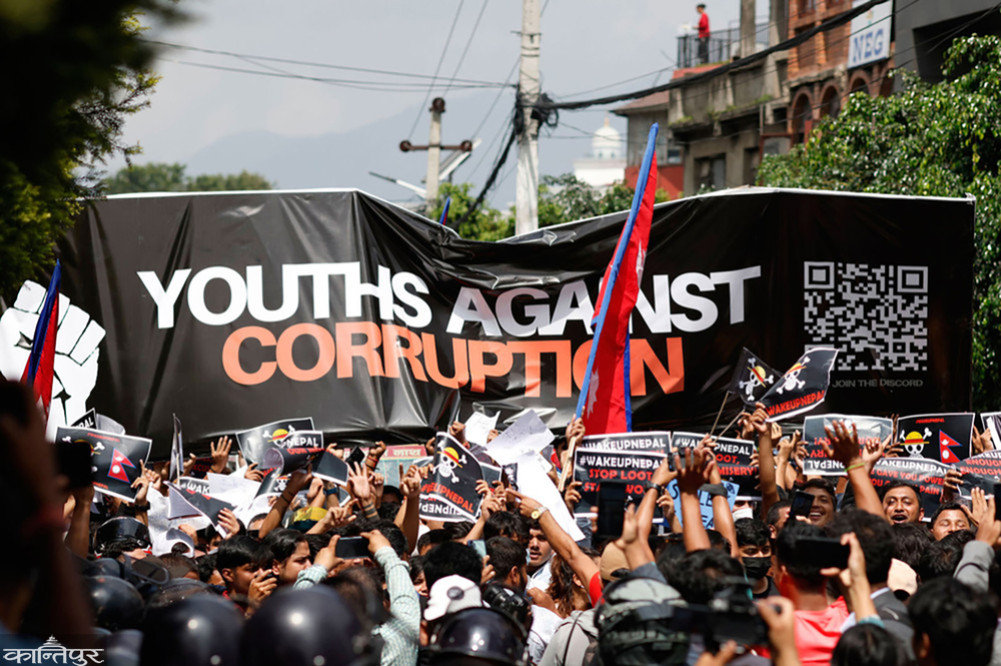
Today's crisis is not in the behavior of the youth. It is a crisis in the philosophy of leadership.
We use Google Cloud Translation Services. Google requires we provide the following disclaimer relating to use of this service:
This service may contain translations powered by Google. Google disclaims all warranties related to the translations, expressed or implied, including any warranties of accuracy, reliability, and any implied warranties of merchantability, fitness for a particular purpose, and noninfringement.
A silent but profound change is taking place across the world. This change is not confined to the borders of any one country, nor is it just a trend on social media. This change is beginning to be seen in people's minds, families, campus alleys, workplace meetings, and street signs.
The culture of unquestioning obedience, long considered natural and inevitable, is gradually eroding. The climate marches on the streets of Europe, the student protests on American universities and campuses, and the youth campaigns against corruption, inequality, and exclusion in South Asia all have one deep meaning: the old leadership styles no longer work. Today’s youth are asking questions we never asked before – why this system? Why this injustice? Why this distance? And why are we not being heard?
Gen X is often portrayed as impatient, rebellious, or overly idealistic, but that picture is incomplete. In reality, this generation is not against leadership. Rather, it is rejecting leadership that is distancing, controlling, exploitative, and morally hollow. This is not a generational impulse – it is a human awakening that is forcing a global redefinition of both the language and behavior of leadership.
Gen-G is a generation that grew up in an era of crisis. The news of climate change frightened them, the pandemic disrupted their studies and dreams, the scenes of war hardened their hearts, and economic uncertainty soured conversations at home. This generation saw the crises that previous generations had read about in the pages of history firsthand on their mobile screens. They experienced how states, markets, and institutions that promised stability and security repeatedly delivered only insecurity. They saw that while talking about sustainability, workers are exploited, conflict is exploited in the name of peace, and power is concentrated in a limited group while talking about inclusion. Therefore, today, age, position, and status alone cannot be the basis for the legitimacy of leadership. This generation demands purpose, empathy, transparency, and accountability from leadership. They are ready to obey, but only from leadership that puts human dignity, social justice, and responsibility for the future at the center. They need ‘meaning’, not ‘strong hands’, ‘open minds’, not ‘orders’.
This is why the movements led by Gen-G seem different in form and spirit from the movements of previous generations. These movements are centerless, value-based, emotionally aware and guided by a deep moral consciousness. They are not limited to the question of ‘who is in power?’ Their core question is – ‘why are they in power and for whom is that power being used?’ This question has forced not only the state, but also the private sector, corporate institutions, universities and social structures to do deep introspection. This is not a sign of rebellion, it is a sign of institutional health. Where questions stop being raised, there collapse begins. The voices of Gen-G are not invitations to chaos, they are warnings for system reform. If they are heard in time, reform is possible. More importantly, their dissent often comes from a heart that wants to ‘build’, not ‘destroy’. They say – we do not have power, but we have the courage to speak the truth. We do not have positions, but we are concerned about the future.
The same picture is even more stark in the Nepali context. Nepal’s Gen-G is not isolated from the global trend. Nepali youth are becoming more organized and vocal, demanding corruption, lack of good governance, job insecurity, migration, climate justice, and respectful treatment in educational institutions. What sets them apart from previous generations is not anger, but clarity and awareness. They question not just individuals, but structures. They go beyond policy weaknesses to point out structural inequalities. But the deeply rooted leadership culture in South Asia still associates authority with control and seniority with intelligence. In the workplace, universities, political parties and social organizations, young people are facing leadership that does not listen to them, controls them, guides them, and imposes discipline. When repression replaces dialogue, then resistance becomes inevitable. In Nepal, this resistance is sometimes seen in the debate on ‘campus politics’, sometimes in the demand for ‘employment’, sometimes in the reform of ‘public services’, and sometimes in the intense question-and-answer sessions on social media. To dismiss this as the ‘stubbornness’ of the youth is to turn a blind eye to institutional reality. Because today’s youth are not only concerned about their future, but also about the future of their parents, their communities and the country. It is easy to laugh at them and say ‘they don’t know’, but listening to their questions is difficult, although necessary.
From here, the basic truth becomes clear – today’s crisis is not in the behavior of the youth. It is a crisis in the philosophy of the leadership. For decades, command, control, efficiency, and obedience have been the highest values in politics, the corporate sector, and institutional leadership. While this has yielded some results in the short term, it has led to burnout, inequality, environmental destruction, and human alienation in the long term. Increasing mental health crises in the workplace, deepening despair among young people, and declining trust in organizations are all consequences. When organizations treat people as mere ‘production units’ or ‘disciplined resources,’ creativity dies and commitment weakens. Gen-G is not looking for perfection in leaders. They are looking for humanity, honesty, and accountability. This is where transformational and servant leadership emerge from academic concepts and become practical and ethical imperatives.
The essence of transformational leadership is simple – a leader is not a ‘status quo’ but a ‘vision builder.’ Such leadership elevates the organization above short-term gain, popularity, or the balance of power and orients it toward a common purpose. The essence of transformational leadership is simple – a leader is not a ‘status quo’ but a ‘vision builder’. Such leadership elevates an organization towards a shared purpose beyond short-term gain, popularity or the balance of power. In a world ravaged by climate change, rapid technological development, migration, unemployment, inequality and misinformation, transformational leadership envisions a shared future, where development is measured not only in terms of profit but also in the coexistence of humans and nature. Gen Z is looking for a similar vision. They want meaning, not order. They want participation, not control. They seek answers to the question of ‘why’ rather than ‘what’. Transformational leadership addresses this expectation because it makes young people partners in change, not followers who follow orders. When young people say ‘involve us in the decision-making’, it is not a desire to take power, but a desire to share responsibility.
In today's organizations, whether in government or the private sector, the view that youth are only seen as a 'workforce' is still strong . But Gen-G wants to tie their time, talent and energy to a 'purpose' . They should be seen not only in the company's vision poster, but also in decisions and policies . Transparent progress, fair opportunities, environmental responsibility and social impact - without these, their commitment will not be long-term . Transformational leadership understands this psychology of youth and connects 'work' with meaning and 'goals' with value . As a result, the organization becomes a place of 'trust and shared identity', not just a production center . Where employees feel 'I am heard' and citizens begin to trust that 'this organization is ours' .
Similarly, servant leadership is an effective remedy for the increasing polarization, hatred and distrust in today's world . Servant leadership puts responsibility at the center of leadership, not a show of power . It protects the weak, prioritizes dialogue, and connects policy from paper to people's lives. When leadership's ability to 'listen' is weak, people are forced to 'scream'. Servant leadership bridges this gap - between managers and employees, between government and citizens, between teachers and students, between leaders and the people. Gen-G sees actions more than words, so only honest practice, not showy speeches, can win their trust. Servant leadership not only builds bridges of trust, it revives the moral foundation of the organization, where leadership does not mean 'authority', but 'service'.
Today's world stands at a stage of multifaceted crisis - where war is not only born from the use of weapons, but also from inequality, exclusion, climate injustice, and institutional distrust. In such a situation, peace is not achieved by signing an agreement, peace is possible when leadership puts people's dignity, voice, and opportunity at the center. Peace is not just a state where conflict has stopped, it is a state where justice has been done, opportunities have opened up and citizens are able to trust their future. Sustainability is also not just an environmental program, it is economic, social and emotional sustainability. Where institutions and society move people forward not by ‘spending’ but by developing ‘potential’. Transformational leadership shows the way to the future. Servant leadership keeps people safe, respected and involved on that path. For both peace and sustainability, these two leadership styles are not ‘optional’ today, but ‘essential’.
First, youth should be accepted as ‘policy partners’ and not ‘problems’. Second, the basis for leadership selection and promotion should not be seniority alone, but ability, ethics, public accountability and vision. Third, institutions should create a regular framework for dialogue. Where criticism should not be suppression, but rather a support for reform. Now the question arises – what should Nepal’s political parties, government agencies, universities, banks, industry, media and civil society do? First, youth should be accepted as ‘policy partners’ and not ‘problems’. Second, leadership selection and promotion should be based not only on seniority, but also on ability, ethics, public accountability and vision. Third, institutions should create a regular framework for dialogue. Where criticism should not be suppressed, but rather nurture reform. Fourth, mental health, work-life balance, fair opportunities and a safe work culture should be established as ‘rights’ and not ‘grace’. Fifth, climate and sustainability should be taken from ceremonial speeches to policy, budget and practice. Such reforms are not necessary to ‘please the youth’, but to save institutions and sustain society.
Ultimately, the choice before today’s leaders is clear. They can either face continued resistance by clinging to power or gain legitimacy by sharing power. They can see opposition as disorder or as a symptom of a disease and seek treatment. They can lead from above or walk alongside the youth. Transformational and servant leadership are not weak options. These are bold and visionary options, options that call for humility in a world full of ego and empathy in a system built on distance. Gen Z is not waiting for permission, they are creating the future. The question now is – are today’s leaders ready to walk with them, or will history leave them behind?