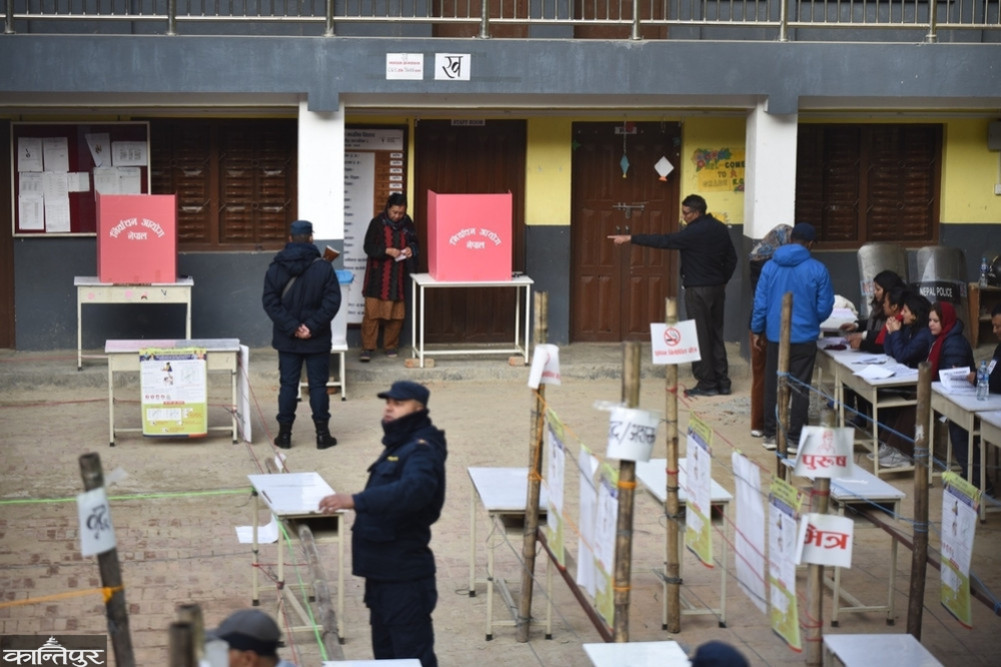
If newly registered parties, in particular, prioritize this issue and ensure that fifty percent of women are included in their candidacies, women's representation in parliament through direct elections will definitely increase in the upcoming elections.
We use Google Cloud Translation Services. Google requires we provide the following disclaimer relating to use of this service:
This service may contain translations powered by Google. Google disclaims all warranties related to the translations, expressed or implied, including any warranties of accuracy, reliability, and any implied warranties of merchantability, fitness for a particular purpose, and noninfringement.
The date of the election to the House of Representatives is approaching. In this context, the Election Commission has issued a revised directive, revoking the Proportional Election Directive for Members of the House of Representatives, 2079 BS.
Earlier, the Commission had prepared a draft unified election law by incorporating seven different laws related to election conduct and management. The proposed draft bill is very important for amending and unifying the laws related to election conduct and management to manage the elections in a clean, free, impartial, credible, participatory, accessible and transparent manner.
The proposed draft bill included important and positive reforms for democracy, electoral practice, and political representation of women, Dalits and marginalized communities. However, they were not complete. In the changed situation after the Gen-G movement, many issues have come to the fore in addition to those proposed in the draft, which do not seem possible to implement in practice unless the law itself is improved.
With the election of the House of Representatives approaching and the closed list for proportional representation has been submitted, it may not be possible to bring all the reforms by bringing a turbulent law, but they can be improved through practice. For that, the initiative of the Election Commission, the honesty of the parties and the vigilance of the citizens are necessary.
Fifty percent female candidacy in direct elections
Although the Commission has stated through the guidelines that fifty percent of women should be submitted for proportional representation, it has not made this provision for direct elections. Due to this, women are once again deprived of participating in the practice of direct elections in large numbers. In the 2079 elections to the House of Representatives and Provincial Assembly, only 9.3 percent of women were candidates for direct elections in the House of Representatives and 8.7 percent for the Provincial Assembly.
Of those elected, only 5.5 percent were women in the House of Representatives and 4.2 percent in the Provincial Assembly. It is not surprising that the percentage of elected candidates has decreased after the parties were deprived of the right to submit candidacies. To improve this, the candidacy itself must be ensured. The interconnectedness and inclusiveness of women within that candidacy must also be taken into account.
If political parties, especially the newly registered parties, prioritize this issue and ensure fifty percent of women in their candidacies, then women's representation in parliament through direct elections will definitely increase in the upcoming elections.
The same provision should also be applicable to Dalits, indigenous people, minorities, Muslims, people with disabilities, and gender and sexual minority communities. However, for this to happen, inclusiveness and equality must be practiced within political parties, which does not look positive if we look at the current presence of women and marginalized people at the leadership level within the party itself. In the changed context, all parties need to take responsible and timely conscious decisions to ensure the essence of inclusiveness.
Ensuring the right to vote
A large part of the country's population is abroad. While the number of Nepalis scattered in more than a hundred countries around the world is two million according to government statistics, the number not included in the statistics is much larger. It is the right of citizens to participate in the democratic process of the country as citizens, regardless of where they are in the world. The responsibility of how to ensure this right lies with the state.
In this era of technology, maintaining the traditional idea that voting requires going to one's birthplace and assuming that out-of-country or out-of-district voting is not possible is an attempt to avoid the consequences that may come from it.
A study conducted by the Nepal Policy Institute has shown that this process is certainly costly and challenging, but not impossible. The study has also proposed three different processes as alternatives for this, which also estimate the time and cost required for preparation. Therefore, rather than delaying it, it would be better for the government to move forward the process quickly, considering the advice and practices of national and international experts.
Ensuring the right to vote not only for those outside the country but also for citizens living outside the district within the country is an even more important issue. The system of having to go to the district to cast votes has not only deprived many of the right to vote, but has also encouraged vote buying, unnecessary spending, and non-transparent election spending. This is laying the foundation for corruption.
Therefore, for good governance, it is necessary to protect the right of citizens outside the district and outside the country to cast their votes. This provision, which the Supreme Court had already ordered to make a law in 2018, must be followed in the upcoming elections. In addition, if the voter does not like any candidate, the right to vote “None of the Above” (NOTA) should also be protected.
Election expenses, deposits and silence period
Elections are an expensive process. A person participating in the elections has to prepare not only mentally but also financially. Looking at the economic activities in past elections, it seems impossible for marginalized and women to participate in elections.
If election expenses cannot be reduced and legal limitations are not set, the past situation will not change. As mentioned in the Gender and Inclusion Policy in Election Management, 2077, the principle of positive discrimination in election expenses should be adopted to ensure that women and inclusive
It may be easier for the community if the state fund is provided to the group for election expenses and a system is ensured for using state resources during election campaigning. Continuous debate is expected on this.
A person who wants to be a candidate in the election has to pay a deposit to register his candidacy. When the deposit amount is large, many people drop out of the first stage of the process. In the past, the amount was doubled in the unified draft prepared by the Election Commission. Doing this means that the state appears insensitive towards women and the marginalized. The deposit amount should be made free for specific individuals or communities, which facilitates ensuring participation and representation.
If we look at the experiences of elections, it is found that the buying and selling of votes and the influence of votes are highest during the silent period. Although direct campaigning is not allowed during the silent period, there is a practice of using that period to influence the election process by circumventing surveillance and monitoring, negatively impacting and discouraging women and candidates from marginalized communities. The current 48-hour silence period should be reduced to 12 hours.
Provisions for disqualification from running for election
The Election Commission's guidelines include disqualification from running for election for criminal offenses (such as human trafficking and smuggling, corruption, rape), individuals convicted of organized crimes, and those sentenced to less than twenty years in prison for crimes related to caste discrimination and untouchability, boxing or polygamy, and three years have not yet passed since the date of serving the sentence.
However, research shows that in a society like ours, the number of sexual violence cases that go to court is five percent. Cases like caste discrimination, domestic violence, and polygamy reach the court as exceptions. Even the cases that do reach the court are rarely decided in favor of the victim, and the guilty are punished.
Since the majority of perpetrators are people in or near the center of power, authority, and politics, setting the disqualification criteria only on the basis of having been convicted or sentenced means allowing those involved in such crimes to participate in the elections. Therefore, not only those who have been proven and found guilty by any court of child abuse, child sexual exploitation, use of child labor, domestic violence, sexual violence, gender violence, labor exploitation, and polygamy, but also those who are accused and have a case registered with the police or court, should be made the basis for the disqualification criteria.
Character abuse, misogynistic expressions, and misleading news during elections
Research has shown that digital or personal violence against women and marginalized candidates increases during elections. Since it is established as an election offense that character abuse should not be committed or caused to be committed in any way during election campaigning, it is necessary to define what is included in ‘character abuse’.
Such actions not only reduce their motivation to participate in the elections but also cause them physical and mental trauma, the effects of which can last for a long time. It is important to address the misogynistic statements, propaganda of character assassination materials, false and misleading information, comments based on gender, sexuality, ethnicity, and the crime of defaming an election candidate to influence the election results.
The Election Code of Conduct, 2078 BS, prohibits such acts and also provides for the possibility of filing a complaint. However, it is not clear what kind of punishment will be imposed after this complaint. Elections are a special time, and there should be a separate legal mechanism to immediately address violence during such times. Going through the regular legal process is not practical and fair.
Finally, corruption, entrenched social structures, gender discrimination, caste discrimination, class differences, harmful social values and thinking, gender-based violence, low presence of women, Dalits, and marginalized communities in the decision-making levels of politics, lack of institutional efforts for gender and inclusion in the election management process, have not resulted in the expected participation of women, Dalits, marginalized and minority groups in elections.
But in the upcoming elections, efforts and initiatives should be taken from all sides to improve this situation. There is a clear need for reform in the electoral law itself to establish a responsible and accountable governance system based on gender equality and social justice. Elections are the only means to institutionalize change and make it felt in the lives of citizens. Therefore, it should be the first duty of the current government to reform the electoral system and embody the rights and changes desired by the youth.