Today, there is no problem for anyone to take their expression or action to a large group, although since not all expressions or actions reach a large group, some people are eager to speak harshly and express distorted actions and reactions out of a desire to gain attention.
We use Google Cloud Translation Services. Google requires we provide the following disclaimer relating to use of this service:
This service may contain translations powered by Google. Google disclaims all warranties related to the translations, expressed or implied, including any warranties of accuracy, reliability, and any implied warranties of merchantability, fitness for a particular purpose, and noninfringement.
52 years ago, Dhami-Jhakris were trained under the government's guidance. 17 Dhami-Jhakris participated in the training conducted by the Panchayat Leading Training Center-Nepalgunj from 2029 Asoj 8 to 20.
The Dhami-Jhankri participants in the training were asked, ‘What do you think is the cause of disease?’ Before the training, five out of 16 people answered that it was ghosts, three people answered that it was germs, and eight people answered that it was both ghosts and germs. When asked the same question after the training, three out of 17 people answered that it was ghosts, five people answered that it was germs, and nine people answered that it was both ghosts and germs.
After the training, a booklet titled ‘Attitudes of Dhami-Jhankris: A Study’ was also published. According to the booklet prepared by Tirtha Prasad Gyawali and Rameshwor Mahato, the program was organized with the aim of instilling faith in modern healthcare among the villagers, considering the special influence of Dhami-Jhankris on them.
35 Dhami-Jhakris from the five zones of the then Far Western Region were invited to take the training, but some Dhami-Jhakris did not participate in the training for fear of being cut off.
33 years later (in Ashar 2063), the National Health Training Center, Teku, conducted a similar program. According to the ‘Orientation Training Manual for Dhami-Jhakris on Essential Health Services’ (2065, First Edition: 2063) published by the center, it was estimated that there were around 600 to 800 Dhami-Jhakris and traditional healers or herbalists across the country at that time. The manual states that the orientation program was conducted with the aim of making Dhami-Jhakris working as health workers in various communities aware of the main elements of essential health services.
The booklet mentions 10 sessions of about one hour each – safe motherhood, newborn care, safe abortion, family planning, sexually transmitted diseases and HIV/AIDS, environmental health, etc. Recently, the center has stopped training the Dhami-Jhankris. In this regard, the center’s information officer, Vijay Shrestha, told me on mobile on December 21, ‘The center does not conduct such programs now. I was not aware that the center conducted such programs before.’
Dhami-Jhankris use herbs and magic to influence the mental state of the patient, that is, to treat him psychologically. ‘You were possessed by a ghost, I drove it away, now you will be cured, eat this Akshata, eat this medicine,’ and a patient could be cured by the Dhami-Jhankri. If someone was mentally and physically ill due to many things playing in their mind due to illiteracy, insecurity, insecure future, inequality, etc., then a religious or religious person could or could be a means of providing self-strength for them.
Society itself also provides the basis for people to play many things in their mind. In a backward society, the oppression and exploitation of the rulers and upper classes, many stories of superstition, many information coming from the powerful classes (such as: the country will be eaten by another big country. Your citizenship or red certificate will not be made, the government has brought or is bringing laws and programs that will make you uncomfortable, etc.), etc., affect the lower classes of society, the uneducated and young children more. Such a situation was more during the Rana period and the Panchayat period, and it is still the case in remote villages.
Generally, people are affected by information and messages. If a person living in a normal situation is given any positive or negative information or message, he can immediately become happy or sad. In today's era of social media, let's say in the era of reels and shorts, there is a flood of positive or negative information and messages. However, there is rarely any debate and training among us regarding how to give and receive information or messages related to what or what.
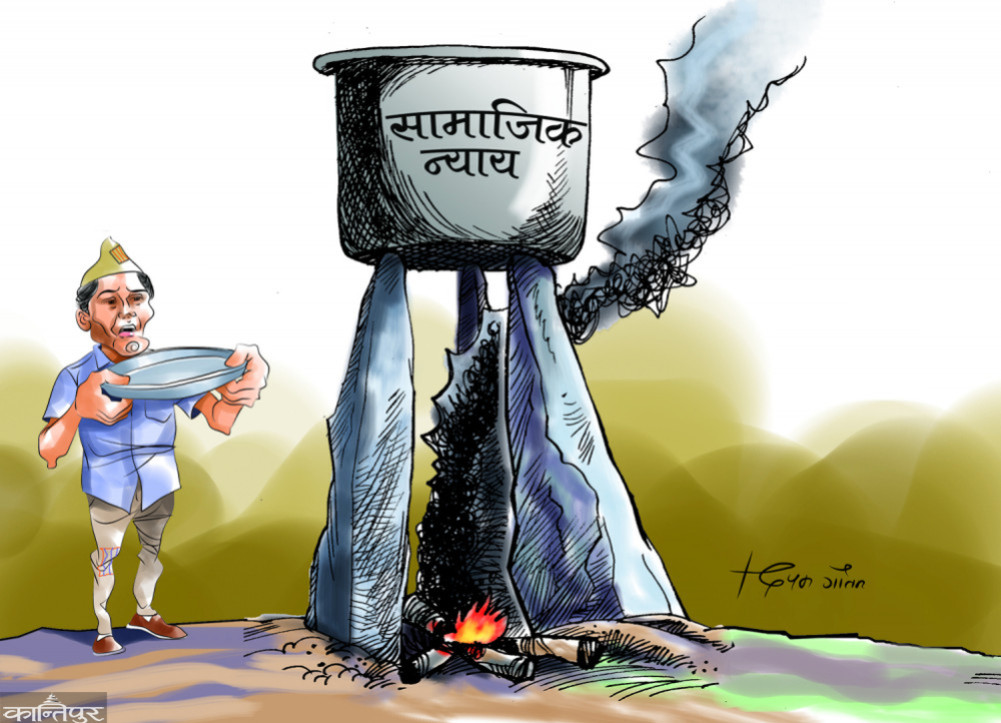
Just as the Panchayat government yesterday brought a program to make Dhami-Jhakri a medium for practicing modern treatment methods, today a handbook and related training or classes seem necessary to explain social justice. This is the purpose of this article, even though the introduction is long.
In this era of social media, it does not take time for a section of Nepali society to take sides or oppose any social and political event or action in response to it. No matter how serious the event or issue, that section seems accustomed to giving light reactions on social media.
Today, some of the mainstream media in the country, social media and society as a whole are seen chasing after any social (including political) event or expression related to it. Most ‘online news portals’ are busy creating 10 news stories when a famous leader or person speaks for 20 minutes. Even a Facebook status of a famous person becomes news.
Recently (28 Mangsir) ‘Media Advocacy Group’ (MAG) held a discussion on ‘Gender Responsibility Media Commitment Targeting Women Politicians’ among various journalists. ‘MAG’ has been discussing with various parties at various stages regarding what should be done when publishing or broadcasting news about women politicians, but what is happening. Suggestions from various previous discussions were also presented there. Among them, one suggestion is particularly noteworthy – conduct internal orientation and training on gender-sensitive and responsible journalism within the media from time to time, targeting journalists, editors and program producers.
While speaking at the program, I also suggested – journalists and public representatives who receive government salaries and benefits should be trained on social justice. For now, it is especially necessary to provide training to explain the 31 articles under the fundamental rights provided by our constitution. At least if this is possible, a responsible party will be more responsible when writing, speaking or giving information.
Today, there is no problem for anyone to take their expression or action to a large group, although since not all expressions or actions reach a large group, some people seem to be eager to speak harshly and express distorted actions and reactions out of a desire to get attention. It has become common for us to have fabricated opinions about a class, community, gender, region, etc. through some commercial media and social media.
Materials that affect child psychology in the long term, increase ethnic or caste-ethnic pride or inferiority, insult other religious or cultural communities, promote violence against women, and cause religious or political conflict are all over social media today.
Moreover, nowadays, the act of showing someone's poverty or physical and mental condition to seek help is also increasing. It is not appropriate to ask for help by showing videos, photos and real identities of especially poor and helpless children. In some cases, photos, videos and news of parents can also affect children mentally. Since such content remains on the internet, it can continue to fester their mental wounds. While writing this article, I spoke to psychologist Dr. Karuna Kunwar on my mobile phone. His reply was, ‘Of course, such things affect the mentality of children. Their self-confidence may weaken and they may not be able to open up in society.’
Nowadays, someone’s personal relationship is exposed on YouTube. They do not consider how it will affect them and their children in the future. Showing the government’s activities, corruption, social distortions, crimes of criminals, etc. is good, it certainly takes the state and society forward. However, it is not fair to become a judge and declare someone a criminal.
Nowadays, there has also been an increase in those who express opinions through social media. Freedom of expression is a fundamental human right, but it also has its limits. It does not mean that law is necessary to operate social media. If we look at it within the scope of law, most of us Nepalis today are criminals. There are laws related to violence against women, child violence, untouchability, and corruption, but these violence and discrimination continue to occur in society knowingly or unknowingly. Therefore, it is necessary to spread public awareness.
Well, today, through social media, it has become easy to know the intellectual status, economic status, civilization, and development status of people in society. On the other hand, it has also made us realize that it is necessary to pay attention to social justice while disseminating information or messages. How much a person has read or understood about social justice does not mean as much as what he does not know. No one is exempted from committing a crime just because he does not know the law.
In this context, it is necessary for a journalist, public representative, and government employee to understand the rights and voices of women, children, Dalits, indigenous people, minorities, and lower classes. Today, when we talk about women, we forget Dalits, when we talk about Dalits, we forget tribals and minorities, and when we talk about all of these, we forget children. Therefore, it is necessary to prepare a handbook on social justice and provide training or classes to most of us. If this can be done, it can be hoped that the steps to eliminate distortions and discrimination in society will be a good start.