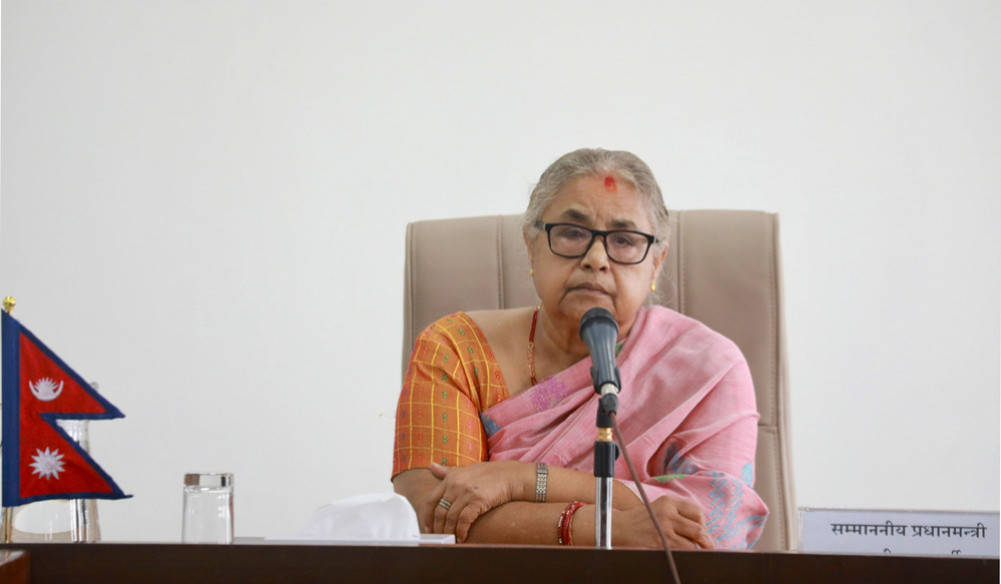
What is the difference between the political and administrative patriarchy that has established itself in the squares and peaks of Singha Durbar and the young people who call Karki 'mother' and sexualize and sexualize her position?
We use Google Cloud Translation Services. Google requires we provide the following disclaimer relating to use of this service:
This service may contain translations powered by Google. Google disclaims all warranties related to the translations, expressed or implied, including any warranties of accuracy, reliability, and any implied warranties of merchantability, fitness for a particular purpose, and noninfringement.
Although I did not know Prime Minister Sushila Karki personally, I met her 36 years ago at the front of the movement to abolish the Panchayat. At that time, I was leading a front of protesters in Kathmandu as the general secretary of the Youth, Medical Students and Nursing Association.
Karki, on the other hand, was leading the agitating legal practitioners in eastern Nepal as an experienced person of the older generation. At that time, when there was no communication and network like now, coordinating the movement was challenging. My second direct meeting with Karki was after Krishna Prasad Bhattarai became the interim Prime Minister after the success of the people's movement.
I remember meeting him at a meeting called by Bhattarai, probably related to the draft constitution, and it ended with a simple conversation. We have not met since then. In the meantime, she has become our ruler as the Prime Minister in the current special situation, having become the Chief Justice. Therefore, we have daily indirect meetings through the relationship between the ruler and the ruled. We can only get information about those in positions of public importance through their actions and expressions.
I see Prime Minister Karki not only because of the limited and periodic role of the Prime Minister, but also as an ordinary citizen with a critical mind. I have also known him as a democratic warrior with political awareness but a product of Nepali society with a less gender-sensitive awareness and probably a corresponding behavior.
I used to follow Karki in his professional role as a combative lawyer, judge, and Chief Justice. However, I disagreed with some of the decisions he made when he led the judiciary. They remain in disagreement to this day. They will always be that way. Behind my calling him a person with low gender sensitivity are some of the decisions he made while in the judiciary. But among the various dimensions of his life, I consider Sushila Karki, the interim Prime Minister of the current difficult environment, more important than Sushila Karki, the lawyer who led a phase of the movement at that time.
As my mentor, the famous sociologist Diane Richardson, said, the merits and demerits of a public figure should not be based on his personal context, but on the basis of the public role he is playing and his consciousness. And those public roles should be viewed in a social context. Which has irrigated the consciousness of the decision-maker and also created intentional behavior.
Karki is grappling with the challenge of bringing the chaotic state administration to a standstill in the role of the interim Prime Minister, who is pressed by the current difficult situation. Therefore, I read, listen to and watch Prime Minister Karki not with tears and pain, but with energy and expectations.
How relevant is it for a person in charge of the state's chief executive to publicly express negative comments? That could be a separate topic of debate. However, we cannot ignore the aspect of why, in what context and under what influence he did so.
In this sense, why did Prime Minister Karki get emotional (saying that everyone had asked for his resignation), why did her eyes water in the eyes of some media outlets? Or did she show tears? This question is important. Because, it is not easy to give a way out to the democracy of the Nepali character, which has been polluted by decades of distorted politics. This is confirmed by her voice of frustration and moments of dignity. And the parties that led the long campaign to democratize the feudal state system, who are also the heroes of political patriarchy, are being further reaffirmed by their latest dishonest behavior.
In the course of three and a half decades of distorted politics, the corruption-like situation has been wrapped like a snake in the veins of society. The syndicate of party, faction, brokerage and familyization has been spread in many forms. Maladministration has flourished in the administrative machinery of the state. It would be an injustice to Prime Minister Karki, who has been brought to the executive responsibility of the country for 6 months with the main responsibility of the election, which is seen as a magic wand to uproot all this, to seek a medicine today and now from both a political and constitutional perspective.
In this sense, Prime Minister Karki is not crying, but rather, relying on the fangs of the distorted challenge, she has warned the political and administrative patriarchy that keeps attacking her momentarily in the premises of Singha Durbar. She is saying - I have come here to face this challenge, I will not run away from the challenge, I am eager to fulfill the responsibility given. She has not mocked public opinion like the rulers before her who were approved by the people. She has not even made fun of power and power outside by hollowing out the state structure from within.
What we need to be clear about is not to exaggerate the work done by the Karki government and say that everything is fine. There is a general expectation that strategically important issues could have been addressed. There is also an expectation that corruption files will be opened and issues of political and administrative misrule will be addressed. But why are those tasks not being done? In this, do the political parties that are not cooperating with him and their party interests, including those occupying the administration, judiciary and other constitutional bodies, play a greater role than the Karki government?
And does some role also belong to some groups of Gen-G who trust him and approve the strategic decision made by the President to lead the government? Who are demanding his resignation from the streets and even from the chowks and peaks of Singha Durbar. Why resign and what is the alternative? Doesn't a few months of time be needed to lay the foundation for addressing the decades-old institutionalized distortions? Karki has been given not even months, but only weeks. And his main task is to defeat the political patriarchy that is watching the government with a smile while pretending to be excluded and hold elections. It can be considered natural for them to feel inferior to the government led by Karki, a non-political person who has been brought to handle the situation that the political parties themselves have created. But it cannot be considered natural for them to pretend not to understand the
‘mandate’ and the limits set by him. And those limits and ‘mandate’ are also reflected in the agreement between Gen-G and the government that was reached some time ago. Isn’t that the roadmap of the Karki government? Do the young people who are committed to reforming politics understand the simple fact that an unelected, short-term, election-focused interim government has the capacity to change the constitution or not, and whether it is allowed to lead the debate towards providing an alternative to the system or not? Here, a strange trend has been seen. One can only hope that they remember the moment when Karki became the government.
Listening to the voices of bewilderment and resentment expressed by Karki, the question arises, what is the difference between the political and administrative patriarchy that has established itself in the squares and peaks of Singha Durbar and the young people who have sexualized and sexualized Karki's official dignity by calling her 'mother'? What kind of culture are we institutionalizing and what do we really want? What kind of good governance do we seek? What kind of situation do we want to establish?
Now let's return to the comments that were tearful, tearful, and emotional. In whatever environment, the roles of the state that an individual receives or is given to him are temporary. But the society we live in is ultimately the same. Although society may be dynamic with the dimension of consciousness, the subtle structures that keep that society alive are the guardians of patriarchy, and are also permanent from many angles.
As another famous sociologist Alan Johnson argues, when analyzing the experiences and expressions of individuals based on gender identity, society analyzes them from the characteristic level of patriarchy in that society, for which he considers three stages as the basis. All three stages speak male-friendly language, convey male ideas, and build ideas centered on male experiences.
A detailed explanation of all three bases may not be relevant here. But this relevant stage is the media, which does not seem anti-women at first glance, when listening to and reading, but plays an important role in creating male-friendly and focused explanations, analysis, arguments, and understanding. Therefore, Johnson further argues that the media is not only primarily responsible for disseminating information, making the general public aware, and building ideas, but is also the guardian of social and earthly patriarchy. Because its main character is a man, and it does not lose anything by remaining male-friendly on the ground.
Johnson's argument is not just a coincidence, but the core character of the Nepali media world. This is an aspect that is widely covered in all types of media, both government and private.
Some media outlets saw Karki crying, understood it and said - the Prime Minister became emotional, cried, his eyes watered, he was shaking, etc. And some exaggerated it even more and gave a sensational message - the Prime Minister's eyes watered, it means the country is in crisis.
This is just an example. Such references are not unrelated to us in the past. Although this applies to all gender-identified people, its volume and depth are greater when women are in charge and they express their feelings in public honestly and without double standards. One can ask, if Sushila Karki were the Prime Minister now, would she have been a man and expressed her frustration in public like Karki? Would she have been emotional? Would her eyes have looked juicy? Or, if she had expressed it, what would have been the society's understanding and media's reaction to it?
This context, which seems normal when listening to it on the radio, watching it on television, and reading it on newspapers and social media, is not so normal when we think about it from the perspective of the patriarchy of our society. The question here is why did Prime Minister Karki have to be emotional, even if he had to cry as some media outlets say, who is putting him in that situation? What is the interest behind it? The media that sees the tears and its readers, listeners, and viewers should all find out? Should we find out whether the media itself has a role in this situation?
Because when we look at the consciousness conveyed by our mass media and the more recent YouTube and podcasts, the messages they convey, the contexts they raise, the topics they choose, and the characters they invite, it is found that protectionist ideas dominate rather than the breakdown of institutional patriarchy. If we think about what topics and ideas are dominating, these questions can be addressed a little.
The problem is not only with the media. To Prime Minister Karki's dismay, the self-proclaimed civic leaders who consider themselves aware, those who hang around Singha Durbar and consider themselves intellectuals, those who wear the turban of subject matter experts, and the leaders who have dragged the country into chaos for decades while earning interest while they are alive, claiming to be leading change, and their evergreen workers who never question them, are also the cause of the problem.
Therefore, the younger generation that has been entrusted with the responsibility of approving him and laying the foundation for addressing corruption, preparing a blueprint for good governance, and handing over that foundation and blueprint to the elected government should be the most careful to understand the essence of Prime Minister Karki's frustration, anguish, and tears, who is trapped in the clutches of the political, administrative, and media-based civil patriarchy. Positive cooperation from the political and administrative levels, the media, and the general public is also necessary. Not a skeptical commentary on tears and emotions.