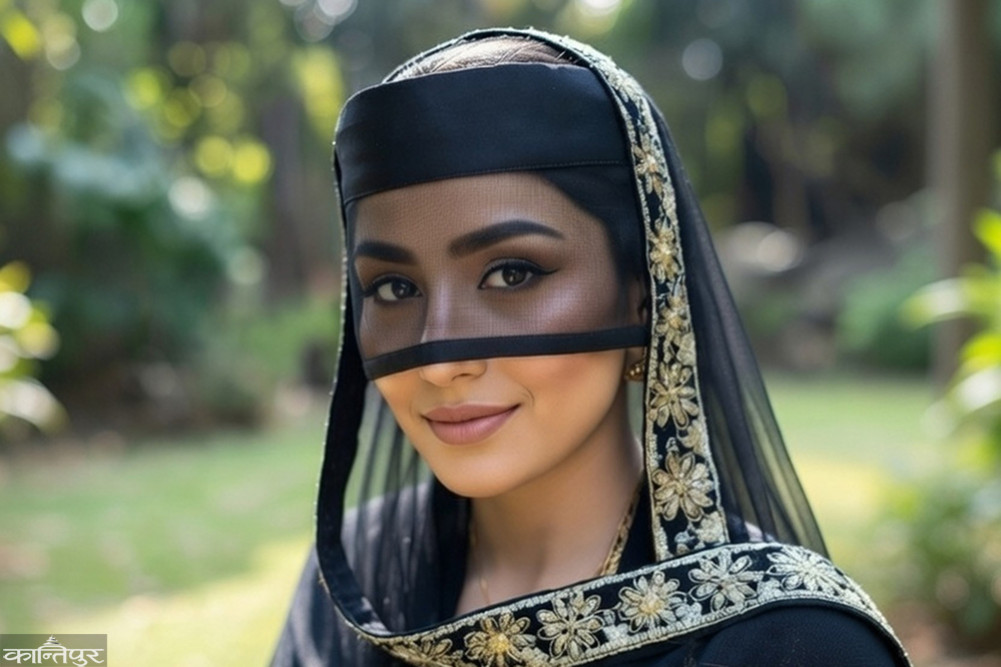
The burqa is not patriarchy, it is faith. For believers, interference with faith is unacceptable. Even if a woman voluntarily wears modern clothing, no one has the right to criticize her.
We use Google Cloud Translation Services. Google requires we provide the following disclaimer relating to use of this service:
This service may contain translations powered by Google. Google disclaims all warranties related to the translations, expressed or implied, including any warranties of accuracy, reliability, and any implied warranties of merchantability, fitness for a particular purpose, and noninfringement.
Recently, Bihar Chief Minister Nitish Kumar removed the niqab from the face of Muslim doctor Nusrat Parveen while giving her appointment letter. And, the issue has become a subject of great controversy.
She has been demanded to apologize or resign. Pulling the niqab from a Muslim woman's face is like pulling clothes from a woman's body.
This incident highlights the importance of the burqa for Muslims. It indicates that the burqa is not patriarchy, but faith. For believers, interference with faith is not acceptable. Women's clothing is respectable. Even if a woman voluntarily wears modern clothing, no one has the right to criticize. However, there is a negative perception of burqa and hijab in Nepal, which is sad.
Nepal is a multi-religious, multicultural, multilingual and secular country. The entire state body should have a structure according to this. Everyone has equal rights in government schools. Children of any religion can get education wearing their clothes. This diversity is our honor and pride. Muslim clothing is not religious propaganda. They have the right to go to school, let alone the parliament, wearing a burqa. Every community and religious group has this right. Article 26 of the Constitution of Nepal ensures equal religious rights for all. The Constitution addresses or recognizes 10 religions, out of which Islam is the third largest religious group in Nepal. The identity and faith of a community are reflected in its dress, the dress itself makes it recognizable, and the picture of diversity is visible in the dress itself. Dress is the religious and cultural identity of a person. All religions and communities have the right to wear clothes according to their own culture.
Buddhists wear their own clothes, the tribal and Tharu communities have their own costumes. There are also differences in jewelry according to the community. And why is there an objection to Muslim clothing? Various comments are heard on the clothing of Muslim women, the hijab or burqa. The burqa is considered a deeply rooted patriarchy, as well as a conservative Muslim tradition and oppression or tyranny against women. And, sympathy is poured out on Muslim women. Burqa is not a tradition, it is a religion. There is a difference between religion and tradition. This is a fundamental right given by law. However, everyone has the right to freely follow their religion. This is the faith and dress of Islam of a particular community.
This is not a dress worn only by Muslims of Nepal and India, Muslims of every country wear it - there are women who wear it, and there are those who do not wear it voluntarily. However, in a democratic secular nation, no one has the right to insult the religion of others.
If the burqa was an obstacle to women's progress, women in the Gulf countries would not have held high positions. Two decades ago, women in the same Gulf did not have the right to vote. Women raised their voices and now they are in all positions, big and small, have taken up politics, and are ambassadors abroad. For that, they did not have to give up the burqa.
What this shows is that if the burqa were patriarchy, women in the Gulf would have opposed it. Linking it to patriarchy is ignorance. This is a command given by religion to men and women separately. Whether someone follows religion or not is their choice. It is considered as their 'karma'.
Today, Gulf women are citizens of developed and progressive countries by wearing burqas. . We, the 'rich in thought', are working under them. Therefore, it is not appropriate to repeatedly raise the issue of Muslim women's clothing, hijab or burqa, as a subject of debate. It creates obstacles in the path of women's education, progress and progress, and discourages women.