Given the current fluid situation, if Bangladeshis do not control their neo-Islamic fervor and traditional nationalism, the challenges to Bangladesh's emergence as a confident nation in South Asia will remain.
We use Google Cloud Translation Services. Google requires we provide the following disclaimer relating to use of this service:
This service may contain translations powered by Google. Google disclaims all warranties related to the translations, expressed or implied, including any warranties of accuracy, reliability, and any implied warranties of merchantability, fitness for a particular purpose, and noninfringement.
The seeds of a language movement had been sown in the then East Pakistan since the partition of British India in 1947, when two independent and sovereign countries—India and Pakistan—were formed. Quaid-e-Azam Muhammad Ali Jinnah addressed the language issue twice during his first and only visit to Dhaka.
Addressing a huge public meeting at the Race Course Ground in 1948, he had said, ‘I want to make it clear to you that the state language of Pakistan will be Urdu only and no other language. Whoever tries to mislead you is actually an enemy of Pakistan.’
He had repeated the same stance at the convocation ceremony of Dhaka University. But what Quaid-e-Azam, who could barely speak Urdu despite being fluent in English, failed to realize was that a rich language like Bangla was not only a means of expression but also a carrier of Bengal’s advanced civilization and sophisticated culture and a symbol of Bengali identity. After Quaid-e-Azam’s untimely death, the struggle for identity and autonomy in East Pakistan began to gain momentum in the form of a language movement.
On February 21, 1952, at least five students were killed when the police opened fire on protesters agitating for language rights in Dhaka. Today, like Nepalis, Bangladeshis also celebrate many martyrs' days, but the most important one is still February 21 (Ekushe), which was the day when the foundation of the country was laid with the blood of the youth after separating from Pakistan. In honor of those sacrifices, UNESCO has declared February 21 as International Mother Language Day.
‘Ekushe’ has become an inspiring festival for mother tongue lovers around the world who are facing linguistic oppression from the hegemonic state. Even if the columnist reads articles in Nepali for dal-bhat, English for tihun-vegetables, and sometimes Hindi to get chutney-achar while making a living, all such nourishment is ultimately distilled into Maithili, but all such nourishment reaches the brain and heart from the brain.
After language, there must be the 1971 liberation war, which indirectly connects Bangladesh. Even school students used to talk enthusiastically about raising funds to help Bengali refugees. Newspapers across the border used to be filled with news of the struggle for Bangladesh's independence. The news of the terror being unleashed by the Pakistani military regime in East Bengal was given priority in the Hindi news of the radio.
The details were only known later after reading BP Koirala's autobiography, but the talk of the Nepali Congress being physically connected to the Bangladesh freedom struggle was heard even then. BP has only verified that a Colonel Rai and a truckload of weapons were sent to provide military training to the warriors fighting for Bangladesh's independence, but rumors circulated that Nepali youths had also gone to fight shoulder to shoulder with the Bengalis. Later, the Gurkha troops of the Indian Army also arrived.
After the liberation of Dhaka, the Nepali Congress had hoped to get New Delhi's support in its democratic struggle. Over time, that turned out to be a mirage. Even the left-leaning leaders seemed happy because not only Pakistan but also the Western strategist of the Cold War, Henry Kissinger, had been defeated in the independence of Bangladesh.
Perhaps King Mahendra was among the Muslims of Madhesh who were saddened by the disintegration of Pakistan, an integral South Asian nation of America, due to the collaboration of India and the then Soviet Union. He died of a heart attack within a few months of Bangladesh's independence. I remember being shocked, like some other students, when Sheikh Mujibur Rahman, who fought against Britain to create an independent Pakistan and fought against Pakistan to create Bangladesh, was killed by his own soldiers on August 15, 1975.
Although there were rumors that he, like the freedom fighters of some newly independent countries in Asia and Africa, was developing a savior complex, Bangladesh, like Pakistan, was moving towards a historical trajectory of military dominance, which was not a good sign for the future of democracy in South Asia. However, the reality is that Sheikh Mujib's personality embodies the role of the visionary, catalyst and creator of the nation.
There are not many personalities in the world who have changed the history, geography and culture of any nation at the same time as Sheikh Mujib. Perhaps that is why, on August 5, when protesters tore down Sheikh Mujibur Rahman's statue in Dhaka, the poet was moved along with some of his Bangladeshi peers.
It was not unusual for the disgruntled masses to overthrow the government led by Sheikh Hasina. If a government that has failed to act according to the people's expectations cannot be legally removed, no gun will have the moral strength to stop the rebellion. When a liberation warrior, nation-builder and cultural hero of a newly created nation was humiliated in a fit of anger, it was realized that deification and demonization are two sides of the same coin in power politics.
The comparison is not the same, but during the Haritpiit Uprising of 2025, when angry young people of Nepal were celebrating by setting fire to the Singha Durbar, the statue of King Prithvi Narayan at the west gate could be clearly seen pointing a finger. The ‘Koirala Niwas’ in Biratnagar, which carried the legacy of the democratic struggle, was demolished.
No one knows the exact details of the incident, because except for two daughters who were abroad, Sheikh Mujib’s entire family was killed in the military coup of August 15, 1975. According to a legend popular among some Bangladeshis, Sheikh Mujib, confident that no soldier could shoot his father of the nation in the chest, was so confident that he did not even put down the cigar in his mouth that he tried to descend the stairs that a whole machine gun of ammunition was emptied into his body.
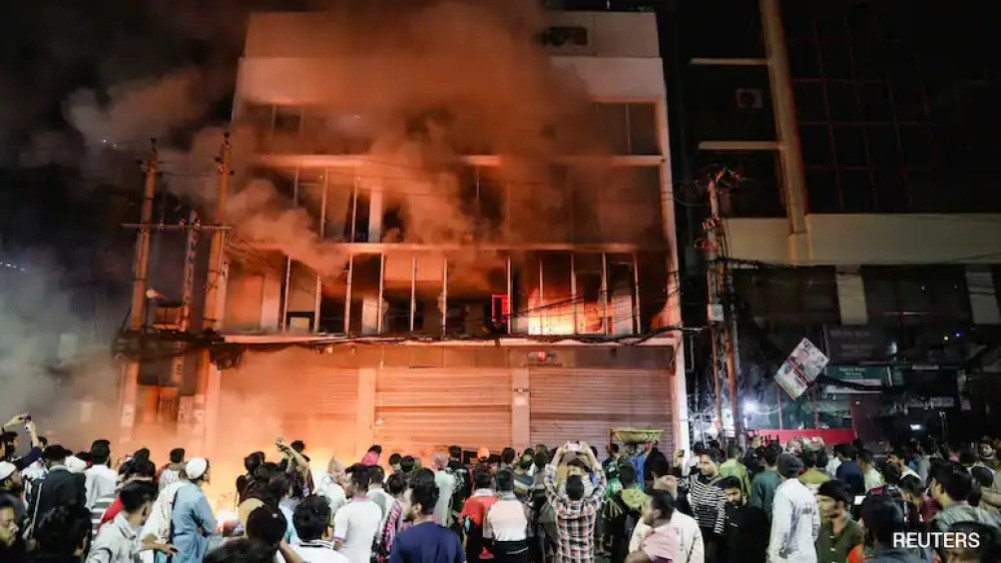
Bangladesh once again disappointed its South Asian well-wishers with the violent activities of the night of December 18-19, 2025. How the protesting crowd gradually degenerated into an aggressive mob was seen in Nepal during the violence of September 8-9, 2025. The reason why the Kantipur Media Group was set on fire is probably still under investigation.
As news of Sharif Usman Hadi’s death spread, violent mobs set fire to the offices of Bangladesh’s leading newspapers, Prothom Alo and the Daily Star, as journalists were working inside the building, as was the case in many other places in Dhaka. Although contact had been lost over time, journalists from Prothom Alo and the Daily Star would occasionally meet with columnists on South Asian forums.
For a time, the ‘State of the State’ column, written for the Nepali Times, was also republished in the English daily Daily Star. Supporters of the arsonists accused both prestigious publications of ‘getting closer to other countries’. Such accusations are enough to make, not to prove. The religious extremism spreading in Bangladesh in the name of nationalism has once again raised doubts about the future of democracy in the newly formed country.
Hi Bangla
It is generally believed that colonial rule in Bengal began in 1757 when the East India Company defeated the last independent Nawab of Bengal, Siraj-ud-Daulah, in the Battle of Palasi. Indirect rule followed after the civil authority to collect revenue in 1765, but institutional colonial administration was systematically established after Warren Hastings made Calcutta the administrative center around 1772.
The series of sufferings in Bengal initiated by colonial control has not yet ended. Among the major famines in Bengal, the widespread famine of 1770 is considered to be the most notable. This was followed by the 1783–84 (Chalisa Famine), the 1866 famine, the 1873–74 famine, the 1896–97 (Indian Subcontinental Famine) and finally the severe Bengal Famine of 1943.
British Prime Minister Winston Churchill's racist remark that the famine was caused by Indians who were 'breeding like rabbits' and the cruel and insensitive question 'how is Mahatma Gandhi still alive if the food shortage was so bad' are still debated among historians. There is general agreement that the Bengal famine killed between 3 and 5 million people.
Despite the glorious past, the bitter experiences of the recent past have hardened the Bengali people's resistance to pain. The addiction to violent politics is perhaps also widespread due to the impact of unbearable group experiences. Natural disasters do not directly trigger processes of independence and regime change, but they can play a structural role in intensifying political discontent.
After an estimated 500,000 people died in the famine caused by the Bhola cyclone in 1970, anger in East Bengal against Pakistan's military rulers gave impetus to the liberation struggle. Some Bangladeshis argue that the weakness in the management of the 1974 famine, which began before independence was institutionalized, led to widespread discontent against Sheikh Mujib's rule, leading to a military coup.
The fate of continuous partition may have also made Bengalis intolerant and violent towards the 'other'. The present-day Bangladesh came into existence after at least four political vivisections. After the partition of Bengal in 1905, Bihar and Odisha were separated. After the reorganization of 1912, Assam also began to form a separate administrative unit. In 1947, the Hindu-majority western part became the Indian state of West Bengal, while the Muslim-majority East Pakistan was established.
The last partition to date was the 1971 liberation war, which brought Bangladesh, with a single Bengali identity, into existence as an independent and sovereign nation, although the indigenous people of the Chittagong Hill Tracts and the Urdu-speaking ‘Biharis’ who came from Bihar and eastern Uttar Pradesh after 1947, have yet to find equality and acceptance.
According to some analysts of political psychology, the forced partition of a homeland can act as a catalyst for radicalization by creating collective trauma, a sense of identity fragmentation and an irreparable sense of injustice. Be it the Indian state of West Bengal or independent Bangladesh, radicalization has become a political character of Bengalis.
The ‘Joy Bangla’ slogan popularized by Sheikh Mujib in the early 1970s used to excite even Bengalis in India. The ups and downs in relations between India and Bangladesh are different from those of other South Asian countries. Identity crises and insecurity also guide relations with India, especially towards Bhutan, Nepal and to some extent Sri Lanka. Pakistan has positioned itself as India’s competitor.
Perhaps the benefactor-beneficiary conflict is more useful in viewing the relationship between New Delhi and Dhaka. The recent statement by Russian Ambassador to Bangladesh Alexander Grigorievich Khozhin, while stressing the importance of reducing tensions with India and pointing out New Delhi’s decisive role in Bangladesh’s independence in 1971, may not have paid enough attention to the sensitivities of the establishment of Dhaka in 2025, if only because the main reason why relations between the two countries are not normal is the sense of indebtedness and the uncomfortable memory.
It is not unusual for the self-respecting generation born after independence to be inclined to deny rather than to be grateful for the fact that Bangladesh was liberated with India’s help. Being grateful means being filled with a sense of awe, including remembrance, humility, and restraint. Such a tendency is not often found in the common people. The social elite and cultural leadership should take the lead in developing humility, and the outbreak of rapid politicization and hollow nationalism has increased the anger of Bangladeshis towards their former benefactors.
Dhaka’s elite and the growing urban middle class, which have become rapidly prosperous thanks to Indian cotton, Chinese technology, Western markets and ready-made garment enterprises based on cheap labor of rural women, seem to have ignored the fact that South Asia is not immune to the competition for influence between China and the United States.
If this is indeed the case, then either the elections scheduled for next February will not take place or, if they do, the outcome will be nothing more than the beginning of a new conflict. Political stability, as one might imagine, will not be easily ensured even in an ethnically homogeneous state. Given the current fluid situation, if Bangladeshis do not control their neo-Islamic frenzy and traditional nationalism, the challenges to Bangladesh’s emergence as a confident nation in South Asia will remain.
Oi Madhesh
The lessons of the July Uprising of Bangladesh 2024 are also worth considering for Nepal as a whole. If the leadership continues to ignore the aspirations of the common people and their expectations of their rights for a long time, there will be a sudden explosion of anger instead of an organized movement to change the situation. After exploding with a loud voice, the accumulated energy of anger is exhausted before an alternative can be developed and new yogis appear to stir up the ashes.
In such a situation, either the old players reappear on the field in new clothes or the pseudo-military rule continues in the name of stability. In Bangladesh, the statue of the nation-builder has been demolished, but in democratic Nepal, the Nepali Army has declared that those who disagree with the ‘symbol of national unity’ cannot be ‘true Nepalis’. The political parties that should be the guardians of citizen supremacy are in a state of disarray.
The party called CPN-UML has been completely transformed into the political platform of Chairman Khadga Prasad Sharma Oli. It is also a fact that since Chairman Sher Bahadur Deuba surrendered to Sharma Oli in self-defense, the Nepali Congress has become a component of the 'UML' group economically and politically.
Even if an alternative alliance of small and petty parties is formed within a limited period of time, it is almost certain that the political basis for such an experiment will be other forces rather than ordinary voters. The situation before the Green Belt rebellion was bad, the current situation is unstable, and even if elections are held, there is no room for optimism.
The fear that the first blow of right-wing extremism, a mixture of religious extremism of Hindutva politics and the frenzied nationalism of Khas Aryan ethnicity, will hit Madhesh is not exaggerated. It would not be surprising if the echo of the conch shell that has been arbitrarily sounded for political parties, media, and religious minorities that have been arbitrarily declared 'India-friendly' in Bangladesh begins to be heard more in Madhesh than in the rest of the country.