Nepal's constitution prohibits the death penalty, but calls for the death penalty for those involved in corruption-related crimes continue to arise. Can the death penalty really control corruption? Are countries that execute corrupt people less corrupt?
We use Google Cloud Translation Services. Google requires we provide the following disclaimer relating to use of this service:
This service may contain translations powered by Google. Google disclaims all warranties related to the translations, expressed or implied, including any warranties of accuracy, reliability, and any implied warranties of merchantability, fitness for a particular purpose, and noninfringement.
Nepal Workers and Peasants Party leader and then MP Prem Suwal spoke in Parliament on Falgun 4, 2081 BS and demanded the introduction of a law to punish corrupt people with death penalty. Leader Suwal claimed that the death penalty law was urgently needed to control the increasing corruption in the country.
Not only leader Suwal, but also the then ruling Nepal Communist Party (NCP) had formally demanded a law to punish corrupt persons with the death penalty in the Central Committee meeting held in Magh 2076 BS. Some central members demanded a law to punish corrupt persons with the death penalty to prevent it, as corruption was increasing day by day instead of decreasing.
It seems that not only political parties and their leaders, but also the common citizens are demanding a law to punish corrupt persons with the death penalty. In a survey by 'Online News' in Poush 2070 BS. More than 80 percent of the participants voted in favor of punishing corrupt persons with the death penalty in Nepal.
Thus, public statements have been made with the argument that a law on the death penalty is necessary to control the growing corruption in Nepal. Every year, the Commission for the Investigation of Abuse of Authority is filing cases alleging that citizens, from the smallest consumer committees to the Prime Minister, are involved in corrupt activities. Some are even saying 'OK' that citizens who are seeing corruption everywhere are demanding a law on the death penalty against corrupt persons. Advocates of the death penalty claim that only strict and harsh laws can help curb corruption.
Nepal has signed the 1991 United Nations Convention against the Death Penalty. Nepal's constitution also prohibits the death penalty, but calls for the death penalty for corruption-related crimes continue to arise. But can the death penalty really curb corruption? Are countries that currently execute corrupt people less corrupt? This article focuses on this.
Global evidence and comparative statistics suggest that the death penalty cannot curb corruption. Rather, strengthening public institutions, judicial independence, transparency, increased institutional capacity, and effective democratic control systems have a positive impact on it.
The most widely used index to measure corruption worldwide is Transparency International's Corruption Perceptions Index. A score of zero indicates that a country is highly corrupt and a score of 100 indicates that it is highly clean. If we take this index as the basis alone, it shows that countries with death penalty laws for corruption crimes have high levels of corruption, while countries without such laws have relatively low levels of corruption, as the table shows.
The table shows that the problem of corruption is higher and more serious in countries with such laws than in countries without such laws.
China has a death penalty law for corrupt people. On December 9, when the world was celebrating International Anti-Corruption Day, China executed a former executive of a state-controlled asset management company on corruption charges. Bai Tianhui, the former general manager of Chinese Huarong International Holdings, was sentenced to death for corruption involving more than $156 million in the acquisition of projects between 2014 and 2018.
According to Amnesty International, China executed about 2,200 people in 2017 and about 2,000 in 2018 alone. There is no clear data on how many of these people were sentenced to death for corruption. However, it is said that about half of the number were sentenced to death for economic and political crimes. If we take this as the basis alone, it seems that a large number of people are executed for corruption charges in China every year. However, the situation of corruption in China is high. The large number of executions carried out every year does not seem to have reduced corruption there.
In addition to China, countries such as Vietnam, North Korea, Iran, Pakistan, Thailand, Myanmar, Laos, and Indonesia also have laws that punish corrupt people. However, various studies have shown that these countries have high levels of corruption. According to a report by Amnesty International, 1,518 people were executed worldwide in 2024. It is not clear how many people were executed for corruption. However, it is seen that the highest number of these may be for drug-related crimes and secondly for corruption-related incidents. Even though the death penalty is imposed on corruption charges, corruption has not decreased in such countries.
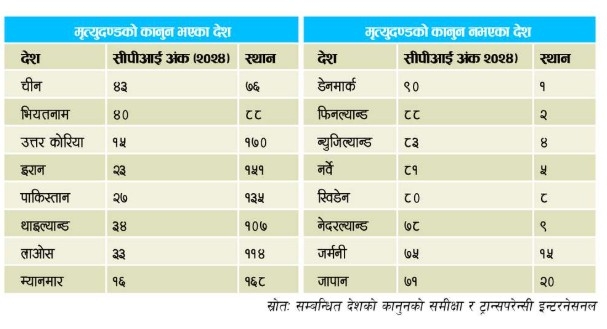
In contrast, studies show that there is very little corruption in countries without death penalty laws. Corruption is seen to be low in countries such as Denmark, Finland, New Zealand, Norway, Sweden, the Netherlands, Germany, and Japan. In countries such as the Netherlands and Switzerland, news is frequently made public that prisons are being closed due to a lack of criminals. The situation of corruption is very low in countries with soft legal systems. The experience of these countries shows that judicial independence, institutional transparency, strong public rules, a free media, and a strong regulatory system reduce corruption more than strict laws such as the death penalty.
The social reasons for corruption are more than personal interests or the lack of strict laws. The social structural conditions shape the psychology of an individual. Therefore, strict laws such as the death penalty, which are designed to control personal psychology or greed as the main reason, have become meaningless. Even legal systems designed to punish individuals by death are not contributing significantly to controlling corruption. The role of economic, social, political, administrative and judicial mechanisms is very important in increasing corruption. It seems that death penalty laws that are made to hold individuals solely responsible while ignoring such issues cannot yield results.
Corruption is basically linked to the economic, legal, social and political structures of the country. The political structure is also linked to this in the most frightening way. In the absence of political will, corruption control cannot be imagined. Such structural issues create a corrupt psychology of an individual.
If the structure itself can be changed, then the corrupt psychology of an individual can also be improved. However, even making legal systems that punish individuals by death while keeping the structure as it is, it cannot contribute to the work of controlling corruption. Specific types of social structures in society contribute to creating a corrupt psychology of an individual. As the social structure remains, the activities, habits and behavior of an individual become the same and no matter how strict the laws are, corruption cannot be controlled.
Therefore, from leaders to citizens, it is more appropriate to focus on improving the governance system and structural conditions immediately rather than advocating for strict laws like the death penalty to control corruption. When looking for solutions to structural problems like corruption, it is necessary to move beyond emotional or punishment-focused thinking.
For this, it is essential to focus on institutional, systemic, and long-term measures. International experience and comparative studies have shown that the basis for the success of corruption control is not the death penalty, but strong democratic institutions and a transparent governance system. Therefore, political parties, their leaders, and ordinary citizens need to press for some institutional, legal, and structural reforms rather than demanding the death penalty law.
First, to control corruption, it is imperative to end partisanship from the Constitutional Commission to public bodies. Since corruption has been institutionalized due to the distribution of positions and institutionalized party interference, it is necessary to create effective policy, legal, and institutional structures to make public bodies impartial and independent.
In addition, the parliament should formulate laws related to corruption control in a timely manner and regularly amend them based on the experience of implementing such laws. Similarly, the government should effectively implement both promotional and preventive measures and develop a culture of zero tolerance towards corruption. Only through such a comprehensive and determined effort can corruption in the country be significantly reduced.
Second, keep the Commission for the Investigation of Abuse of Authority away from the partisan shadow and strengthen it. The Commission can work effectively only by reforming the existing system in which partisan interests dominate the appointment of the Commission's officials and strengthening its institutional structure. There are complaints that the Commission has fallen into the shadow of power and authority in some corruption-related cases. In such a situation, instead of demanding a law on the death penalty, political party activists will demand a strong law to free the Commission from the clutches of partisan interests.
Third, strengthen judicial independence and the capacity of the judiciary. The backbone of corruption control is an independent, competent and trustworthy judiciary. Where investigative bodies are under political pressure, courts make slow decisions or access to justice is limited, corruption flourishes even in the presence of strict laws. Therefore, policy, legal and institutional reforms should be prioritized to make the judiciary completely independent from executive and political influence, to make investigative agencies professional and resourceful, and to make the case resolution process quick and transparent. Fair, speedy and certain justice is the real basis for controlling corruption, rather than the severity of punishment.
Fourth, maintain full transparency in open government data and public investment and contracting processes. Corruption is often deeply intertwined with government budgets, contracts, procurement processes and public investment. Therefore, it is necessary to open government data so that all citizens can understand it, to make the public procurement system digital and competitive, and to provide citizen oversight in the contracting process. Globally, where open data, open budgets and transparent contracting systems have been implemented, corruption appears to be less prevalent. A regime of openness is a long-term solution to controlling corruption rather than enacting death penalty laws and engaging in politics of fear.
Fifth, effectively implement strong laws that protect whistleblowers in corruption. Corruption will not come out unless whistleblowers, whether from within or outside the organization, are given legal, social, and professional protection to fight corruption. In a society where the whistleblower himself is defenseless, fear and silence do not reinforce corruption. Therefore, strong laws should be formulated to protect whistleblowers.
Sixth, promote ethics and public accountability through civil society, the media, and the education system. Corruption is not just a legal problem, it is also a social and moral problem. Corruption control is not easy without an active civil society, independent investigative journalism, and an education system that develops critical awareness. Including education on public ethics, civic duty, and accountability from schools to universities, allowing the media to work independently, and providing an environment of cooperation, not fear, for civil society are the foundations of democratic good governance.
Seventh, invest in restorative and institutional reforms rather than punitive thinking. Stricter punishment in the name of controlling corruption will not yield results. बरु यसले शक्ति दुरुपयोग, चयनमुखी न्याय र मानवअधिकार उल्लंघनको जोखिम बढाउँछ । त्यसको सट्टा सार्वजनिक प्रशासन र तलब–भत्ता प्रणाली सुधार गरिनुपर्छ ।
सार्वजनिक पद धारण गरेका व्यक्तिलाई उनीहरूको आधारभूत आवश्यकता परिपूर्ति सहज रूपमा हुने गरी तलब तथा सुविधा उपलब्ध गराउनुपर्छ । आधारभूत आवश्यकता परिपूर्ति हुने गरी तलब–भत्तामा प्रणालीगत सुधार नगर्ने हो भने हजारौं व्यक्तिलाई मृत्युदण्ड दिए पनि भ्रष्टाचार नियन्त्रण सम्भव छैन । यसका साथै डिजिटल शासन प्रणालीको विकास, सेवा प्रवाहमा सरलता र संस्थागत जवाफदेहितामा लगानी गर्नु दीर्घकालीन रूपमा भ्रष्टाचार नियन्त्रणमा प्रभावकारी हुन्छ । दण्ड होइन, प्रणाली सुधार नै भ्रष्टाचार नियन्त्रणको मूल उपाय हो ।
अतः राजनीतिक दलका नेता तथा आम नागरिकले बुझ्नुपर्छ— मृत्युदण्डको कानुन बनाउँदैमा भ्रष्टाचार नियन्त्रण सम्भव छैन । बरु भ्रष्टाचार नियन्त्रण बलियो कानुनी व्यवस्था, पारदर्शी शासन–प्रणाली र संस्थागत सवलीकरणबाट सम्भव छ । भ्रष्टाचार नियन्त्रणका लागि भन्दै ल्याइने मृत्युदण्डसम्बन्धी कानुन आफ्ना प्रतिस्पर्धीहरू सक्याउने डरलाग्दो हतियार बन्न सक्छ, हेक्का राखौं ।