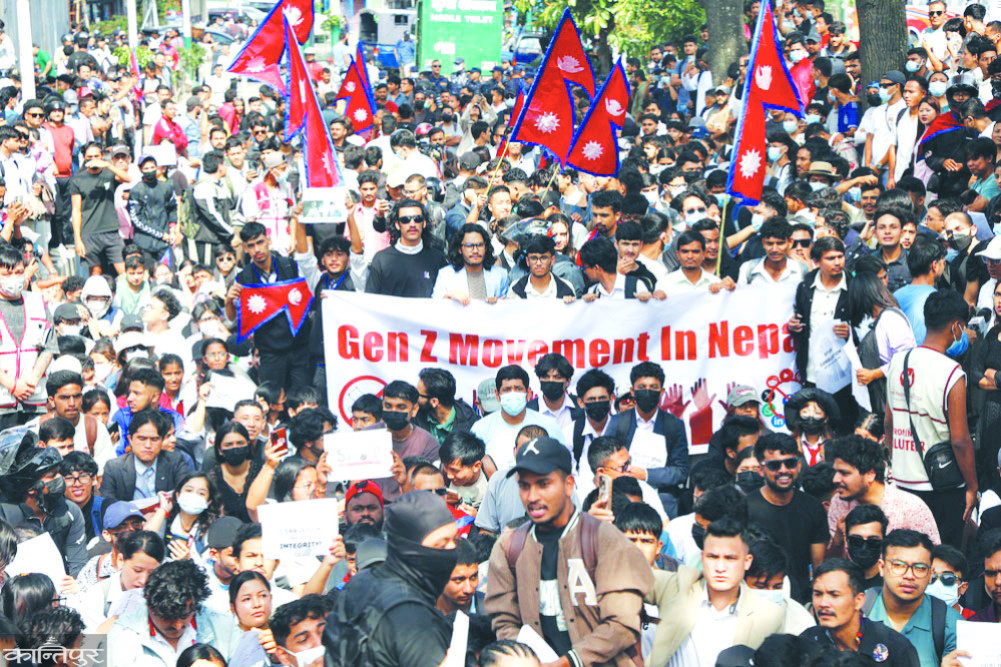
This rebellion was born neither against democracy, nor against the constitution or the current system. It is simply a dream of strengthening the regime and a desire for a better system.
We use Google Cloud Translation Services. Google requires we provide the following disclaimer relating to use of this service:
This service may contain translations powered by Google. Google disclaims all warranties related to the translations, expressed or implied, including any warranties of accuracy, reliability, and any implied warranties of merchantability, fitness for a particular purpose, and noninfringement.
What does today's political climate look like from a different perspective than party workers and Gen Z? Let's take a moment to look at current politics through that lens.
The government was unable to provide facilities to the people, and the tendency to keep their ears warm by shutting down even the existing social media was not acceptable. On that pretext, the Gen-G rebellion took place. The shutdown of social media was only a pretext - rebellion. The people had been angry with the leaders and the government since the old days.
Before the dream that was shown to the people in 2062/63 BS, what kind of hopes were shown to the people in the 'people's war' before that? What promises did the leaders make to become prime ministers and ministers? After coming to power, only 'pranks' were made on the same people. The suffering of the people was ridiculed. Did the youth wait for two decades. Did any new work happen? Except for making money and winning elections, very little was done. The fragrance spread by taking the country to federalism and changing the constitution disappeared in the air. The youth did not get anywhere without going abroad.
And, the most bitter reality is that the events such as the expulsion of big leaders, the burning of their coffers, etc. were related to the rebellion. The destruction of physical structures was certainly not justified. The blame for those who set fire to vent their anger is being placed on the Gen-G rebellion today. And, this is truly a grave injustice being done to the Gen-G rebellion. The intention of the Gen-G rebellion has been covered in thick smoke.
A person like me, who is watching from afar from the political circle, now has to openly and firmly write that the intention of the Gen-G rebellion is not to overthrow the constitution, much less to destroy the country, nor is it to become a leader by killing the existing leaders. Their voice is – corruption-free governance, a policy of creating self-employment in the country, facilities like education and health should be accessible to the common people, etc.
That is why the Gen-G rebellion shook the twenty-year-old governance system of Nepali politics. Sometimes, even the strong beliefs that have been holding the state power are surprised by unexpected events. The events that are ignored by those in power become small causes, which explode as rebellions or revolutions or ultimately lead to transformation. The entire scene of that transformation is the Gen-G rebellion of Bhadra 23 and 24, which the government has now recognized as a people's movement. It is such a rare event that suddenly removed those who had ruled through the party for a long time from the seat of power.
The generation born from 1997 to 2012 is considered Gen-G. Before this movement, we ignored that generation as a generation that was busy with mobile phones or a generation that had no interest in politics and society. The rebellion led by that generation shattered the arrogance of the regime. The same generation that was ignored in every discussion and public debate has now dominated from the media to public debate and politics. And, Gen-G will be recorded as an ancestor who has shown indomitable courage that previous generations did not. The generation of ignored technology led the movement in a changing environment.
We had the dominant belief that ‘movement or rebellion always starts with a public appeal by organized organizations and leaders, and that shows the way for that movement.’ Looking at it through our old eyes towards change, it took people like us a long time to process ‘what is happening and why’ in this movement. In the Bhadra 23 movement, the state unexpectedly killed students and injured many. After the state repression of 23, some have continued to try to defame the angry crowd and movement that erupted on 24 Bhadra in the public sphere. However, what needs to be understood is that be it the Jana Andolan-2 of 062/63 or the movement of 046 – the anger among the people increased in this Gen-G movement after more students were killed in a single day than in those movements that overthrew the entire system. The natural reaction of that anger was seen in the movement the next day. And, some have also appeared as an opportunity to vent their anger with each other. Therefore, young students want to make this country free of corruption and protect their freedom of expression. It is not desirable to try to distort the Gen-G rebellion by showing the incident of 24.
The leaders of the Gen-G movement, Raksha Bam, Sudan Gurung, and Uparjan Chamling, have saved democracy and the constitution. From the beginning of the movement, they have taken the initiative in participating in negotiations with the army to the government formation process. Raksha Bam and Sudan Gurung never protested to 'kill the government'. They simply wanted to purify and strengthen politics, but the government's own stubbornness changed the form of the movement terribly. Students lost their lives unnecessarily. Dozens of limbs were amputated. However, the result was transformed. Therefore, these young people have been used as an image in this movement as carriers of change.
Especially on the 24th, when all the leaders of Nepal's political parties fled and hid in the army barracks, when the army was in power and various manipulations were taking place in the country, how was this generation able to save democracy and the constitution? This is the real question.
The army of every country remains a traditional force. If it were not for these sensible youth, the government would have been ready to go into the hands of the army. The people's natural opinion was that power would definitely go into the hands of the king or the army. At such a time, the leaders of all parties, from the Prime Minister of the country, had to hide to save their lives. During that vacuum, the movement of these youth, including the generation of youth who could question the army at Singha Durbar, was not to go against the system, but to strengthen the system further. The government that will be formed should not forget this.
In today's time, the cyclical rule of the leaders of the main parties must end now. There is a saying in English, 'Leader and deputy should be changed on time', that is, 'Just as a leader enters politics, he should take time to leave it.' In developed democracies, the practice of returning to practical life after ruling the state has been very natural, which has made both the party and politics seem like a murky river. On the contrary, in Nepal, the culture of a single leader taking the reins of state power for life has made the country hollow. It has created aversion to democracy itself. Our leaders have been sitting alone in the state power or in places that can influence it since the 1950s. This has created bitterness not only among the general public but also within the party. Only the leaders have remained in power when the constitution should be strong to run the country. When they continued to occupy political seats, it did not even make the common people feel 'fresh'. On top of that, to stay in power, they have done things to paralyze the authorities and various bodies by partying, which has led to 'frustration' and that 'frustration' is the product of the second day's rebellion.
The interest of the current emerging generation in politics has increased even more. We must never forget and keep reminding others that this rebellion was not born against democracy, nor against the constitution or the current system. It is simply a dream of strengthening the regime and a desire for a better system.
This is not a system, this is a generation that is demanding a change in the situation. No matter what the state or those around it may say, the views of the common youth who are involved in this movement are very sensitive to the country, which is equally attached to the achievements of the movements in the past.
Sadly, the country was not able to feel the change due to the two extreme views of showing these youth as regressive and trying to bring about a regime of loot and regress. This movement has brought about such change. And, the generation that is agitating wants to see no corruption. They want to see government offices work quickly, they want to see selection based on merit rather than political participation in institutions, and they want employment opportunities in the country. They want their freedom of expression, not only that, but also want to learn the new discoveries and methods brought about by technological change. Gen-G wants to create a new generation of informed people and a new generation of knowledge that has been transformed by technology. Youth, who have been greatly influenced by information, communication, and technology to AI, should not be sent abroad after completing 12th grade, but now they need an environment where they can show their skills in their own country.
The fastest adopters of new technology and get used to it are always the younger generation. The previous changes were changes in 'tools or techniques', which did not have much impact on the dominance of knowledge. However, with the advent of current AI, the dominance of knowledge has moved from the domain of educated intellectuals to the 'access' of the common man. Therefore, they do not have to depend much on others for knowledge except empirical subjects.
This generation, which gets information about 'what is happening in the world?' at once, is a small part of the 'global village'. The knowledge dominance of the generation that can think 'globally' is also global. They may be more interested in 'data surveillance' than Marx, Lenin or Gandhi. They may be more concerned about issues like 'global warming' than the French Revolution. Therefore, in addition to the knowledge within our definition, they are in search of a wider range of new knowledge. Not only is knowledge new, they also have new 'tools' and this new generation is accustomed to those 'tools'.
What we should understand and explain is - let's let the young people win in the upcoming elections and let them run the country for once. The elections are being held on Falgun 21, there is election excitement. The workers of every party must respect their leaders, the time spent in that party and their love for them. However, the day has come when every person should think for the country more than for themselves. If exams change fate, let's stop loving books and teachers, and let's decide with our own conscience.
After the elections, the country will gradually return to normal from the extra-constitutional loop. Now it is the responsibility of all of us to bring the youth to power in the upcoming elections and hand over the country to them.