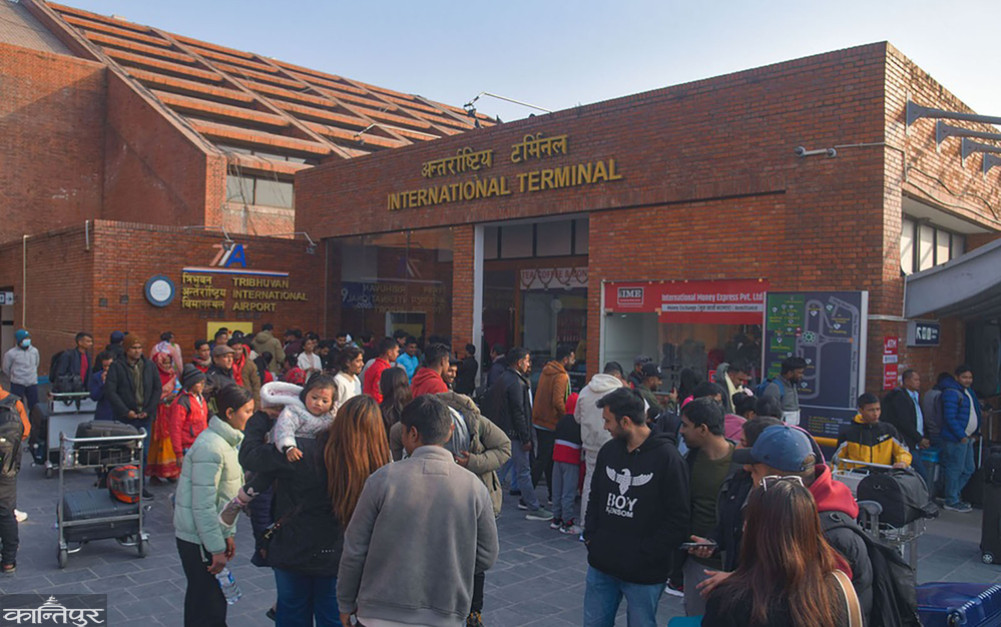
The increasing presence of middlemen in foreign employment has made labor migration more difficult. It has also increased the cost of migration for workers.
We use Google Cloud Translation Services. Google requires we provide the following disclaimer relating to use of this service:
This service may contain translations powered by Google. Google disclaims all warranties related to the translations, expressed or implied, including any warranties of accuracy, reliability, and any implied warranties of merchantability, fitness for a particular purpose, and noninfringement.
Due to political, social and economic instability, limited opportunities, unequal distribution of resources and rising unemployment, millions of Nepali youth have been migrating abroad in search of employment for years. The children of Nepalis who left their families in Nepal to work abroad have also started migrating for foreign employment. Only the time and days have changed, but the social situation, hardship and economic situation are the same.
Some countries in the Middle East have become a source of hope for the youth of Nepal, who are burdened by family responsibilities and financial constraints. And, one of the tempting destinations among them is the UAE.
It is not that the Nepal government has not made efforts to ensure safe immigration for foreign employment through various rules and laws, but it is equally important to bring and implement timely laws to regulate foreign employment. Moreover, the increasing number of middlemen in foreign employment has made labor immigration more difficult, which has also increased the cost of immigration for workers.
There are about 700,000 to 800,000 Nepali workers in the UAE. Most of them lack awareness in the Nepali community. Due to the lack of knowledge of the social structure of the country they are working in and the legal framework related to labor, workers easily fall into economic, social and legal risks. Nepali workers do not even have the general knowledge that ‘passport and visa should be renewed on time’.
The UAE has implemented strict employment laws and regulations to ensure the rights and safety of workers and has provided a digital means to register labor complaints. In case of difficulty, if the company does not pay the salary as per the contract or for any labor-related complaint or problem, the complaint can be registered immediately through the UAE's toll-free helpline number or F. Despite all the persuasion, Nepali workers do not seem willing to formally register their complaints with the relevant bodies here. Instead, they tend to run away from the company and expect the embassy to do all the work. It is seen that about 30 workers from Nepal run away from the company and come to the embassy within a month or two of coming to work.
While positioning itself as a leading country in the world market that exports workers, the state must ensure the rights and legal rights of citizens in foreign lands and employees must provide services to service recipients based on the prevailing laws. However, the bureaucracy is accustomed to the tradition of getting involved in paperwork more than solutions or alternatives to solutions in service delivery. When some Nepali workers and employees who violate the rules and regulations and have the mentality that 'no matter what you do, the embassy must do it' come face to face at the embassy, a situation of conflict arises between the employees and the workers.
In most cases, by the time the workers reach the embassy door, local legal complications have already arisen. Therefore, the employees focus on explaining the necessary procedural issues and arranging the paperwork according to local laws. However, when the workers who come to the embassy expecting the problem to be resolved immediately do not get the solution as expected, dissatisfaction arises. The trust of the workers who are badly trapped in the temptation of middlemen in the Nepal government and the embassy employees seems to be very low. The reason is that if there is some problem, the embassy employees show the legal path or facilitate their return to Nepal. However, on the other hand, the middlemen take money and offer the temptation of employment. On the one hand, the employees who take the initiative to return to Nepal and on the other hand, the middlemen who offer employment, the unemployed youth choose the middleman.
In the course of foreign employment, every worker must follow the rules, laws, and social systems of the country where he works and resides. Failure to comply with local laws wherever he works will result in personal legal action, fines, dismissal from employment, and in some cases, even imprisonment. It is difficult to explain to the Nepali community working here that ignorance of the law is not forgivable.
Recently, the number of Nepalis who are expelled from the UAE for drinking alcohol, causing fights, and making noise and not following the rules related to housing here has increased. Looking at the data from last January to December, the embassy has issued one-way travel permits to about 4,190 people. Most of them are those who do not follow the rules of the residence here, those who have run away from the company and filed cases against the company, those who drink alcohol and fight, those who sell alcohol and other goods without permission, and those involved in drug cases. A Nepali is serving a prison sentence in Sharjah after stabbing his friend who was sitting with him while drinking alcohol and killing him.
The burden of debt on one hand, and loneliness and worries about family abroad, problems arising from the lack of emotional connection when away from family at a young age, frustration in the mind, and family disintegration resulting from the increasing incidence of divorce, the problem of single parenthood, and the inability to earn money as expected have recently seen psychological problems in Nepalis. The result of such problems is a terrible decision—suicide. Since January 2025, about 32 Nepalis have committed suicide in the UAE, of which 6 are women and 26 are men.
Similarly, the trend of living without marriage and extramarital affairs among Nepalis is increasing. On the one hand, this is increasing the problem of divorce, and on the other hand, men are avoiding responsibility when women become pregnant due to natural causes. And, women are caught in the grip of the stigma of illegal relationships and the sole responsibility of children born from such relationships. About one woman per month whose father is unknown/hidden comes to the embassy to get documents for her child.
It is also seen that some Nepali women working in the UAE are giving birth at home. Reason - illegal relationships and illegal stay and fear of being imprisoned and deported. Giving birth to a child without marriage in the UAE is considered illegal for legal and cultural reasons. However, with the increase in the number of immigrants in the UAE, the UAE has now amended the law. In the case of migrant workers, children born out of wedlock can obtain a birth certificate with only the mother's name if the father is not known.
As the number of migrants increases, there are legal complications in obtaining compensation even after accidents, tragic deaths, and disabilities at work. Since most companies in the UAE only provide workplace insurance for workers and do not provide 24-hour insurance or life insurance, the person cannot receive compensation if they have an accident or a fatal illness outside the workplace for some reason.
From taking out loans by mortgage of passports to providing maternity expenses, from paying money to middlemen for visa changes to investing capital in the name of others with the intention of doing business in the UAE, there are widespread incidents among the Nepali community. Similarly, the number of people who are fined for leaving the company without completing the contract period with the old company due to the temptation of not getting a salary or getting a better job and without canceling their visas in the process is also significant. Similarly, from parents who do not get their children's documents after polygamy and give birth at home to cases where children are left in the hospital and return to Nepal after giving birth, we see here .
No other country in the world is exempt from rules and social codes of conduct as easily as it is in Nepal . Educated, aware and disciplined citizens play an important role in creating a positive environment in society . Therefore, the Nepali Embassy in Abu Dhabi continuously urges Nepalis to follow local rules and laws, not drink alcohol, be aware of their health, not engage in illegal transactions and fully comply with the laws of the country.
To ensure the employment and safety of Nepali workers going for foreign employment, it is mandatory for the Nepali government to provide them with information about the labor laws, social codes of conduct and safe foreign employment of that country before they go to the destination country . As the issue related to women in foreign employment is more sensitive, it is necessary to protect their rights and dignity by enacting laws. Gradually, Nepali society seems to need to ensure women's decisions regarding marriage and the economic, social and legal rights of children born from them.
It is necessary to work on these points to make foreign employment more secure, organized and dignified:
- For the ease of workers' lives, a system for filing complaints through apps from the place where they work.
- Action taken against those who provide false and misleading information.
- Awareness-raising programs regarding foreign employment for workers and dependent families.
- Problem-solving in a fast and transparent manner.