Although the statements of some party leaders and Gen-G activists have created confusion, the situation has not become so unfavorable that there is any doubt about the election being held. Similarly, it appears that some work has been done that contributes to good governance, which is the second responsibility.
We use Google Cloud Translation Services. Google requires we provide the following disclaimer relating to use of this service:
This service may contain translations powered by Google. Google disclaims all warranties related to the translations, expressed or implied, including any warranties of accuracy, reliability, and any implied warranties of merchantability, fitness for a particular purpose, and noninfringement.
A hundred days is a short period, even for a strong government that emerged from an election. Despite the hustle and bustle and morale, the expected list of results is not ready in this period.
The first hundred days of a government are considered a 'honeymoon period' because it has to start collaborating by interacting with the already established systems and working styles in the state structure. During this period, even if the government does not perform properly, does not work at the expected pace, or does not produce results, it is not criticized.
Because it is believed that it is trying to adapt to the new situation. It is believed that it is discussing new plans. But not all governments get the benefit of a 'honeymoon period'. They are expected to produce results immediately. The current government led by Sushila Karki falls into such a category. The main responsibility of the government is to hold elections, institutionalize good governance initiatives, and give political respite to the Gen-G movement. But the expectations of the citizens are high. Therefore, the government should move forward by striking a balance between its main responsibility and the expectations of the citizens.
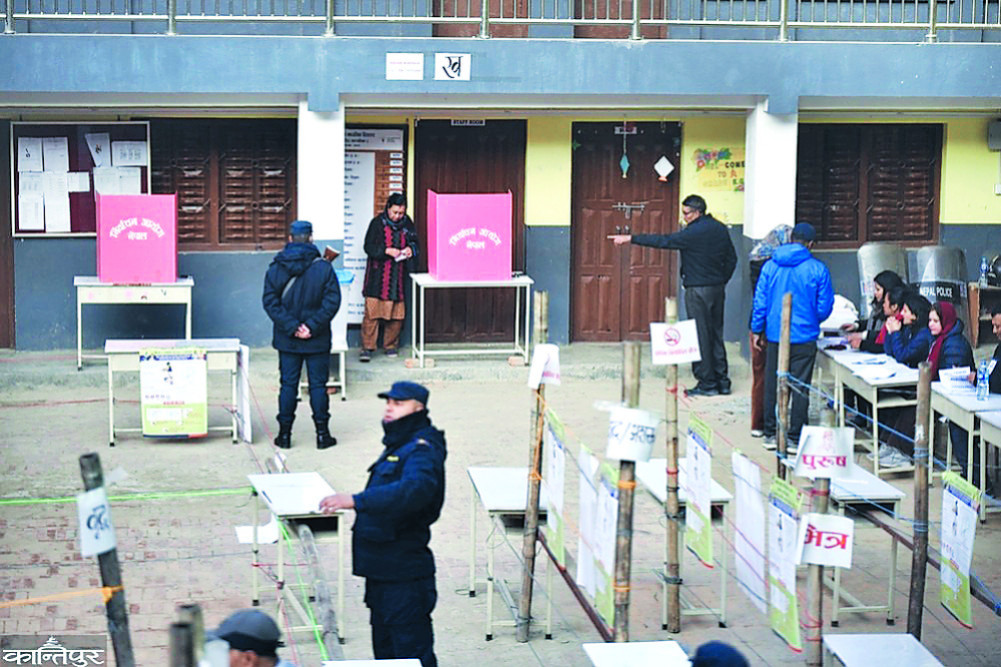
Efforts are being made for the 21 Falgun elections, which is the main responsibility of the government. From the introduction of an ordinance to include Gen-G in the voter list with the aim of getting Gen-G to participate in the elections, to the ongoing discussions with various parties, the government's commitment to the election has been confirmed. Although the statements of some party leaders and Gen-G activists have created confusion, the situation has not become so unfavorable that there is any doubt about the election being held. Similarly, some work has been done that contributes to good governance, which is the second responsibility.
For example, there is no interference in the investigation and filing of major corruption cases. In addition, there has been no dispute in the transfer and promotion of employees and the appointment of the Inspector General of Police and Chief Secretary. Third, a 10-point agreement has been reached to treat the Gen-G movement in a political manner and take its 'mandate' to the implementation process. The agreement signed on December 24 has documented the dimensions and guidelines of the Gen-G movement. Overall, the government's efforts towards its core responsibility appear positive. It should be carried out in a swift and achievement-oriented manner.
Everyone should accept the limitations of the government. This is not a government that came after winning the election. An interim government is an arrangement made to hold urgent elections to resume the political and governance process disrupted by the Gen-G movement. Such a government has to face extremely fluid and adverse political and social conditions. On the other hand, the expectations of the participants or supporters of the movement are high. Therefore, the government is considered successful only if it can successfully complete the elections and transfer power despite adverse conditions.
In addition, it is not appropriate to have high expectations like a regular government and to think that results should be achieved immediately. There are limitations to having a new character in the government's work and governance, the style and characters in which the state machinery operates are all the same. The current situation is like putting a new driver in an old and broken car. It is everyone's responsibility to expect and cooperate so that the new driver (Sushila Karki) can take the car to the repair center (elections) as soon as possible.
Controversies have also arisen when the government itself takes unnecessary interest in some matters. The decision to remove the Executive Director of the Electricity Authority, the decision to recall ambassadors, and the decision to abolish the Land Commission and district structure became controversial, and the Supreme Court overturned the government's decision. Similarly, the decision to grant capital gains tax exemption to the Dolma Impact Fund was also criticized. Ignoring the Supreme Court's interim order, a bulldozer was driven into a roadside settlement in Hetauda.
Such work is not related to elections. It is not a very important work that even the interim government cannot do. However, the government had to face criticism when it showed interest in it. The responsibility to promote accountability and transparency lies with all governments. However, despite the calls to remove 'Hope Fertility and Diagnostic Pvt. Ltd.', which extracts and sells eggs from teenage girls and sells them to others, and Attorney General Savita Bhandari, who decided not to prosecute those involved in this work, the Prime Minister is not listening. Even after more than a hundred days of the formation of the government, the asset details have not been made public. Such issues have increased the criticism of the government.
It is not appropriate to criticize the current government, which has many limitations, for not being able to deliver results at a time when it is not enough for a regular government that came after the election to deliver results in all areas. Excessive expectations without understanding the situation lead to disappointment. Everyone needs to understand this truth. If all-party dialogue can be regularized, a balance can be maintained between the government's priorities and the expectations of the citizens. Similarly, efforts for good governance should be institutionalized. As much effort as possible should be made for the election itself. On the other hand, one should not rush into work that is not related to the election and that does not have a justification that needs to be done immediately. That not only causes controversy, but sometimes creates confusion in achieving the main objective. It increases political conflict.