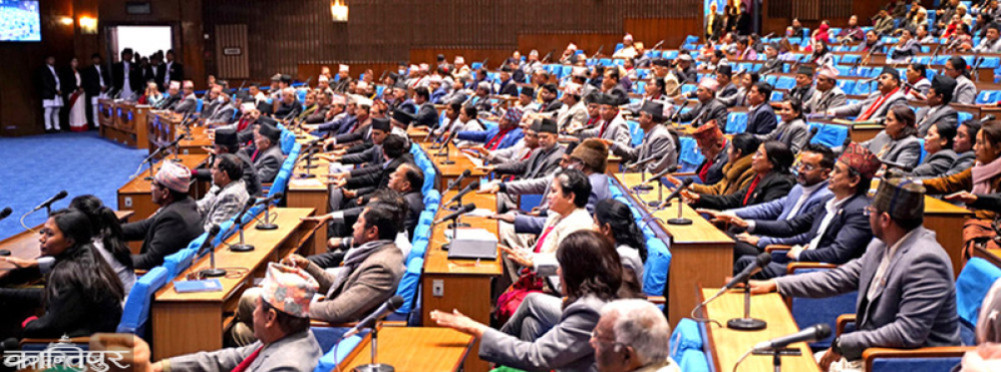
After the people's movement, the coalition played a pioneering role in political change. However, the same coalition has today become a tool of the power grab and aristocracy. It has become a hostage of democracy.
We use Google Cloud Translation Services. Google requires we provide the following disclaimer relating to use of this service:
This service may contain translations powered by Google. Google disclaims all warranties related to the translations, expressed or implied, including any warranties of accuracy, reliability, and any implied warranties of merchantability, fitness for a particular purpose, and noninfringement.
The political scene is slowly heating up with the upcoming House of Representatives elections on February 21. In this context, it may be relevant to debate the issue of 'alliance', i.e. the reconciliation of the ideological and personal ambitions of political parties.
After the people's movements of 2046 and 2062/63, the coalition played a pioneering role in political change. However, the same coalition has today become a tool of power grab and oligarchy. It has become a hostage to democracy.
Amid the loud buzz of political party alliances, potential ticket-buying games, and election-focused announcements, one question must be asked - does the system of forming a government under the leadership of another party, even if voters vote for one party, strengthen democracy? No! In the context of Nepal, coalitions have become a factor of instability, a symbol of corruption, and a threat to democracy.
What is a coalition?
A coalition is an agreement between different political parties, which helps parties that have not won a majority to share power. Accordingly, a government is formed on the basis of a common agenda and minimum program. However, in Nepal, there is a lot of power-sharing and chair transactions. As a democratic practice, citizens vote in periodic elections, but due to alliances, parties are using the people's votes improperly.
Article 17 (2) (a) of the Constitution of Nepal grants every citizen the right to vote and Article 17 (2) (d) gives freedom of expression. But, what is happening in practice? Even if voters vote for one party, the coalition makes the leader of another party the Prime Minister. Even if voters reject a party, the same party is exploiting their votes by distributing ministerial posts in the name of ‘power sharing’. This is not just a political game, it is an attack on the sovereignty of the voters.
If a voter is forced to abandon his or her own ideas and principles and vote for a candidate who carries different ideas and principles in the name of the coalition, it is a prohibition of democratic expression. The alliance between the Congress and the Maoists in the last election was surprising and unexpected. The Congress, which claims to be pro-democracy, and the then Maoists, who came to power through the People’s Revolution, had difficulty justifying the alliance.
Background of the alliance in Nepal
For the 2046 movement, the communist parties formed a United Left Front under the leadership of the Congress. The success of the movement led to the end of the Panchayat system and the restoration of democracy. A seven-party alliance was formed even before the 2062/63 people's movement. The nature of the alliance changed after the 2070 Constituent Assembly elections. In the name of consensus politics between the Congress-UML-Maoist, an alliance for power began to form, and the culture of alliances in Nepal's democracy was fading.
In the 2074 elections, the left alliance of the UML-Maoist Center succeeded in winning close to two-thirds of the seats in the House of Representatives, i.e. 174 seats out of a total of 265 seats. Voters gave a clear majority and dreamed of a 'stable government, prosperous Nepal'. However, less than three years later, in 2077, the alliance (at that time a single party) broke up due to the personal ego and moustache fighting of Oli-Prachanda, and attempts were made to dissolve the parliaments two by two. The dream of a stable government and prosperous Nepal that the people had seen was shattered. After the Supreme Court's order, the five-party alliance led by Sher Bahadur Deuba came to power.
In the 2079 elections, an electoral alliance was formed between the Congress, the then Maoists and the Unified Socialists, who had no ideological or principle compatibility. But the parties that formed the alliance did not form the government on 10 Poush. Instead, Oli-Prachanda formed a coalition government. This unity did not last long. Within a few weeks, the Maoists and Congress, among others, formed a government. Again, the Maoists and UML, among others, formed a government.
On 17 Ashad 2081, a new seven-point agreement was reached between Deuba and Oli, and a new alliance was formed. According to which, on 30 Ashad, Oli became the Prime Minister for the fourth time. This alliance gave the big slogan of 'Stability and good governance now'. However, this unity was also shattered by the storm of the Gen-G movement on 23-24 Bhadra 2082. The youth blocked the road against corruption, misrule and the division of the alliance. Oli resigned on 24 Bhadra 2082. This proves that alliances in Nepal are not a solution to stability, but the biggest root of misrule and instability. Thus, the coalition initially showed a dream of bringing about change, but later it became the biggest reason for instability, misrule, and corruption.
In the last seven years, the government has changed repeatedly, the cabinet has been reorganized repeatedly. Dozens of policies have been left behind. Dozens of bills considered important for fully implementing federalism have been left behind in the House. The situation in the provinces is even more dire. The situation in the provincial governments is similar to that of the federal government.
The common people wanted 'stability', the coalition gave 'instability'. They asked for 'accountable government', the coalition gave 'chaos of division'. Therefore, the biggest political problem in Nepal today can be said to be 'rule of coalition'. That is why the Gen-G movement took place.
The pre-election and post-election coalitions
The pre-election coalition is a mechanism to deceive the voters. Voters vote for one party's election symbol, manifesto, and candidate, but the next day the same party joins forces with another to make a leader the voters dislike the prime minister is a fraud on the voters' votes. In a diverse country like Nepal, pre-election alliances further increase regional and ethnic polarization, influence black money, and push young people away from politics.
There is also a problem with post-election alliances. Whoever wins the most seats gets the ministries and budget. However, this is also limited to personal ego and the squabbles of the chair. In a country with an underdeveloped and unstable political culture like Nepal, both types of alliances are harmful. Pre-election alliances deceive voters, post-election alliances institutionalize misrule.
The Gaijatra of alliances
Alliances are becoming a curse even for democracy. First, alliances are against the constitutional and legal spirit. The practice of alliances is inconsistent with Articles 269, 271 of the Constitution of Nepal and the provisions of federal law. The Constitution and the law have made a constitutional provision for political parties to compete in elections on the basis of their principles, ideas, and programs. However, the parties' practice of distributing seats and not fielding candidates in places agreed upon has created a contradictory situation as if the parties are legally unable to field candidates. This has confirmed the lack of principles, ideals, and destination in politics.
Second, it has mocked the will of the voters and majority rule. According to the electoral system, the party to which the voters give the majority is the one who forms the government. Forming an alliance before the election is an insult to the will of the people and against the constitutional spirit. The constitutional provision in Articles 76 and 168 states that only if a party fails to secure a majority, parties with similar ideas, programs, or similar views on some issues can form a joint government.
Third, the practice of alliances has alienated political parties from their ideas, principles, and ideals. Parties with different ideas, manifestos, and values have formed alliances just to win elections, which has created confusion among the people. The post-2074 BS coalition seems to have been guided by the vested interests of the leaders and has forced political parties to lose their identity.
Fourth, it questions the purpose of the proportional electoral system. The main purpose of the proportional electoral system adopted by Nepal is to elect 110 and 220 members of parliament to the House of Representatives and the Provincial Assemblies, respectively, based on the votes they receive. This system also clearly indicates that the parties themselves go to the elections with their own principles, ideas, values, and beliefs. The current practice has created a paradoxical situation where the same voter has to vote for different parties at the same time.
Fifth, the coalition is a kind of deceitful strategy used to reach power, which has turned into a game of a party with a small power joining forces with a large power or joining forces with another large power to block a large power. It has ignored the will of the voters by forcing the big parties to sit on a limited number of seats and electing those who cannot win even a single seat to multiple seats.
Sixth, alliances reduce the credibility and honesty of the leadership. It has become a common political character to form alliances before elections and break them later. Seventh, it negatively affects the morale of the workers. The contradictory situation of workers who carry the party's principles and flag all year round and have to campaign for another party's candidate in their area due to the alliance and vote has had a major negative impact on their psychology.
Eighth, alliances have increased voter participation and invalid votes. Due to the alliance culture, voters have a tendency to participate less in the voting process or deliberately vote invalidly when they do not get the candidate of the party they want and choose.
Ninth, alliances are responsible for increasing the complexity and costliness of the electoral system. Due to alliances, it is impossible to predict how many candidates will be from which party in which area, which has led to complications in the management of ballot papers. According to the Election Commission's study, the electoral system has become more expensive, complex and challenging in recent years due to the coalition culture.
Tenth, the indicators of democracy and good governance have declined due to the coalition practice. The practice of coalitions has led to a gradual decline in the indicators of democracy and good governance due to the need to adopt any tactic to win the election, the influence of money, access and power in the selection of candidates and ultimately the game of coming to power as a means of compensation. This has led to the country's governance system being run through politics without principle and vision.
The responsibility of voters in the upcoming elections
The voters themselves should be the decisive factor in the general elections. The good news is that the government is trying to amend the Election Act-Ordinance to provide for 'NOTA', i.e. 'I do not support any of the above candidates'. If the voter does not like the coalition, they will now be able to vote 'NOTA'. The best solution is to punish the party that forms an alliance before the election by not giving it votes, and to give an answer in the next election to the party that continues to divide the votes after the election. If this is done, the situation will gradually improve.
Nepal's democracy can no longer remain hostage to alliances. There is no other option but the upcoming ballot box on 21 Falgun to eradicate this disease. Now, not an alliance, but a government with a clear majority and a clear agenda is needed.