The questions raised about the UML today are not because its organizational structure is weak, but because it has failed to establish political legitimacy. The UML has come under siege because the people have shaken the trust they had in it.
We use Google Cloud Translation Services. Google requires we provide the following disclaimer relating to use of this service:
This service may contain translations powered by Google. Google disclaims all warranties related to the translations, expressed or implied, including any warranties of accuracy, reliability, and any implied warranties of merchantability, fitness for a particular purpose, and noninfringement.
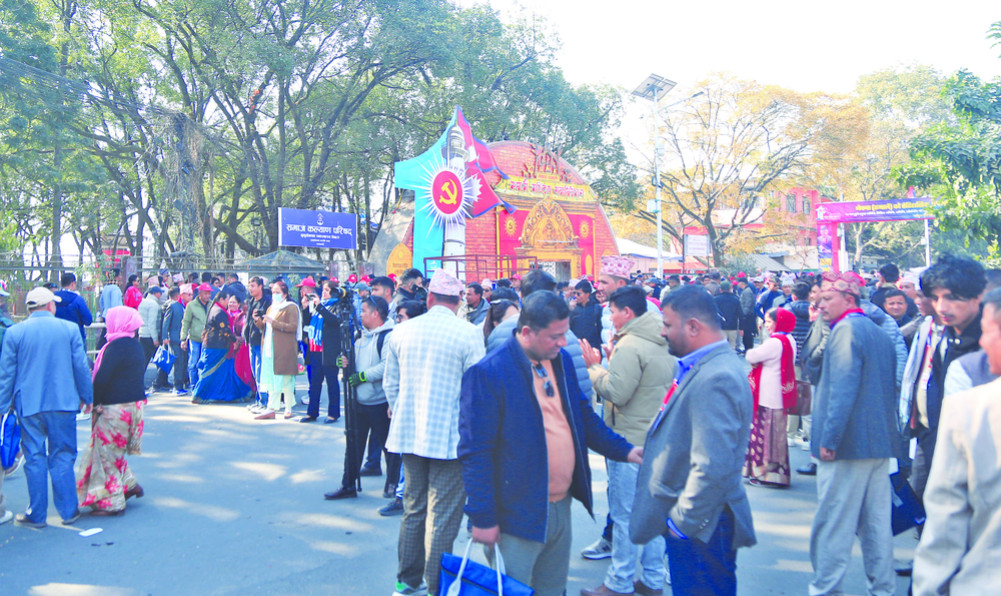
As the CPN-UML continues to engage in leadership selection exercises from the closed session, social media is abuzz with the presence of the Sallaghari Sabha on Saturday. The reaction to a photo posted on social media claiming to have been taken from a drone showing a large crowd of participants during the meeting on Saturday has not stopped.
Some have criticized the AI-generated image for spreading confusion, while the UML's 'propaganda unit' has come out in protest.
In particular, this kind of 'propaganda' was not necessary given the size of the Sallaghari meeting. That is because a large number of UMLs were mobilized in Sallaghari on Saturday. There was no need to exaggerate it. However, the way the UMLs are excited about the participation in Sallaghari, it is necessary to raise questions. Is that crowd the measure of UML's entire success? Has it regained its lost credibility by demonstrating its power and confirmed its political legitimacy?
UML is a party with strong organizational roots extending to the local level. Compared to other political parties, its organizational network is strong and cadre mobilization is systematic. Whenever UML holds a public demonstration, there is a good turnout of cadres. The party, which was on the defensive after the Gen-G street protests and the subsequent destruction, was able to attract a large crowd of workers and well-wishers at the Sallaghari meeting amidst adversity.
This has encouraged the leadership, worried about the weak participation of organized members during the selection of general convention delegates. The leadership has been cheered up after the grand presence of the inaugural session. Chairman KP Sharma Oli claimed in his inaugural speech, ‘This ocean of people is not the entire UML, but only a few drops of the ocean.’ He added, laughing even more, ‘UML is a mess.’ He did not stop there. He added, ‘The 11th General Convention will now make a firm determination to develop UML as a decisive national force.’
The fact that workers, supporters or well-wishers of any party can gather in large numbers in a public demonstration certainly shows the organizational strength of that party. In the case of UML too, the show of strength has shown its organizational ‘strength’. But can the 11th General Convention establish this party as a decisive national force, as Oli claims? Is this party invincible and unstoppable? What are its bases for becoming a decisive national force? The leadership and party ranks may be excited when a large crowd gathers. But, can the crowd also restore the lost public trust? Will the 11th General Convention be able to resolve these questions? This time, this column will focus on these questions raised by the UML, which is busy in the rush of the closed session.
Can the UML become a decisive national force? Before resolving this question, how should we understand decisive national force? Let's see.
A party that can turn the existing political discourse in the country to its favor, or rather raise issues of national debate and formulate a commentary accordingly, is a decisive national force. It may be erroneous to conclude that it will become a decisive force just because it is numerically large. The style of work adopted by a political party and its leadership, the party's ideas, policies or issues make it a national power.
Is UML playing a decisive role in power formation at this time? In the situation that arose after the recent Gen-G demonstration and the subsequent destruction, UML has reached a defensive position. The coalition government was led by UML. However, without even a hint of the growing discontent and public anger coming, the coalition government including UML was swept away by that flood.
At this time, UML is struggling to confirm its political legitimacy and usefulness. It has declared that it will rise again from the ashes. However, it is not moving forward on the path to reforming itself to make itself decisive. The ego and arrogance in the leadership have not diminished, they are increasing. How can UML, wounded by political revenge, become a decisive national power? A decisive power is one that can effectively intervene in the operation of the government even when it is not in power. It can balance the mechanisms of the street, parliament or state.
Another advantage of the decisive national power is that it can set agendas in the national scenario. Currently, the UML is trying to set the restoration of the parliament as a national agenda. However, the unthinkable accident that occurred after the Gen-G demonstration and the subsequent destruction, the country's politics is on the most appropriate course among the needs and options at that time. At this time when it is trapped in a political and constitutional crisis, the surest weapon to prevent further damage and to get out of the crisis is elections.
By raising other political issues and adopting the political path of revenge, the country can become more polarized and can fall into a bigger crisis. Therefore, now all the main parties except the UML and the civil society are saying that they should go to the elections. The UML, on the other hand, has expressed skepticism about the elections and emphasized the restoration of the parliament.
It seems that a section of the Congress has followed it. However, the UML's issue of restoration of the parliament has not been able to have a positive impact on public opinion and social psychology. When the issues raised by a political party affect public opinion and social psychology are shaped accordingly, that party cannot be called a decisive force.
At one time, UML emerged as a decisive force in national political life. The rise of this party came about through democratic transformation. During the underground political period before 2046, while it was active as the then ML, this party held its general convention in secret. Although the general convention played a role in the party's internal politics and organizational expansion, it did not have much impact on the people.
When the CPN-ML and Marxists joined forces to form the CPN-UML with the change of 2046, the fifth general convention of this party held in 2049 BS was its political 'turning point', from which its democratic descent took place. The political rise of this party was under the leadership of the simple and loyal leader Manmohan Adhikari and the clear ideological leader Madan Bhandari.
Nepali society's attraction to UML has increased after it entered competitive politics by accepting open debate and the change of 2046 BS. Initially a strong opposition, it was able to establish itself as a national force through some promising work within 9 months through a minority government in 2051 BS. During this period, UML connected with the common people through important people-oriented programs like 'Let's build our own village' and old age allowance. The public's attraction to its issues of democracy, nationality, and people's livelihood made UML decisive.
UML remained a balancing force even during the second people's movement of 2062/63 BS and the subsequent political transition. The party shrank organizationally for a period of Maoist violence and peaceful politics that followed, but it became a force that played a mediating and balancing role in the politics of consensus and cooperation. During this period too, UML was one of the decisive national forces.
Even during the peace process, the drafting of a new constitution through the Constituent Assembly, and the proclamation of the Constitution of Federal Nepal in 2072, the UML remained in a decisive position. Moreover, in the 2074 general elections, the UML became even more decisive. There was a strong communist party government made up of big communists like the UML and the Maoists. The communists had become the decisive national force amidst domestic and international favoritism.
However, today the situation has changed. The communists are not decisive, but have reached a defensive position. The political power of the communists is waning due to many reasons such as the distorted practice of power politics, corruption and misrule, the fight for personal ego and prestige, an aristocratic and opaque lifestyle, factionalism, and a self-centered working style. Even today, the communists, divided into various factions and groups, are trying to regain their lost power. Pushpa Kamal Dahal (Prachanda) is trying to regain their lost power by uniting the communist constituents. The UML is practicing leadership renewal through the Eleventh General Convention. He has claimed that the 11th general convention will develop UML as a decisive national force.
UML is still big in size. Based on the balance of power in the last election, it is the second largest party in the country. It has shown through the consultation gathering on Saturday that it can mobilize cadres in a strong manner, but the problem of UML is not the organization, but the lack of political and ideological direction.
It is the working style of the leadership. Today, UML does not have Madan Bhandari, who carries a clear ideology like in the past, nor Manmohan Adhikari, who is honest, simple and has a moral character. The questions raised against UML today are not because its organizational structure is weak, but because it has not been able to establish political legitimacy.
The trust that the people had in UML has been shaken, and UML has come under siege due to the question of UML. Therefore, UML leaders need to look at their faces in the mirror before being reactive, saying that this party has been besieged and attacked from all sides. In the 11th General Convention, UML will not wipe the dust from the mirror, but will have to wash its own face.
UML is in a leadership tug-of-war during the closed session. The rush of office-bearers is worth watching. The leadership is doing a lot of brainstorming for faction management. While leaders and leadership-oriented characters continue to dominate, UML has forgotten that this General Convention is taking place in a special and hostile environment. To say the least, it has talked about bringing the youth generation under 40 into leadership after the General Convention, but in fact, it has completely ignored the social psychology that has developed recently.
It seems that UML is polarized with the Gen-G generation. The Gen-G generation is looking for a UML leadership that can communicate with this generation, self-criticize and move towards the path of participation and creative politics. However, UML has not been able to attract this generation. If the general convention is to be successful and meaningful, the UML leadership needs to think more deeply about how to integrate itself with the new political consciousness of the Gen-G generation.
UML, which was once known for democracy within the party, has today collapsed in terms of methods and systems. Democracy within the party is in a weak state. Will this general convention be able to institutionalize different opinions, criticism of the leadership, and disagreements? Will it be able to break the single-party rule that has become entrenched within the UML, or will the closed session be just a formality? With the resolution of these questions, it will be clear whether the political legitimacy of the UML will be established or not. Political legitimacy is confirmed when the internal democracy within the party is strengthened. How different opinions are treated also confirms the legitimacy of the party's democratic and political character.
The cause of mass dissatisfaction at the public level is misgovernance and corruption. UML Chairman Oli never tired of saying throughout his life that he will not commit corruption and will not allow it to be committed. However, Maluk has fallen into a vicious cycle due to misgovernance. The psychology of saying that political leadership is corrupt as soon as one sees it has developed in the general public. After all, not all leaders are corrupt and not all are bathed in milk. Can the UML general convention build a wall between corrupt and honest leadership?
Who will come to the leadership depends on the conscience of the cadres. But, can the UML develop itself again as a party with strong internal democracy? Will it not be limited to lip service to good governance but will it sideline corrupt leadership in practice? Will it be able to truly address the issue of generational transfer and leadership transfer? Can it move forward from the old rhetoric of nationalism and come with a new ideology of justice, transparency, and accountability? Can it come out of the purview of power-centered politics and carry out a people-oriented political/organizational restructuring? These are some of the questions that, if addressed correctly, can UML's aspiration to become a decisive national force be fulfilled. Otherwise, this party, which has reached a defensive position, will be further weakened. Despite Oli's claims, 'Ajambari' is neither a person nor a political organization.