Ishwori Bhattarai writes, “The negative impact of climate change has not only affected the livelihoods and income sources of the fishing community, but has also directly affected their social and cultural structure.”
We use Google Cloud Translation Services. Google requires we provide the following disclaimer relating to use of this service:
This service may contain translations powered by Google. Google disclaims all warranties related to the translations, expressed or implied, including any warranties of accuracy, reliability, and any implied warranties of merchantability, fitness for a particular purpose, and noninfringement.
The Majhi community lives around the banks of the Indrawati River in Sindhupalchowk's Indrawati Rural Municipality. Traditionally, they used to ferry people across the river using boats, fish, and cultivate the land along the riverbanks. This was their main occupation and the basis of their livelihood.
In other words, they were completely dependent on nature for their livelihood. This was how their life was going. This work continued for generations. However, now that Majhi settlement and livelihood are in serious crisis. In the past years, this settlement has also suffered from the direct effects of environmental destruction and climate change, including floods, landslides, and temperature increases.
In 2068, a flood in the Indravati River entered their settlement. It not only destroyed the Majhi household, but also destroyed the farmland that was producing a little. The farmland turned into a swamp. They were displaced from there and settled in a hut on a nearby piece of land. The remaining money was spent on building a temporary hut. The 2072 earthquake also caused damage to that place. The Majhi family was displaced from there. Around 2018-2019, various organizations built small houses in the name of integrated settlements for about 50 displaced Majhi families. However, the heavy rains of 11-12 Asoj 2081 also damaged that settlement. Most of the houses cracked due to the landslides that came with the rain, making them uninhabitable. They were forced to move to a nearby place again.
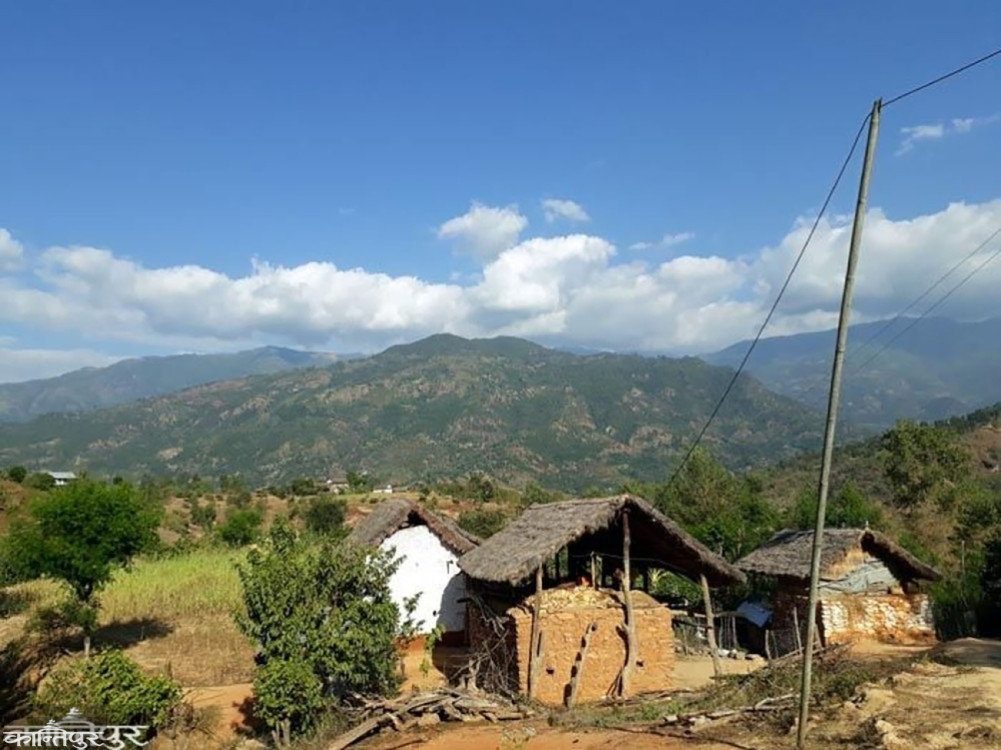
The Mid-Hill Highway was expanded along the banks of the Indrawati River. The same Majhi families lived on the steep land above the highway. Due to the expansion of the highway, a landslide occurred on that steep land during the rainy season. From there, they also built tin huts on public land near the highway. However, that place is also not safe and habitable. Thus, in the past 15-20 years, the Majhi families were forced to move to 2-3 places repeatedly. The repeated displacement has had an impact on geographical, economic, and social aspects. It is also affecting the education of their children.
The Majhi community still does not have the title deed of the land they live on. Basic services like drinking water and electricity are not available there. The Majhi family is deprived of basic services. Some Majhi families are using electricity by asking for help from a house far away that has electricity and paying monthly bills. In such a situation, their residence is unsafe and it is difficult to live in the increasing heat in summer and the tin huts are getting colder in winter.
With the traditional occupation of the Majhi family, farming and nature-based economic activities in crisis, they are now mainly dependent on daily wages. Since these jobs are also irregular and the income is very low, their daily livelihood is only subsistence. Their wages are completely dependent on physical labor and they do not have any savings. Even the small savings from their earnings are spent on building temporary shelters. Some of them have taken loans to build shelters. Some Majhi families have been forced to build shelters repeatedly due to repeated displacement. A large part of the income of wage laborers goes to repaying loans for a long time. Therefore, their food and housing conditions have become critical, but they are forced to fall into a cycle of long-term economic insecurity.
The effects of climate change have affected the lower classes like the Majhi, minority communities, and residents of the Himalayan region more. However, the debate about climate change and its effects has not touched the Majhi settlements. The negative effects of climate change have not only affected the livelihoods and income sources of the Majhi community, but it has also directly affected their social structure and cultural aspects. Along with boating, fishing, and farming, festivals, celebrations, and traditions were also integral to their lives. However, human activities have changed the nature of the river and also disrupted their habitat. In the past decades, uncontrolled gravel and sand mining has changed the natural rhythm and nature of the river. The crusher industry that has opened in Bagrelti has not only increased river pollution, but has also disrupted the water flow, water system, fish, and ecosystem. This has had a direct impact on the daily livelihood of the fishermen. The number of fish in the river has decreased and is on the verge of extinction. The occasional terrible floods have also turned their little cultivable land into a wasteland. This community, dependent on nature, was forced to leave its traditional place. The Majhi community not only lost their homes, but their traditions, culture, and livelihood, as well as their identity, were also in danger. The displacement of the Majhi community is a vivid example of the disproportionate effects of the crisis caused by climate change in recent years.
Families with relatively strong social and economic status have adopted various security measures or migrated to safer places to make their residence safer. However, the lower class and marginalized communities have neither been able to migrate to safer places nor to make their current places safer. Trapped in the vicious cycle of economic problems and poverty, marginalized communities like the Majhi have not been able to improve the educational status of their children. Children of the Majhi community drop out of school and get married at a young age. Their family financial situation is so precarious that they do not even see a chance to migrate to safer places or buy real estate elsewhere. Such a situation seems to have almost closed the way for their economic, educational and social status to improve.
In an environment where the issue of climate change is becoming increasingly complex globally, Nepal is not immune to this. Many studies have confirmed that human activities have been affecting the climate at a rapid pace in the past few decades. Studies have indicated that the rate of temperature increase in the Himalayan region is higher than average. The impact of such changes is being seen in Nepal in the form of water and weather disasters such as floods, landslides, glacial lake outburst floods, avalanches, heavy rainfall, droughts, etc.
Residents of the Himalayan districts say that snowfall has been decreasing in their settlements in recent years, and the direct impact of climate change is being seen. The human capacity to adapt to such rapidly occurring crises is also decreasing. An example is the dry landslide and flood that occurred in Til village of Limi, Humla in Jestha 2082, which displaced the entire village. A landslide in Ilam last Asoj caused a huge loss of life and property. In the future, there is a strong possibility that the incidence of disasters caused by such changing climate will increase instead of decreasing. There is no doubt that these events will generally have a greater and disproportionate impact on certain classes, castes, communities, women, children, people with disabilities, and the elderly.
Since the activities created due to climate change will change the social structure, demographic structure, and social relations of the Majhi community, it will have a long-term impact. Compared to castes or communities that have benefited structurally through economic, social, and political access, the Majhi community, which has suffered structural discrimination, lacks the means and resources to deal with the effects of a changing climate. Since more resources are needed, the effects of climate change will have a disproportionate impact on such communities. Therefore, if adequate measures are not taken in a timely manner, it will be impossible to return the social structure and ecological system of minorities and other disadvantaged communities like the Majhi to their previous state, which will undoubtedly have terrible and devastating consequences.
Therefore, this issue should not be viewed in a one-sided manner. It is important to prioritize multidimensional aspects including economy and livelihood, including education, health, environment, and others, while focusing on the human and ecological systems as a whole. It seems that climate adaptation strategies should be developed at the local level through inclusive planning and community participatory processes and resources should be provided. For this, it is necessary for the federal, provincial, and local governments to pay attention to the sustainability of climate change and adaptation aspects according to their respective areas of work.
– Bhattarai conducts research on climate change and migration at the International Center for Integrated Mountain Development (ICIMOD).