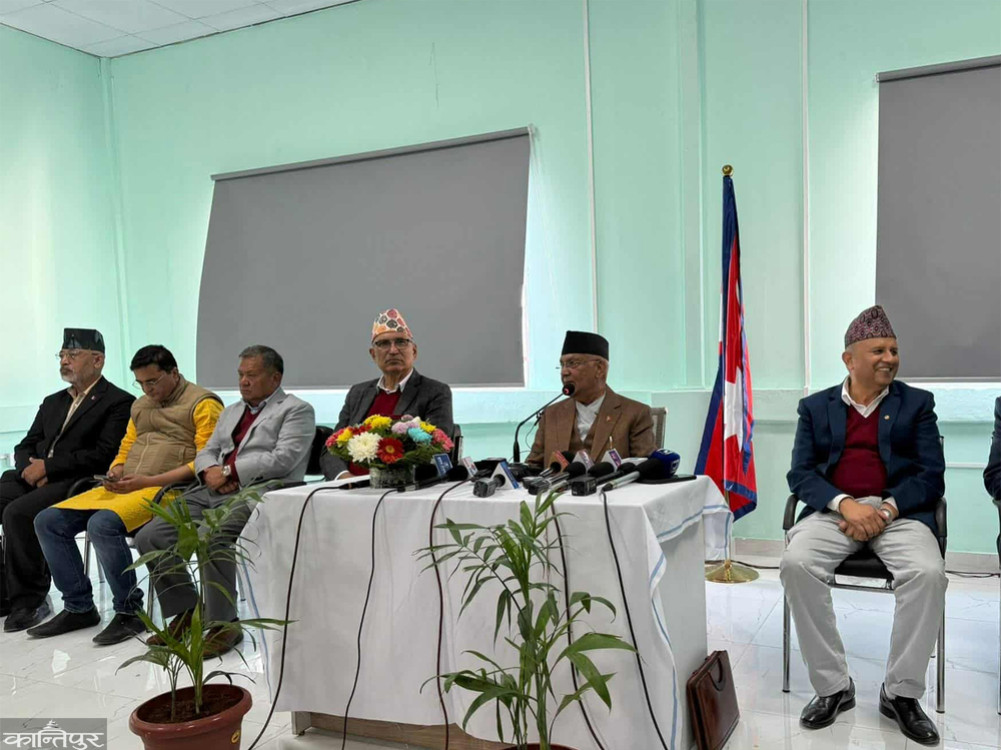
Whether the UML leadership accepts it or not. Compared to other parties, the UML's behavior seems 'moderate' when it comes to giving Karnali a fair place in various occasions of party and state power. By understanding the psychology of Karnali, the general convention should be able to correct the injustices done in the past.
We use Google Cloud Translation Services. Google requires we provide the following disclaimer relating to use of this service:
This service may contain translations powered by Google. Google disclaims all warranties related to the translations, expressed or implied, including any warranties of accuracy, reliability, and any implied warranties of merchantability, fitness for a particular purpose, and noninfringement.
The 11th General Convention of the CPN (UML) is starting tomorrow (Saturday). Representatives, leaders, cadres and well-wishers are currently gathering in Kathmandu for the general convention. The representatives have already started lobbying to reach the central leadership. The representatives are expressing their aspirations through the media, social media and their supporters. Some have opened their mouths in meetings with key leaders. The 11th General Convention of the UML is drawing a lot of UML people in the federal capital.
This general convention is being watched with great interest after the federal government withdrew from it due to the Gen-G movement on Bhadra 23 and 24. Will the UML leadership be able to conduct a clean democratic exercise in the general convention in line with the essence of the people's multi-party democracy? How will it address generational change and youth representation? Will it include classes, regions and communities that were not prioritized in the past in the leadership this time? Not only the general party ranks, but also those interested in UML politics are currently playing with similar questions.
Because in the last few years, the UML core leadership has become intolerant of criticism and different opinions, and has established the dominance of a certain class community in political opportunities, such as party management, which has raised questions about the public image of UML. Whether the UML leadership admits it or not, such questions are also surrounding the ranks of cadres at the grassroots level. This article focuses on the issue of fair representation of Karnali, which has been neglected by the party leadership.
UML elected 19 office bearers at its 10th general convention held in Sauraha, Chitwan in November 2078. Even though there were seven vice-presidents, seven secretaries and three deputy general secretaries, the entire Karnali province was not included in the office bearers. Karnali became zero when the number of office bearers from Lumbini province reached 6. Although this may seem normal when understood in general terms, it was not fair to deprive an entire geography of the central leadership of a responsible and large party in the country. Such a decision of the general convention could not address the sentiments of the people of Karnali.
It can never be said that a democratic party can make various excuses and turn any class, community or region into a grocery store. After all, competence and ability also matter in politics. There are not many leaders among the UML leaders in Karnali who can 'deserve' office bearers. Yamalal Kandel was almost the only contender for the post of secretary from Karnali at the Sauraha general convention.
He was no less than the current office bearers in terms of organizational experience, qualifications, and capabilities. Kandel, who has a firm grip on geography, won parliamentary elections many times, became a federal minister in 2054 BS, and had already served as the province in-charge, had already started asking for votes in Sauraha. But in the end, he did not fit in.
UML has not been able to provide balanced representation not only in the party's central office bearers but also in other state opportunities. When the main leadership became lenient towards Karnali province, local leaders and cadres have been expressing their disappointment and anger in public. In 2073 BS, when the Sher Bahadur Deuba-led electoral government appointed a leader from the respective province as the provincial chief, KP Sharma Oli, who then led the government, appointed and sent a leader from the Far West.
Even though a person who had repeatedly lost in the general elections was made the provincial chief, that appointment could not accommodate the psychology of Karnali. When Deuba gave the responsibility to a Congress leader from Karnali, it was natural to expect that the UML would have made a leader from its own province the provincial chief in that place. Even when appointing the provincial chief for the second time, UML Chairman Oli did not like the leader from Karnali.
There is talk that the party leadership has shown a disregard for Karnali while appointing federal ministers, provincial chiefs, ambassadors, and various constitutional commissions. This has not only created discontent within the party, but the opposition party has repeatedly called the core leadership of the UML ‘anti-Karnali’ and ‘undemocratic leadership’.
Competitively strong, ignored by the leadership
If we look at the results of the 2079 general election, the UML received 183,133 votes in the House of Representatives and 183,950 votes in the Provincial Assembly from Karnali under proportional representation. In proportional representation, the UML received more votes than the Congress and the Maoist Center. Out of the total 12 seats in the direct representation, the UML candidate was defeated by a very small margin in some areas. In the direct representation, all parties except the UML were in alliance.
Despite the alliance, it won five out of 24 provincial assembly seats. In the local elections, the UML won 15 mayors and 21 deputy mayors out of 79 municipalities by competing alone against the candidates of the then ruling coalition. It won 184 out of 719 wards in the province.
In 2074, it received 182,843 votes in the House of Representatives and 169,756 votes in the Provincial Assembly through proportional representation. This is also a more popular vote than the Congress and the Maoist Center. It became the first party in Karnali by winning 6 out of 12 seats in the House of Representatives directly and 20 out of 40 seats in the Provincial Assembly. According to the latest census, there are more than 600,000 organized members of the UML in Karnali, which has a population of 1,688,412. This organizational situation of the UML in a province where the Maoists claim a 'base area' cannot be called 'weak'.
The representation of Karnali leaders in the politics of the other two big parties, the Nepali Congress and the Nepali Communist Party (formerly the Maoist Center and the Unified Socialist Party), is not only significant, but also influential. Purna Bahadur Khadka of Surkhet, who has been a party central member, joint general secretary, general secretary, deputy president and is now leading the party general convention as the acting president, is currently one of the strong contenders for the presidency from the establishment camp. Janardan Sharma and Shakti Basnet were deputy general secretaries in the then Maoist Center. Sharma is currently in the role of the protector of the Progressive Democratic Party.
Prakash Jwala was the vice president of the Unified Socialist Party, which was formed after splitting from the UML. He is now in an influential role in the Nepali Communist Party. The leaders of the Congress, Maoists and Unified Socialists (currently affiliated with the CPN) have held powerful ministries such as finance, home, defense, physical infrastructure, and energy. Khadka even rose to the position of deputy prime minister from the Congress.
Leaders from Karnali geography are seen in influential roles even in the parties led by the RPP and Biplav. But in a democratic party like UML, which has an old and vast organization, Karnali has been deprived of the opportunity of leadership.
UML has not been able to give Karnali leaders a proper place in parliamentary politics. After the 2060s, Karnali's presence in the Council of Ministers has not been strong from UML. When KP Oli became Prime Minister for the second time, Mohan Baniya from Mugu became a minister for 13 days. That too without a department. Apart from that, there is no record of him becoming a cabinet minister. Surkhet's Nawaraj Rawat, Jumla's Dilli Mahat, and Dolpa's Dhan Bahadur Budha were made ministers of state.
Instead, after leaving UML, Prakash Jwala and Dhan Bahadur Budha got important ministries. Non-MP Govinda Bandi from Dailekh was able to become the law minister for 6 months on the recommendation of the Unified Socialists. Prem Bahadur Singh of Kalikot also left UML and Madhav Kumar became the Minister of Law in the Council of Ministers of Nepal on the recommendation of small parties. In 2054 BS, Yamalal Kandel became the Minister of Tourism in the government led by Girija Prasad Koirala. His tenure lasted for about three months.
Due to repeated pressure, UML got the opportunity to lead the Karnali provincial government in Chaitra 2080. Only then was Kandel able to become the Chief Minister. After becoming the Chief Minister from the UML-Maoist alliance, the Congress-UML alliance also gave him continuity. Kandel is currently the Chief Minister. Even after winning 20 out of 40 seats in 2074 BS, the UML had handed over the Chief Minister's post to the ruling partner party. There was some conflict between the Karnali party leadership and the central leadership after it was unable to lead the government despite becoming the largest party in the province.
The UML leadership is accused of being stingy in giving opportunities to qualified cadres in ambassadorships, various constitutional bodies, and institutions. The local leadership has repeatedly expressed public anger when Karnali is not in the eyes of the leadership, no matter how much expertise the cadres have. While there are many examples of the Congress and the Maoist Center giving priority to their cadres in various political opportunities from this province.
So far, the leaders here are limited to the standing committee, politburo, and central members. Although the UML is organizationally strong, the leaders and the party here have been missing important opportunities because the central leadership has not been generous towards Karnali. In some cases, the leaders say, 'Our party does not listen to us even when we ask for it, but those who left the UML have got good positions.' Even when leaders are given any position, they are given with kindness.'
This time too, Karnali leaders have been meeting with the top leadership including Chairman KP Sharma Oli, General Secretary Shankar Pokharel and claiming at least one position in the office bearers. The leaders argue that they are capable of becoming part of the leadership in terms of geography and strength. The cadres understand that as long as Karnali province is not represented in the party headquarters, there will be less interest and priority in solving Karnali's problems. However, no matter what happened in the past, Karnali is confident that this time it will get a proper place in the leadership.
It seems certain that there will be a competition for leadership in this general convention. The majority of leaders and representatives in Karnali seem to be in favor of Chairman Oli's continuity. In this regard, Oli will have a hard time managing the leaders of his team. This general convention should be able to correct the injustices of the past by adopting the psychology of the party ranks of Karnali. Whether the leadership accepts it or not, the liberal behavior on the issue of giving Karnali a fair place in various occasions of the party and state should not be repeated. The 11th general convention should be successful in reducing the distance between Karnali and the party center by understanding the psychology of the common workers.
Karnali
Provincial Chief – 0
Cabinet Minister – 1 person 13 days (without departmental)
Minister of State – 3
Chief Minister – 1 (current)
Ambassador – 0
Constitutional Commission – 0
Planning Commission Member – 1