The trend towards more common prosecutions compared to corruption has led to a lack of public shame and fear when engaging in irregularities.
We use Google Cloud Translation Services. Google requires we provide the following disclaimer relating to use of this service:
This service may contain translations powered by Google. Google disclaims all warranties related to the translations, expressed or implied, including any warranties of accuracy, reliability, and any implied warranties of merchantability, fitness for a particular purpose, and noninfringement.
With every development project, the state should gain positive experience and national self-confidence should be enhanced. In our country, development projects have often brought about stories of corruption.
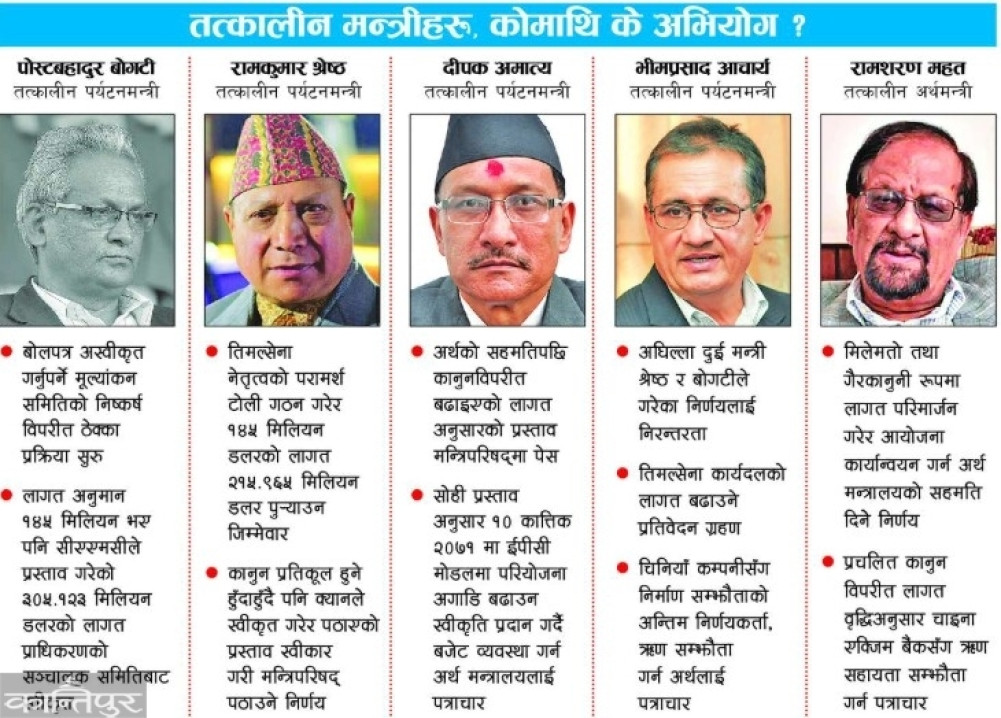
With every big project, some ministers and high-level employees are known as corrupt. As a result, big development projects are becoming synonymous with not only national pride and prestige, but also disrepute. In this regard, the Commission for the Investigation of Abuse of Authority (CIAA) on Sunday filed a case against 56 people, including 5 former ministers, 9 former secretaries, and a former registrar of the Supreme Court, in a special court, alleging corruption during the construction of the Pokhara Regional International Airport. The society has become restless after so many officials, including ministers, were charged with corruption in a development project. In the context of the project, which was built at a cost of billions of rupees by borrowing foreign loans, and has not been commercially operated even three years after its inauguration, the scale of corruption and the details of the accused that the CIAA has made public are extremely worrying. This makes us realize the need to make our fight against corruption more systematic and firm.
A case has been filed claiming that the construction of the Pokhara Airport, which was built as a national pride project at a cost of 24.58 billion rupees, has caused more than 8 billion rupees in losses to the government. Like Pokhara, many other big projects are also plagued by corruption. There are allegations of irregularities in the distribution of compensation and construction during the construction of the 30 billion-dollar Gautam Buddha Airport. The Authority for National Investigation and Control (AINC) has filed a case against Pradeep Adhikari, Director General of the Civil Aviation Authority, and six others in a special court on Wednesday for corruption in the construction of a heliport in Nalinchowk, Bhaktapur.
Similarly, there are allegations of corruption in the construction of the Sikta Irrigation Project under the National Pride Project. The case is pending in the Supreme Court. There are also allegations of corruption in the purchase of wide-body, security printing press, 'MDMS' system that is said to deactivate mobile phones brought by evading customs, Terramax technology, and health supplies during the Corona epidemic. Lalita Niwas, Giribandhu Tea Estate, Bansbari, Bal Mandir, fake Bhutanese refugees, and camp scams are all known as corruption scandals.
It has become common for development projects not to be completed on time. Such a situation has deprived people of getting the benefits they should have received from the relevant projects on time. The financial burden of construction increases with the cost increasing over time. They are also being deprived of the jobs and capital formation that would be generated when projects are completed on time. On the other hand, every major project or procurement is being mired in corruption. Along with the risk of substandard structures or systems, corruption also increases frustration among citizens. Distrust and anger arise towards the state's systems, mechanisms and working style. Citizens' self-confidence also weakens. How can a country rise above corruption when every project is involved in corruption?
Taking the corruption in the construction of Pokhara Airport into context, it is necessary to discuss some aspects. First, there are allegations that so much money has been lost in a single project. So, are there structural weaknesses in our development projects that make it easy for corruption to occur? Are there loopholes in the law? Or, are there areas where errors occur in administrative work? Why are projects becoming fertile fields for corruption to flourish? The answer to such questions is linked to the review and improvement of our legal provisions. If there are weaknesses in the law and our practices, they must be improved.
Similarly, currently, the lowest bidder in project construction or procurement gets the contract. Although this makes government expenditure economical, it has led to problems such as not completing the project on time and not ensuring quality. Therefore, binding provisions should be made so that even if the contract is given at a low price, the project is completed on time and the quality is also ensured. Such laws and practices should be made so that there is no possibility of corruption, delay and poor quality.
Second, a case has been filed against 56 people on charges of corruption during the construction of Pokhara Airport. What does the accusation of involvement of so many people in a single project indicate? The list of those accused or filed in other projects or irregularities is also long. This sends a message that the attitude of committing irregularities wherever they are found is spreading like wildfire. The attitude has developed that a person who has assumed official responsibility does not consider it difficult to harm the interests of the country and the people for personal gain. Abuse of office has become normal. Public shame and fear have also ceased to be felt when involved in irregularities.
What are the factors that play a role in developing such a trend? Is it because of the lack of legal action, the fact that action is common compared to corruption, or the fact that society itself does not consider corruption as unnatural? If so, then society itself needs moral awakening. No, if the fault lies with the law or the state machinery, then reform is needed. If reform is not done even now, the state will become more hollow. On the other hand, even with good intentions, there will be a situation where the state will hesitate to proceed with projects or purchases that are necessary. That will ultimately increase indirect corruption.