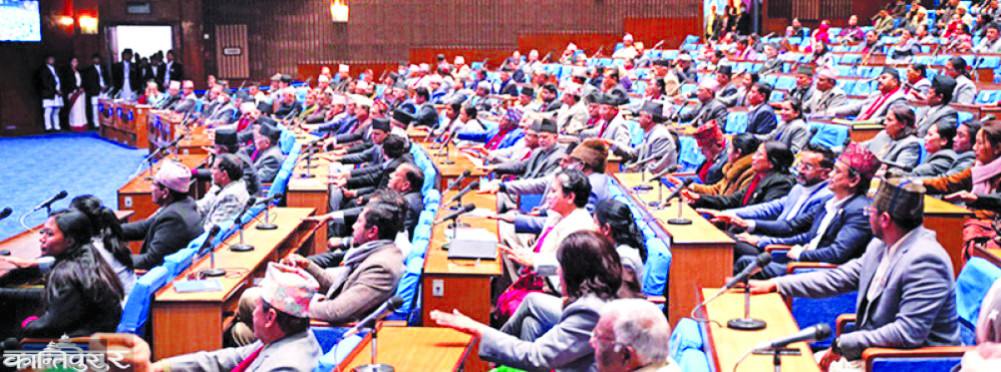
When parliament is not active and questioning, all efforts to control corruption are weakened.
We use Google Cloud Translation Services. Google requires we provide the following disclaimer relating to use of this service:
This service may contain translations powered by Google. Google disclaims all warranties related to the translations, expressed or implied, including any warranties of accuracy, reliability, and any implied warranties of merchantability, fitness for a particular purpose, and noninfringement.
Recently, corruption has spread to the villages to an extraordinary extent. Corruption has taken root at all three levels. Due to corruption, administrative services are not easy. The contract system is not organized.
The plan is not completed within the stipulated time. From the political and administrative appointment process, law enforcement to the justice system, citizens are forced to experience unequal treatment and irregularities. Therefore, the question is natural – how did corruption reach this level?
Many people say that corruption has increased due to the weakness of the Commission for the Investigation of Abuse of Authority. That is one reason, although not the whole story. Article 239 of the Constitution has narrowed the authority of the authority. Its role is basically limited to implementing the law. The task of formulating and monitoring policies to control corruption is the responsibility of the Parliament. The tasks of making laws, forming the government, monitoring the executive, holding parliamentary hearings on the appointments of constitutional bodies and judges, discussing the annual reports of constitutional bodies, bringing a motion of no confidence against the Prime Minister if he does not act in accordance with the dignity of his office, and impeaching the officials of the Constitutional Commission and the judges of the Supreme Court are among the tasks of the Parliament. But ironically, the Parliament has not been able to fulfill these responsibilities for a long time. Which has a direct impact on the establishment of good governance and corruption control.
Why has the parliament become ineffective?
The main political control and leadership of corruption control lies in the parliament. Bodies like the Authority, the Auditor General, and the judiciary are just its tools. The essence of the constitution is that the parliament should be at the forefront of corruption control. But unfortunately, the parliament and the members of parliament have become ineffective by not being able to fulfill their role effectively. The parliament is gradually becoming weak, ineffective, and a puppet of political parties. There are some reasons behind this.
First, the parliament could not enact the necessary acts and laws related to corruption control on time. The 2072 constitution removed the provision related to improper acts from the jurisdiction of the Authority. However, the parliament could not enact laws related to improper acts for 10 years. The bill to amend the Authority Act was not finalized for years. The bill on conflict of interest and national vigilance was not advanced. Nepal had to enact seven new laws and amend 27 laws to implement the International Convention against Corruption. The parliament was not serious about this either. Article 239(2) of the Constitution provides that a person who is removed from office after an impeachment motion is passed, a judge who is removed from office by the Judicial Council, and a person who is subject to action under the Military Act may be investigated or ordered to be investigated in accordance with federal law after his or her removal from office. However, Parliament has not been able to enact the said Act. This has created a legal 'vacuum' in the field of corruption control.
Second, the responsibility of forming the government lies with Parliament. It is within the jurisdiction of Parliament to appoint a person as the Prime Minister. If the Prime Minister fails to establish good governance and control corruption, he or she can be called to Parliament and held accountable. If he or she is found to be very weak, a no-confidence motion can be brought to remove him or her. However, in recent times, Parliament has not even had the power to call the head of government even once to discuss in general terms why corruption is increasing and what is being planned to control it. Third, Article 292 of the Constitution provides for parliamentary hearings. Constitutional
Before the appointment of the Chief Justice, Supreme Court judges, members of the Judicial Council, heads or officials of constitutional bodies and ambassadors to the posts recommended by the Council, there must be a parliamentary hearing in accordance with federal law. Appointments cannot be made without the hearing and approval of a parliamentary committee. Its original purpose was to maintain democratic control over the decisions of the executive, make the appointment process transparent and prevent political interference or division. But in practice, this system is often 'ineffective' and limited to formalities. The ruling-opposition coalition, party interests, division and political proximity of individuals sitting on the hearing committee determine the committee's decisions. Access to leaders, loyalty to the party, financial mobilization and personal relationships have begun to take precedence over qualifications.
As a result, the practice of appointing politically convenient individuals rather than independent and honest individuals to positions sensitive to corruption control such as the Authority, the Auditor General, the Chief Justice and Judges of the Supreme Court, and members of the Judicial Council has spread. Such an appointment structure has posed a serious challenge to institutional independence, accountability, and oversight capacity. The weakness of parliamentary hearings has contributed to increasing corruption in the country. Similarly, if an appointed person is found not to have acted in accordance with his or her official conduct, the parliament itself has the right to immediately impeach such a person. However, it seems that the parliament has not been able to fulfill its role.
Fourth, the parliament seems to have become a place for political bargaining rather than a policy-making institution. There is no competition of policies and ideas between the ruling and opposition parties in the parliament. Instead, the culture of power sharing and position sharing has been destroyed. MPs are spending more energy on political and self-serving interests of their leaders than on issues of concern to the citizens. While the parliament is busy with political bargaining, it has not been able to pay attention to the country's governance system. What is the pace of corruption, what are the dimensions, where are the problems, and what can be the solutions? There is no discussion in the parliament about what is the pace of corruption, what are the dimensions, where are the problems, and what can be the solutions. As a result, the parliament has not been able to fulfill its obligations and responsibilities in controlling corruption.
Fifth, the culture of monitoring and questioning has disappeared. The weakening of the parliamentary culture of monitoring and questioning is also a major reason for the increase in corruption. The main responsibility of the parliament is to monitor the activities of the government, evaluate the effectiveness of policies and programs, and hold the government accountable to the citizens. But this role is not being fulfilled seriously by the parliament. Parliament has become a place for formalities rather than discussion, debate, argument, criticism, and review. The practice of calling ministers and asking them clear questions about their work, budget expenditures, policy implementation, and their role in good governance and weaknesses is disappearing.
Parliamentary committees are considered the most effective mechanism for controlling corruption in many countries, but such committees appear weak, inactive, or politically divided in Nepal. Parliamentary committees could easily have dealt with issues such as various ministries, contract systems, financial irregularities, and corruption, but there is little activity in that direction. Regular question-and-answer sessions also end in formalities, where questions are superficial, answers are unclear, and accountability is low. Even if a minister or high-ranking official is present in parliament, an environment has been created where they only make promises, do not provide clear facts, and easily evade accountability. In this way, when the culture of monitoring, criticism, and questioning is lost, government decisions are believed, wrong decisions or irregularities remain unchallenged, and impunity increases. When parliament is not active and question-oriented, all efforts to control corruption are weakened. Because, the strongest monitoring mechanism of democracy, parliament, becomes useless.
Sixth, there is a situation where reports pile up but implementation is zero. There is a tendency in Nepal to produce cartloads of reports but not implement them. Every year, various parliamentary bodies, including the Public Accounts Committee, prepare detailed reports on irregularities and corruption. They include scams and irregularities worth billions. The reports prepared by parliamentary committees are very important evidence of where and how corruption is taking place. Ironically, such reports are not discussed in parliament. The reports are discussed in the media for a few days, and then they sit for years ‘waiting for implementation’. It is the responsibility of the parliament to initiate action against the guilty individuals or institutions mentioned there, to re-investigate or implement reform measures, and to formulate necessary laws if policy weaknesses are found. However, the parliament's activity in this regard is almost nil.
The parliament neither activates the implementation committee, nor directs the thematic committee, nor holds the government accountable based on the issues raised in the report. As a result, the culture of impunity has become even stronger. This kind of impunity is basically seriously affecting three issues. First, it is constantly recurring when the mechanism to prevent corruption is inactive. Second, it has reduced the trust of citizens in the parliament. Third, the understanding that punishment will not be imposed even after the report is made public has become strong, encouraging state bodies to shirk their responsibilities. Thus, the pile of reports and the lack of implementation have rendered the parliament useless. And, corruption is increasing.
Seventh, the closeness between the top leadership of the parties and the parliament. The excessive closeness between political parties and the parliament has weakened the parliament in controlling corruption in Nepal. In theory, parliament is the highest democratic institution representing citizens, where MPs are expected to make decisions based on their conscience, knowledge, and the voice of the people. But in practice, the situation is the opposite. Most MPs have become the order takers of party leaders, not citizens. The top leaders of the party dictate what to say on which issue, how to vote, and whom to support or oppose. MPs are happy to make their freedom to think, question, oppose, or propose alternatives hostage to the leader's instructions.
When the dictates of the party leadership dominate the parliament, the priority of the parliament automatically becomes not the citizens' problems, but the interests of the party leadership, the equation of power, and political bargaining. This leads to three serious problems. First, MPs are afraid to ask questions, because they fear that their politics will end if the leadership is dissatisfied. Second, parliamentary committees become ineffective, because strict monitoring is not possible due to party interests. Third, control over the government becomes weak, because most MPs do not want to raise questions that will make their own party's government uncomfortable.
On the other hand, party commitments are made greater than the duty of speaking up for the interests of the citizens as public representatives. This has destroyed the culture of personal conscience, policy debate, and accountability within the parliament. As a result, the parliament has become a place to fulfill party interests rather than the main institutional force against corruption. When the parliament becomes inactive and the control over the government weakens, corruption begins to take an institutional form. State bodies become ‘partners’ rather than ‘controllers’ in the context of corruption.
The way forward
The issue of making the parliament active and accountable has been neglected in the programs to discuss corruption control. The problems mentioned above show that the lack of corruption control cannot be controlled by blaming bodies like the Authority alone, but rather the institutional renaissance of the parliament is essential. Only if the parliament is strong will the government be accountable, constitutional and other bodies will be transparent. Impunity will decrease. Therefore, the first place to take responsibility for controlling corruption should be the people’s representative bodies. Something needs to be done for this. First, the parliament should be made independent and active. Policy and legal arrangements should be made to free the parliament from the orders of the top leaders of political parties and make decisions based on discretion. After the upcoming elections, the system of holding regular parliamentary meetings, quickly passing pending or necessary bills related to corruption control and good governance, and conducting monitoring activities in a timely manner should be strictly implemented.
Second, the parliamentary hearing system should be made more transparent and effective. Parliamentary hearings have become like a decision-making body according to the interests of the top leaders. Therefore, policy arrangements should be made to make the hearing process open, fact-based, and transparent. The tendency to look at party affiliation over merit should be ended. Third, the revival of the question-and-answer and monitoring culture in parliament is necessary. In-depth debate, review, and accountability should be ensured in parliament.
Fourth, a legal arrangement is necessary to ensure the implementation of reports. Once the reports of parliamentary committees and constitutional commissions are presented to parliament, a clear deadline should be set for implementation. A powerful report implementation monitoring committee should be formed in parliament. The commission should be made mandatory to identify the culprits, recommend action and implement corrective measures. Fifth, the distance between political parties and parliament should be clearly defined. MPs are representatives of the citizens. Therefore, party whips (party instructions) should be limited only to the context of government formation and dissolution. In addition, an environment should be created for MPs to make independent decisions, prevent unnecessary interference from party leadership, and encourage a culture of debate based on discretion and expertise.
The most important issue is that continuous pressure from civil society, the youth generation, and the mass media is necessary to make parliament accountable. Citizens should also develop a culture of monitoring the activities of MPs, holding public hearings with MPs in their respective constituencies at least twice a year, and regularly demanding accountability from MPs through digital technology.
Finally, corruption is not the result of the mistakes of any individual or institution. It is the result of the weakness of the political structure and the inefficiency of parliament. Corruption cannot be controlled unless parliament is strong, transparent, and citizen-oriented. Authorities and courts alone cannot win this battle. Parliament should take the lead. The opposition should also be active, and citizens should constantly ask questions. Parliament is the backbone of corruption control and establishing good governance. The journey of corruption control can begin with the renaissance of Parliament. Therefore, if Parliament becomes aware, corruption will decrease. If Parliament remains ineffective, corruption will continue to be our destiny.