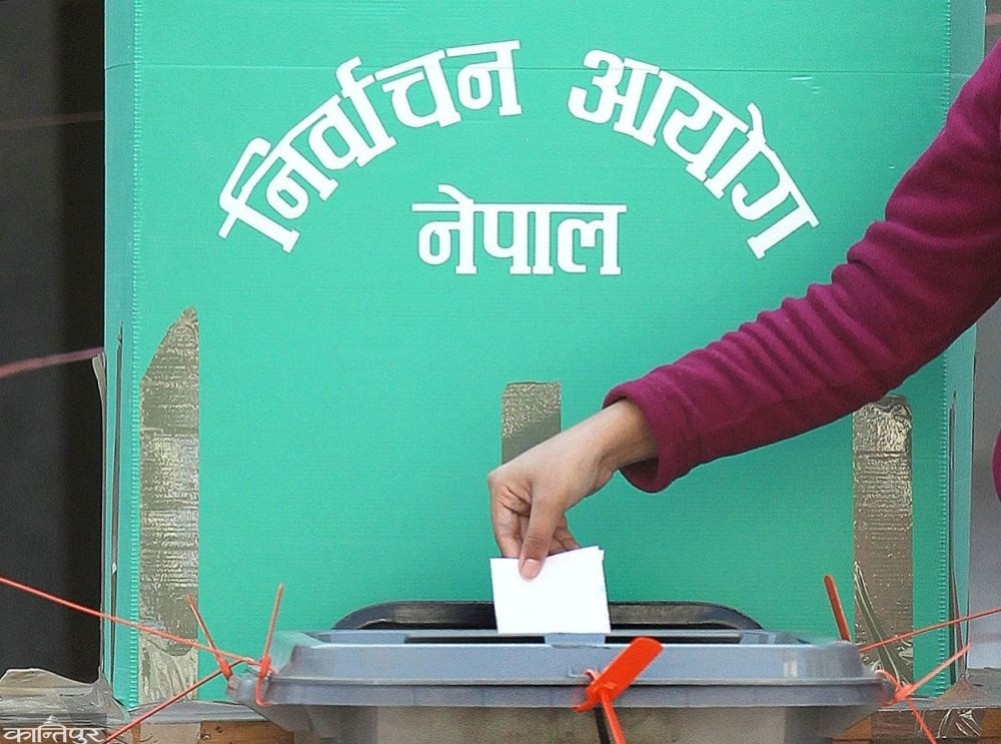
Meena Poudel writes, “Efforts to mitigate challenges should be proportionate to time, technology, security, voter awareness, the democratic environment of the destination country, and the diversification of diplomacy between the two countries.”
We use Google Cloud Translation Services. Google requires we provide the following disclaimer relating to use of this service:
This service may contain translations powered by Google. Google disclaims all warranties related to the translations, expressed or implied, including any warranties of accuracy, reliability, and any implied warranties of merchantability, fitness for a particular purpose, and noninfringement.
The debate over migrant worker voting rights has been resurfacing for some time now. In fact, whenever federal elections approach, the issue of migrant worker voting rights also comes up for discussion.
After the election, the discussion tends to disappear until the next election date is set. This has been going on for about a decade.
Due to the dishonesty of political parties and governments towards the current constitutional provisions and the Supreme Court's directives for their implementation, the provision of voting rights for migrant workers has become like a 'story of one country'. This reality is probably known to all sections of the society, including the workers participating in this debate.
The then corrupt rulers spent decades embezzling the national treasury created from remittances. But the economic elite ignored the voting rights of millions of youth. Instead, they were busy selling youth to prolong their rule. They are now loudly asking the interim government to create an environment for Nepali voters working abroad for various purposes, including foreign employment, to participate in the general elections to be held in Falgun. It is strange. Can an interim government that they themselves dislike and are not cooperating with do this complex and challenging task that they have been ignoring for decades, in two-three months? They have also understood the reality. However, it is important for all of us, including migrant workers, who want to see the country return to a democratic rhythm, to understand their crooked moves.
The latest movement was to further strengthen the current constitution and system and to end corruption and ensure good governance. The young generation that led it also needs to understand that it is legally, politically, diplomatically, technically and practically impossible to get Nepali voters scattered in more than a hundred countries to participate in the elections to be held in Falgun from their workplaces.
The task of exercising voting rights from foreign destinations is not easy. But the question arises whether any efforts have been made for all these years. Countries like ours, such as Estonia, the Philippines and Indonesia, which are dependent on remittances, are continuously moving forward with efforts and gaining experience for this complex task. However, according to studies in that direction, more work needs to be done to reach a resolution regarding their labor migration, especially in terms of electoral diplomacy and cyber diplomacy. Why didn't we even start the effort? Should the leaders who have lost political relevance by bringing the country to this situation answer this or not? We should keep looking for answers to such questions from each political party and its candidates.
This is what happened, the situation so far regarding the voting rights of migrant workers and Nepali voters abroad. But we should not forget the current political climate that the youth leadership has turned upside down. Fundamental rights must be ensured without prejudice. In addition, attention should also be paid to social justice regarding the voting rights of migrant workers. Therefore, it is important for all of us to advocate - as Prime Minister Sushila Karki expressed a while ago, this government should not delay in initiating a meaningful process.
If the current interim government does not initiate a process, there is a possibility of reaching the same zero result after the election. Nevertheless, it would be timely to focus our discussion on starting a basic process for the voting rights of migrant workers this time, rather than pressuring the impossible that Nepali voters scattered around the world should be allowed to cast their votes from their destinations. Therefore, the people's representatives and the elected government that comes after the election should honestly carry out the appropriate process. And in the next periodic election, workers, students and other eligible Nepali voters working in as many countries as possible, including India, should be allowed to vote from their destinations.
The practices of other countries also indicate the same. The situation we want is not found when analyzing the research and lessons learned so far. The experience of Europeans and Americans, who are said to have mature democracies and stable and relatively good governance, and who are considered experts in technology, is also complex. Most have postal voting procedures, which allow months of voting time.
The main methods in practice
Whether they are internal migrants or those in external destinations, overall, those outside their home countries seem to use four methods to vote – 1) voting at their embassies, 2) voting by mail, 3) ‘proxy’ voting, i.e. voting by a person authorized by the voter, and 4) internet voting.
Voting using these four methods has been systematically raised in the United Nations’ discussions on migrants’ rights for several decades. These methods have their own potential and challenges. But overall, the challenges are focused on political, diplomatic, and management. Empirical studies/research have indicated that the nature and seriousness of the challenges are largely determined by the diplomatic relations and balance of power between the migrant’s home country and the destination country.
Different countries have been found to practice different methods for their voters living outside the country. Some have also adopted mixed methods. In the case of Nepal, a brief study conducted by the Policy Research Institute for the government a few weeks ago has also suggested three methods other than 'proxy' voting to the government, in which it has been concluded that mixed methods can also be adopted.
When considering the context of Nepali labor migration and countries with similar destinations, Indonesia and the Philippines seem to be more relevant, in terms of opportunities and challenges. For example, Indonesia had placed ballot boxes in the embassy and ambassador's residences for its millions of citizens working in Malaysia in the 2019 election. They were given the opportunity to vote in person. In which only a few hundred people around Kuala Lumpur attended. Research has shown that this method does not represent the opportunities of the entire electorate.
The Philippines, which has a positive example in labor migration management, began the process of creating a law for the right to vote for migrant workers in 2002. A mixed method has been adopted, using methods that are convenient for them, such as attending the embassy, foreign service agencies, or through the post. Recently, Filipino migrant networks say that an internet voting method has also been introduced. However, the results of research conducted on the efforts of these two countries are not very encouraging.
These are the references related to our character of democracy, migration management, and common destination. The experiences of societies that are perceived to have different character of destination labor markets and different socio-political consciousness do not seem to be much different. According to various studies conducted by the United Nations and election-related organizations around the four methods mentioned above or about mixed efforts, the experiences of other so-called developed countries, including European, North-Central-South America, British, and African, also seem challenging. This indicates that no matter what method we adopt, there will be challenges. Efforts to mitigate the challenges should be related to time, technology, security, voter awareness, the democratic environment of the destination country, and the diversification of diplomacy between the two countries. The question today is whether we are ready for all of these, not only for the upcoming elections, but also for the subsequent ones. This question will have to be addressed by the newly elected government and the federal parliament.
Challenges pointed out
The challenges pointed out by studies based on the experiences of various countries seem to be the same. In summary, some points can be made. 1) The political awareness of voters voting from the destination country, their technological skills, and their interest in voting, which some countries have also called the status of voting literacy. 2) Cyber security management of their own country and the destination country. 3) Complex diplomacy, which includes political/electoral, labor, and cyber diplomacy. 4) Political challenges, this challenge encompasses the destination country's understanding and commitment to democracy, its political system, and the fundamental rights of citizens defined within that system. 5) Legal challenges. 6) Economic challenges. 7) Administrative/managerial challenges. 8) Inter-agency and transnational, multilateral coordination challenges, this is primarily related to the capacity, strategy, and scope of diplomacy and embassies. 9) The challenge of access to domestic workers who are informally/brokered, trafficked, and working in private homes.
On the one hand, these challenges are bound to be more complicated for a country like ours that does not even have a unified immigration policy. On the other hand, the lack of a unified immigration policy also means the lack of a national perspective on immigration. In our country, where immigration is defined by ministries and understood by political parties, the list of practical/ground-based challenges may be even longer.
Labor agreements themselves may be at risk
According to studies, the above-mentioned challenges seem to be more troubling for the sending country than the destination country, due to the destination country's approach to democracy and the civil rights framework, labor diplomacy, and social character dictated by the political system they adopt. Because there is not only economic but also political power inequality between the sending country and the employment destination. The first blow is likely to be to the labor agreement and overall immigration. Because the destination has the authority to decide what kind of workers and how many from which country to hire for what work. On the other hand, even if we sign an unequal agreement, we want the unemployed youth to work as much as possible. When we raise the issue of human rights of workers and the gender aspect of domestic workers and female workers, which has always been a challenge in the context of the 2022 World Cup in Qatar, we can guess from the diplomatic response and behavior received from them, what response we will get from them regarding the labor agreement that ensures the voting rights of our citizens.
Since immigration with India is of an informal nature and India itself is a democratic destination, the context of cybersecurity and international vote security will be more important. Not the electoral diplomacy required in bilateral labor agreements.
Let's start the process for the next election now
For years, labor agreements have not been renewed, labor agreements with new destinations have not been able to be concluded, those that have been made are not labor-friendly, and bilateral general understandings have not been implemented. Nepali foreign employment entrepreneurs who have flourished as fraternal organizations of the party and their level internal and international brokers are being cheated, sold in the name of domestic workers, trapped in smuggling, raped and in some cases killed. In such a situation, to say that we will create an environment for exercising our voting rights by setting labor diplomacy including election diplomacy in the current situation is to lie to the voters working in the destination country.
In the current fluid labor relationship with our destination country, where labor agreements cannot be reached, we neither have the diplomatic status to talk about election diplomacy and the cyber diplomacy connected to it, nor will they listen, but rather they cannot make labor agreements to be made in the future. For example, some Gulf countries are reluctant to make labor agreements due to disagreements over the context of domestic workers.
Therefore, instead of suddenly ignoring the challenges pointed out above and making decisions or putting pressure on them, let us start the initial preparations now, as the Prime Minister said, and let us move forward with the goal of internet or mixed voting, even if only in a trial form, in at least some countries by the next election. This will be relevant.
Finally, when talking about the voting rights of migrant workers, we should not forget the context of workers working in the internal labor market, which is a separate topic of discussion. Because, ensuring the voting rights of internal workers who are forced to work in remote corners of the country far from their hometowns is not so challenging for the government. Therefore, since this is a situation of a different trend, it is appropriate to have a separate discussion on this.