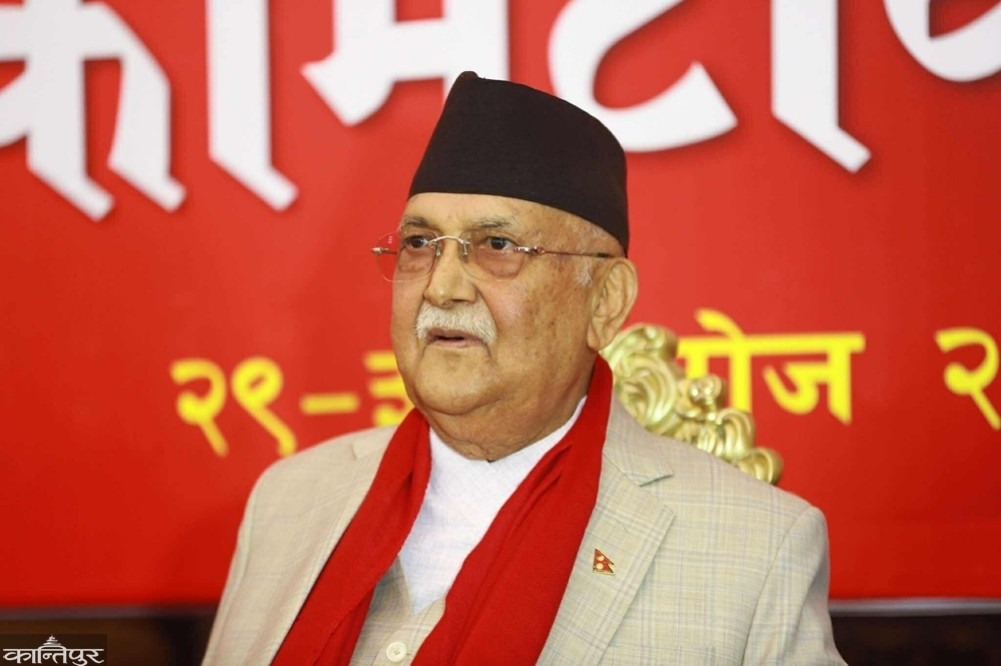
Amidst the controversy, the unpopularity, and the siege, one reality is that there is no other leader in UML who has the capacity to exert nationwide influence like Oli, at this time. Therefore, whether it is an election or a rehabilitation issue, when it comes to defensive or any other agenda-setting, UML depends on the Oli ‘brand’.
We use Google Cloud Translation Services. Google requires we provide the following disclaimer relating to use of this service:
This service may contain translations powered by Google. Google disclaims all warranties related to the translations, expressed or implied, including any warranties of accuracy, reliability, and any implied warranties of merchantability, fitness for a particular purpose, and noninfringement.
While the public's view of outgoing Prime Minister KP Sharma Oli, who was ousted in the street protests, is not very positive, a section of the CPN-UML is singing his praises. The party, which is trying to install Oli as the leader for the third time from the 11th general convention to be held in the last week of Mangesh (27-29), is saying, "Oli's leadership is indispensable to get the party and the country out of crisis."
There is another group within the UML, which wants the party to grow under the leadership of Senior Vice President Ishwor Pokharel instead of Oli.
Oli supporters believe that UML, which has become defensive after the Gen-G demonstration on Bhadra 23 and the destruction on the 24th, has been energized by Oli's recent activism, expressions and activities. The party is getting weaker. Other groups believe that Oli's confrontations and provocative activities will cause further damage to the party. Now he should be limited to the role of a protector or guardian.
UML is heading for its 11th general convention mainly amid the conflict between these two thoughts and tendencies. In the meantime, it has selected nearly 2,200 general convention delegates from across the country. The delegates have been selected through both unanimous and electoral methods. However, in many places, disputes and conflicts between the two factions have surfaced, resulting in a situation of chaos and chaos.
The outcome of the 11th General Convention is expected. Barring any unexpected or dramatic developments, Oli is certain to score a 'hat-trick' under the leadership of UML. He has mastered how to establish 'legal control' in the party. A striking example of this is the previous 10th General Convention held in Chitwan. Where he monopolized the General Convention in favor of his faction right from the stage of selecting representatives in the name of consensus.
After Bhim Rawal did not give up his stance on electing a legal leadership, elections were held for some posts including the chairman, however, Oli announced some office bearers and central members on his own initiative. Oli, who had the right to elect office bearers and members from a closed session, even said at that time that 'being able to reach an agreement is also the highest practice of democracy'.
Who can force Oli to bend the logic to his liking? He is the one who brought the proposal of an age limit of seventy years in UML. He himself brought the proposal of the age limit of seventy years, got it approved and removed it after many attempts when he was against it. Recently, he has paved the way for a third term as the chairman by removing the age limit of seventy years from the legislative session. It is likely that he will become the chairman for the third time through the same path. However, will his ability to lead become a topic of discussion as he is being promoted?
Oli has tried to prohibit discussions/questions by saying that the general convention will end after choosing the leadership along with his 'instructional address'. However, the general convention is a place to raise questions and find solutions through serious debate on them. Questions cannot be ignored in this place. Many questions have been raised regarding the leadership and role of this party before the UML. On which a deep discussion is required.
The questions raised now mainly need to be debated from three angles. First, the UMLs are now demanding Oli's leadership to resolve the political crisis. But, isn't Oli himself a major factor in the current crisis? How can Oli, who is a participant in today's political disaster, be a crisis solver? The country wants to see a generational transition of leadership in the parties.
Why are the UMLs looking for Oli even after changing the constitution? What is his leadership qualification? The UML is moving away from public opinion, the credibility of the parties is under question, democracy is weakening, isn't the failure and working style of Oli and the so-called top leadership like him responsible for all this? If so, why Oli again?
Second, Oli's sometime charioteer and current rival Ishwor Pokharel is also not free from questions. What is the justification for his candidacy against Oli? Perhaps if he becomes the leader of the UML, in what sense will he be different from Oli? Will the issue of generational transition be justified if he becomes the leader of the UML?
Third, what should be the role of the grassroots workers of the UML? In particular, the role/discretion of the general convention delegates who were elected and selected from below is also under examination and questioning.
Let's start this analysis with the first question. Why do the UMLs want to depend on Oli again?
Because, Oli is a 'brand' of the UML party. There are examples of this party presenting Oli as a 'brand' during elections or when he led the government. Oli himself also presents himself as a 'brand'. Sometimes he engages in 'ba' branding and sometimes he prefers to wear the garb of a nationalist leader. Sometimes he tries to 'brand' himself as the initiator of prosperity.
Oli, after the Gen-G movement, has reached a defensive state. However, at the same time, he is also trying to show himself aggressive. His confrontations and arrogant statements are also being opposed by other political parties, civil society circles and a section within the party. However, Oli is confronting all fronts at once.
Even after the Gen-G movement, he has tried to destroy the same 'brand' by saying that the power centers played on him because of the nationalist stance he took due to his loss of power. Amidst the controversial, unpopular and besieged situation, one reality is that there is no other leader in UML who has the status of having a nationwide impact like Oli, at this time. Therefore, whether it is an election or a rehabilitation issue, when it comes to being defensive or when it comes to 'setting' any other agenda, UML depends on the Oli 'brand'.
His jokes, sometimes airy comments, create a chain of actions and reactions. Since the national political scenario can make you feel present, it is possible that UML members are still calling him Oli. However, today, UML's Oli 'brand' has declined. It is becoming criticized and unpopular.
It has been almost five decades since Oli started being politically active. There are three main phases of his long political life. First, the phase of struggle. The painful prison life he endured during the struggle against the autocratic Panchayat system is memorable.
During the struggle against the autocratic system, many Congress-Communist leaders/activists were killed at that time. Many others suffered imprisonment. Among those leaders who spent a long time in prison, Oli is included in that list. Oli still occasionally recalls his days of struggle and tries to do 'emotional politics' under the guise of it.
Second, in the open environment after the restoration of democracy in 2046 BS, Oli remained in the roles of party politics and government administration. His original image during this period became that of a cunning leader who divided the party into factions. Due to his character of being close to the main leadership and being able to 'play power', he was able to come to power since the UML first came to power. He was the Home Minister in the first Communist government led by Manmohan Adhikari. After that, he also held roles including Deputy Prime Minister and Foreign Minister.
His political rise, or the third phase, took place after the ninth general convention of UML in 2071 BS. Where he defeated Madhav Nepal and became the party president. Since then, Oli has been leading UML for more than a decade. Moreover, he is at the center of national politics.
After becoming the president, Oli became the leader of the party's parliamentary party and became the Prime Minister for the first time in Asoj 2072 BS. This was the peak of his politics. It was then that his image as a national leader was formed. The role he played in the constitution-making process, and the context and events in which he steadfastly faced the economic blockade imposed by India gave him the image of a 'nationalist' leader.
Oli, who became popular for his strong stance in adverse times, has since become the Prime Minister four times. Oli is one of the leaders who has been in power for the longest period since the constitution was adopted in Asoj 2072 BS. Therefore, he is also the one who is most involved in the current political crisis. At present, he neither has the image of a nationalist leader like yesterday, nor does he have any popularity left. At present, Oli's face is stained with the blood shed in the Gen-G movement. It is covered with the ashes of the chaotic destruction after the movement.
There was never any consistency in Oli's words and actions. He says one thing and does another. He never got tired of saying that he will not commit corruption and will not allow it to be committed, but the country never got to taste good governance. The issue of good governance has cost the country so much that it has now gone out of politics and has reached the current constitutional and political crisis.
Why did all this happen? Isn't it the result of the self-centered and selfish politics of Oli and top leaders like him? When Oli is more dependent, conflict and polarization have increased in the internal life of the party. The party, which had a strong organization, has been shattered. Leaders who have been in the UML for many years have been divided. Therefore, should we create the party's 'brand' or rely on the 'brand' of a particular leader? The UML ranks, which are obsessed with the Oli 'brand', should not miss these discussions at the general convention.
This question will probably be raised by Senior Vice President Ishwor Pokharel and his group, who have announced that they will compete with him. However, there are questions on him himself that will justify his candidacy.
Pokharel has been a key campaigner in the campaign to return former President Vidya Bhandari to the UML for some time. Pokharel and his group, who are unable to strongly oppose Oli within the party but are trapped inside, were considered by Bhandari to be a trump card to Oli.
Bhandari also had aspirations to return to the UML and become the president. And, perhaps, that aspiration is still alive. This group was trying to bring Bhandari into the UML, thinking that he could become a bridge of unity between the communists and keep Oli in check. However, Oli blocked Bhandari's path. After that, the aspirations of this group were thwarted. Now Pokharel has gently urged Oli to become a guardian and protector. However, his inner issue is to return Bhandari to the UML.
Pokharel is certainly an old leader of UML. He had struggled like Oli or other leaders during the underground political period. He had left his studies midway and set out to change society. Reading the memories of the days of struggle he spent in Kathmandu with the communist martyr Ratna Vantawa, known as the Red Star of Ilam, is truly emotional. However, those emotional stories have no meaning today.
Neither Oli is in the spirit of the 14 years he spent in prison or the Jhapa rebellion, nor are the Pokharels who lived a life of struggle with Vantawa in Kathmandu's dormitory eating fuka chyura and sugar, remembering those days. Those leaders who set out to change society have themselves changed. They have become privileged and elite. Therefore, there is no justification for dwelling on their past. Rather, how is he different from Oli when he is competing under the leadership of UML? What are his policies on party reform, government operation, economic reform programs, and expanding foreign relations? You should be able to say that.
Today's UML is in the political ocean. There is a single-minded power of arrogance and conceit within the party. Mutual trust and understanding are eroding. The bond with the same class for which politics was done yesterday has been broken. Relations with the new generation have not been established.
There is a gap between political ideals and practice. In this hour of great crisis, UML needs a leadership that can rekindle trust and relations with the people. The decisive role in choosing such leadership will be played by the general convention delegates.
Will those sovereign delegates once again carry the baggage of 'I am a loser' or will they maintain critical loyalty to the party and leadership? Will they choose issue-based politics or become hostages to the demands of a particular leader and faction? Will they try to make the general convention a bridge of dialogue with the new generation or a hymn to a corrupt and arrogant leadership? Will they rejoice in the status quo and factional conflict or will they search for a third party that can truly lead the party on the path of reform? This is also the time when their conscience will be tested.