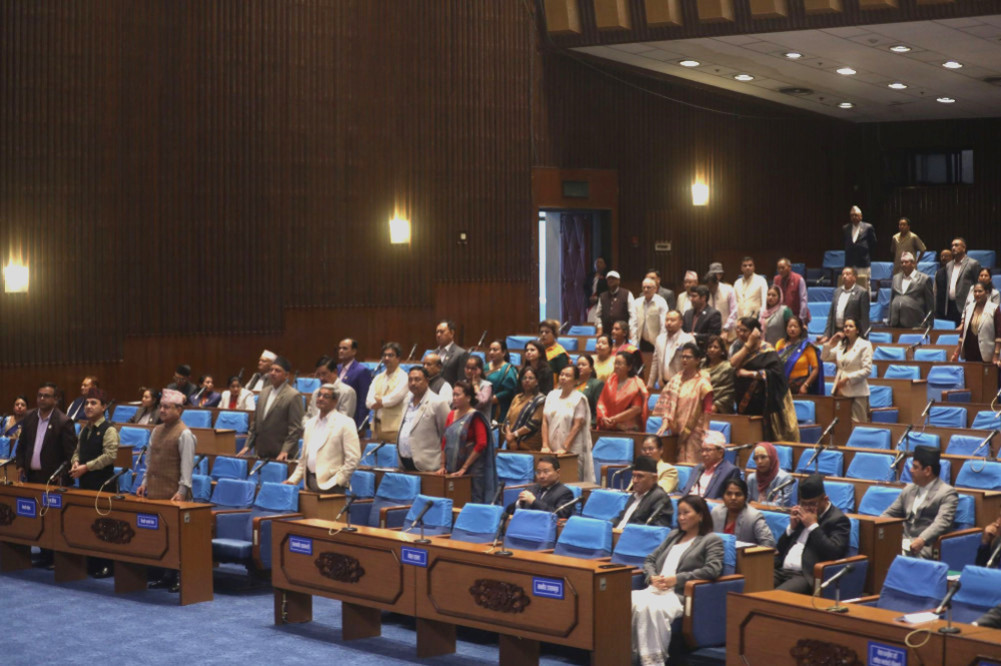
Oli's resignation and Sushila Karki's government are not a 'coup', it is immoral to say that I should resign myself and restore the parliament myself. If that is the case, I did not resign either, but if I withdraw it, it is okay?
We use Google Cloud Translation Services. Google requires we provide the following disclaimer relating to use of this service:
This service may contain translations powered by Google. Google disclaims all warranties related to the translations, expressed or implied, including any warranties of accuracy, reliability, and any implied warranties of merchantability, fitness for a particular purpose, and noninfringement.
The issue of dissolution of Parliament is pending in the Supreme Court. Therefore, this article is not about the issue. Rather, it is about the theoretical aspect of dissolution of Parliament. The government collapsed in Bhadau due to not understanding the demands of Gen-G. Kathmandu burned. Singha Durbar burned. The Supreme Court and Parliament burned. The Prime Minister and ministers fled. The country became governmentless. Curfew was imposed in the country. The army was mobilized. Countries including the US issued a 'travel advisory' to their citizens.
Both the government and the parliament have 'completely failed'. The rationale for the parliament has ended. The parliament has been dissolved. A government has been formed under the leadership of Sushila Karki. The failure of the then government led by KP Oli has led to the dissolution of the parliament, general elections and the formation of a caretaker government. If the government fails, the dissolution of the parliament and general elections are the norm of the parliamentary system.
The Oli government was not ousted from power. He resigned on his own after realizing that he had failed. A resigned prime minister does not have the 'locus standi' right to demand the restoration of the parliament. Oli's resignation and Sushila Karki's government are not 'coups'. It is unethical to resign on his own and say that he had to restore the parliament himself. If that is the case, I did not resign, but if I withdraw it, what will happen?
The demand for the restoration of the parliament should not be judged by looking at today, but by the events of 23 and 24 Bhadra, which saw tens of millions of people protest against the government, damage to property worth billions, arson and the government having to flee. Only then will we get an answer as to whether the dissolution of the parliament was right or wrong.
If the parliament had not been dissolved after the incidents of 23 and 24 Bhadra, a state of emergency could have occurred. The army could have taken power. Military rule could have been imposed. Infrastructure could have burned even more. Property worth trillions could have been lost. Students' education could have been destroyed. Thousands of lives could have been lost. The arson and chaos were an explosion of corruption that had been accumulating for decades and the incompetence and excesses of the seven-point government.
The demand that the parliament should be restored is being made by 'the loudest voice of the thief'. If the social media ban is lifted and a seven-point government is formed, a powerful and strong commission including representatives of Gen-G would have been formed as per its own declaration of 'fairly investigating and taking action against all corruption cases since 047' written in the minimum common program, the massacre of 76 youth would not have occurred. Parliament would not have had to be dissolved. The movement of 23 and 24 would not have happened.
The Karki government was not formed out of desire. Gen-G refused to form a government of party representatives. The then government was so unpopular and unsuccessful that not only the Gen-G but also the general public were 'allergic' to the party's government. The general public had not embraced the seven-point government. It had become a 'liability' for the country. It never became an 'asset'. The 'bottom line' of Gen-G was the dissolution of parliament, general elections, and the formation of a government by someone outside the party. The Karki government was formed as per the understanding. If there is no division, elections are possible on 21 Falgun.
The general public believes that the Karki government will hold elections. They believe that it will not commit corruption. It also has the support of the neighbors and the international community. But there are signs that the UML is trying to make it fail. Apart from the UML, other parties have not opposed the elections. They have not even demanded the restoration of parliament. Oli also did not demand the restoration of parliament until several weeks after he returned to Gundu from hiding in the army. But the UML is saying that the parliament had to be revived after almost two months.
UML's demand for the restoration of parliament is wrong. Someone's writ petition had already reached the Supreme Court. If we are to say a responsible party, it had to dissolve the parliament for its own reasons, so it had to wait for the Supreme Court's decision. When the government fails, the parliament automatically becomes incompetent. A failed parliament should be dissolved. Sovereignty is vested in the Nepalis.
Parliament is a system in which sovereign Nepalis elect 275 members of parliament through elections and hand over their sovereignty for five years. Article (1) of the Paris Declaration of March 26, 1994 states that 'the government derives legitimacy only through general elections'. In support of this, the International Covenant on Civil and Political Rights, 1966, to which Nepal is a party, also states in Article 25 that 'the government derives legitimacy only through regular elections'. After collapsing due to incompetence, the government derives legitimacy only through general elections.
The incidents of 23 and 24 Bhadra proved the failure and incompetence of both the government and the parliament. After the massacre of 76 youths, the government's collapse and billions of rupees in losses and the burning of Nepal, the Nepalese immediately took back the sovereignty transferred in 2075 through the elections three years ago. It has been said that we are ready to transfer our sovereignty again to the MPs who will be elected through the elections.
Radical change is needed to prevent a repeat of the events of 23 and 24 Bhadra. This is possible only through elections. Only the selfish oppose elections. It has been 38 years since democracy was achieved. There were three movements in 38 years - 046, 062/63 and 23 and 24 Bhadra. The governments could not work according to the spirit of the previous movements. They had the desire but did not have the vision.
Since the leaders after the 046 movement, the prime ministers from Girija Prasad Koirala 'Haru' to KP Oli 'Haru' did not have the experience of governance and ran the Singha Durbar by looking at the 'office copy' of the work done by the Panchayat's Surya Bahadur Thapa 'Haru'. The Singha Durbar was spent in 'trial and error'. The country did not get a leader with a vision. Meanwhile, the young, educated, and vibrant Gen-G generation emerged. They did not like the way Singha Durbar was being run. They protested. This was the reason for the explosions of 23 and 24 Bhadra.
Meanwhile, Germany, Japan, and Korea, which were destroyed by the war, had become industrialized nations. But Nepal could not earn foreign exchange by exporting even within the zero customs quota given by the US. There was no development. What is needed is development that generates foreign exchange by converting raw materials into 'finished products' and creating jobs, and by exporting 'finest products' and replacing imports. Vietnam, which was embroiled in war until the 1970s and whose infrastructure was destroyed, has also become a nation that contributes to the world economy through industrial production. We could not.
It should be understood that the demand for the restoration of parliament is not just fishing in muddy water, but also fishing by muddying clean water ourselves. The interests and loyalty of the country and the people cannot be seen through speeches. It must be seen through deeds. Unless the court wakes up the parliament on a pending case, no party should deceive the people by gathering honest people, pouring petrol on motorcycles, feeding them two free meals of meat and rice, feeding them noodles, giving them pocket money, gathering crowds, and blocking roads to show that there is a demand for the restoration of the parliament.
If any party does that, it will be considered as exploiting its own citizens who are unemployed. Let's not exploit the unemployed. If any party wants the country's well-being and is not greedy for office, it would be wise for any party to send an 'amicus curiae' to advocate for the dissolution of the parliament in a pending case in the court. The massacre of 76 youths and their 'cause' will be a big 'tribute'.
A black mark has been placed on the face of Nepal and Nepalis. India's National Security Advisor Ajit Doval and Professor Sheela, a geopolitical security expert in the South Asia and Pacific region, said that Nepal, like Bangladesh and Sri Lanka, has lost its government due to corruption and misrule, the nation has failed, and the legitimacy of democracy has ended. This statement and view is the statement and view of 193 countries of the United Nations towards Nepal. Where has Nepal's reputation gone?
In countries with established parliamentary democracies, including Britain and Japan, the dissolution of parliament is considered a 'dispute that cannot be managed through judicial means'. In those countries, the dissolution of parliament is considered a matter that can only be managed through political means. In those countries, there is no case against the dissolution of parliament. In India, there is no case against the dissolution of the Lok Sabha.
It has been three and a half decades since the parliamentary system was implemented. Parliament was usually not allowed to last for five years. The tradition of dissolving parliament was established when there was a possibility of the prime minister leaving office. To prevent this, some conditions for dissolution were prescribed in the constitution. Our court considered the issue of dissolution to be 'judicially manageable' 'depending on the circumstances'. Constitutional scholars like Harold Lasky and Markesennis have said that dissolving parliament is the prerogative of the Prime Minister. Parliament is not dissolved to stay in power. The UML, which is demanding the restoration of parliament, did not understand the essence of Article 85(1) and the interpretations of parliament dissolution before the Supreme Court.
UML's understanding seemed mechanical. All the parliament dissolutions from Girija Prasad Koirala to KP Oli were plagued by jealousy to prevent others from becoming prime ministers if they had to leave the prime minister's chair. Parliament had not lost faith in the dissolutions at that time as it does today. That is why the Supreme Court considered those dissolutions to be 'judicially manageable' and conducted judicial review. But this time's dissolution is not like that. It is because the parliament itself failed. The court punished the prime minister for not being able to stay in office or for dissolving parliament as he has done in the past three and a half decades.
This time's dissolution is different. This situation has not become a precedent for dissolution. The Prime Minister, who is not a politician, has recommended the dissolution of the Parliament. This dissolution is not to become the Prime Minister after winning the election. The then government has lost the legitimacy and credibility of the Parliament by taking the Constitution off track and burning the country. The previous dissolution was a Parliament capable of forming a government. The Supreme Court has conducted a judicial review since the previous dissolutions were dissolved with corrupt intentions and could be managed through judicial means. But it is clear that this time the dissolution cannot be managed through judicial means and must be managed through political means.
Since the security forces could not sustain and hold on, the army had to take power, millions of youth demanded the dissolution of the Parliament, general elections and the formation of another government. Seeing the government as a failure, the Parliament lost confidence. Sovereign Nepalis took back the sovereignty they had. When the MPs lose confidence, the government automatically loses confidence.
At that time, the Parliament is dissolved. Since the truly sovereign people have taken back their sovereignty, the UML should not consider the dissolution of the parliament unconstitutional. If they say that elections are not needed anymore, that the parliament needs to be restored, what will the governments of other countries in the world and the countries that are watching the events of 23-24 Bhadra and the condition of the leaders on TV say to Nepal and the Nepalis? This is the time to think and improve. Now let's not say, 'We will come back again, we will rule.'
Finally, the election process has moved forward. Other parties besides the UML want elections. The government is ready to hold elections. The government has said that there is no shortage of funds. The army and security agencies are ready to provide security. The Election Commission is ready to hold elections. If the government needs a law, it is ready to issue an ordinance. All sovereign Nepalis above the age of 18 are ready to vote. Nepalis living abroad are also waiting to vote in their own country.
The voter list of citizens above the age of 18 is being compiled. In such a situation, preventing elections is to see bloodshed again. If you can't fish in muddy water by splitting the election, you can't fish in clean water by muddying it. Let there be no conspiracy. May all parties have the wisdom to make the election successful.