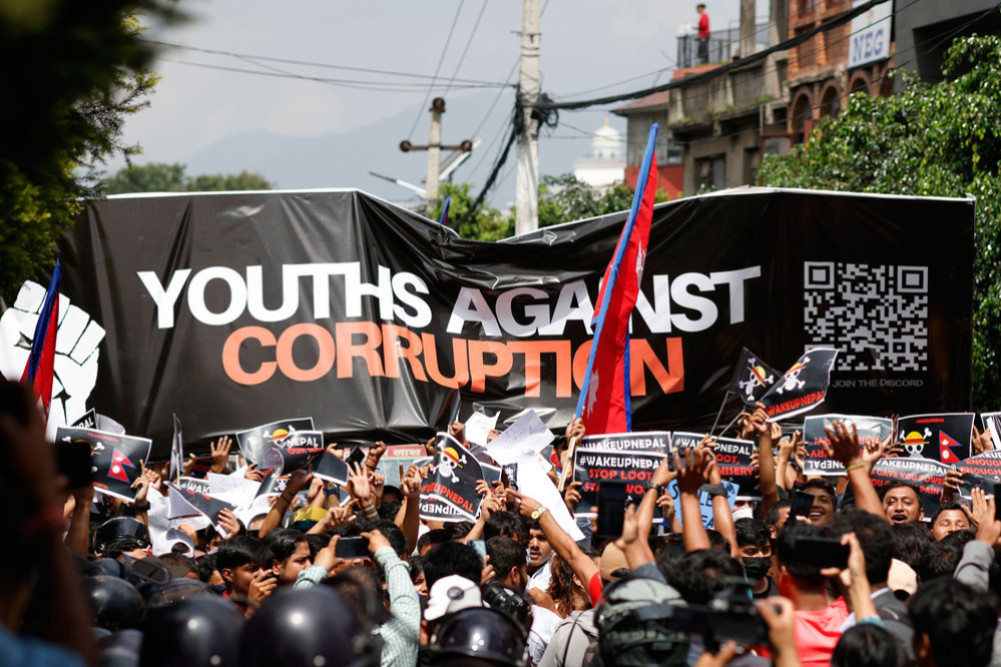
At this point, the old parties may resurface, and new ones may emerge, but the possibility of repeated rebellions against parties that do not want transformation cannot be ruled out.
We use Google Cloud Translation Services. Google requires we provide the following disclaimer relating to use of this service:
This service may contain translations powered by Google. Google disclaims all warranties related to the translations, expressed or implied, including any warranties of accuracy, reliability, and any implied warranties of merchantability, fitness for a particular purpose, and noninfringement.
When this columnist learned, there was a non-party rule in the country. From the village to the district, zone and center, the ruling elite was the ruling class. The CDOs and zone administrators were the ears, eyes and brains of the state. It was a time when the walls had ears. Elite politicians used to tell college students, 'You shouldn't do politics at this age.' At that time, parties were banned.
Some of the past party leaders were in prison and some were in exile in India. After becoming a little older, I realized that political parties provide stability to democracy, organize the common people, and involve them in political activities.
Party leaders and activists will be responsible. Voters will be able to choose party leaders and activists who will serve their personal and class interests and will have the freedom to choose leaders who will work in the interests of themselves and the community. That is why we joined the struggle for multi-party democracy. Through the first people's movement of 2046, a party system was achieved.
Along with party independence, there were some basic demands of the people. First, ensuring the working class's access to the means of production. Second, access to quality education and health for all. Third, industrialization to increase employment in the country and democratization of banks and financial institutions.
Fourth, representation on the basis of inclusion in politics. But after the government elected in the first general election adopted neoliberal economic policies, those basic demands were left to the market. Then the UML and later the Maoist governments were formed. But the Congress government continued with the policies and programs adopted by it. Which ignored the demands mentioned in the constitution such as guarantee of food, shelter, cotton, education, health, employment related to the livelihood of the common working class people.
Our main political parties
The formation of political parties is based on political philosophy, programs that follow the philosophy, and organizations that implement the programs and organizational activities. Political work is often done voluntarily, influenced by principles and ideas. Liberal democratic capitalism and Marxist socialist streams are the dominant ideologies in the world. Over the course of one and a half to two centuries, both ideological streams have undergone many modifications.
Along with the discoveries, research and inventions in the production system and science and technology, ideology has also been developing. In Nepal, the Congress was influenced by the economic philosophy of British economist John Maynard Keynes shortly after its establishment. But after forming a majority government after the 2046 general election, the Nepali Congress Party accepted the neoliberal market of Friedrich Hayek and Milton Friedman in principle and abandoned the liberal left in practice.
Except for a few components of the Left Front that were active in the 2046 movement, all of them united to form the UML, and that party became the mainstay of the leftist opinion in parliament. But after coming to power, it continued the same program put forward by the Congress, except for some public welfare programs. At the fifth general convention, it merged itself into the liberal democratic party in the name of multi-party democracy.
Within a few decades, it abandoned the Leninist organizational system and formed a hierarchical party like a capitalist party and abandoned the collective leadership system. The Maoists, who started the people's war in 2052, had announced that they had brought democracy in the 21st century, but after 2064, they put aside the people's war and democracy and indirectly adopted an independent economic policy, concluding that the country's current economic crisis could not be averted, that the pressure of financial globalization could not be stopped, and that money was ultimately necessary to win elections, and they took refuge in the neoliberal market. But they continued to call themselves the Communist Party and the program they carried socialist.
Thus, after 2048, many elections were held. There were movements, wars, and rebellions. But there was no theoretical or programmatic difference between these three parties mentioned above. They did not show that they had different views with the previous Panchayat-following party, the RPP, in practice.
After the promulgation of the new constitution, another party, the RPP, was added. It came to the fore by declaring that it would raise its voice against the old parties, saying that they were involved in corruption, black marketing, nepotism, and favoritism. A fourth major party was also formed, but it joined a coalition sooner than expected and came to power. It seemed like a party of tricksters.
The RSVP could not be proven to be a different face in philosophy, politics, program, and moral values than the previous ruling parties. Its leader is in jail in a cooperative fraud case. Other office bearers are at a loss as to what moral basis to carry him. Because this party did not stand on a theoretical ideological platform. There was no one in this party who was committed to principles and ideas and felt a sense of responsibility towards the people. Therefore, no one is tied to the thread of 'ethics'.
Recently, more than 150 parties have been registered with the Election Commission. Before the election announcement, 123 parties were registered with the commission. After the election announcement, 32 parties have joined the registration process. In such a small country where almost half of the young workers are forced to sell their labor abroad, it is surprising to see so many parties trying to represent them. But were these parties formed to solve the complex problems facing the country or to make a profit by making politics a profession? It is difficult to find an answer.
International Challenge
The current era is an era in which the far-right is triumphing not only over socialism, but also over liberal democracy. After Donald Trump's second victory in the US, he has not only crippled the World Trade Organization, but is also using customs duties as a weapon to harm the production and trade of other countries.
He has publicly disrespected the United Nations. For example, he has not paid the International Court of Justice and the World Health Organization as promised and has brought it to a state of inoperability. American involvement in the genocide in Gaza that Israel is carrying out is not hidden. Now his government is cultivating war to overthrow the Venezuelan government. Trump is behaving like a 16th century king or emperor in a visible and understandable way. He has been resisting the institutional restructuring of international financial institutions since the past.
Since then, the rulers of European countries like Britain, France, and Germany have gradually moved away from basic liberal values such as legal equality, the right to speak, write, and organize, and the guarantee of free and fair elections. The helplessness and greed of the supposedly liberal rulers have led to the rise of ultra-conservative fascists, and they themselves are seen as their followers. Due to the rich countries, wars are likely to break out again within Europe itself, in the oil-producing Gulf countries, and in the Asia-Pacific region. In such a situation, three things can affect underdeveloped countries including Nepal.
First, the purchase of consumer and capital goods, including mineral oil, becomes extremely expensive, which is difficult to afford. Second, in countries where wars have broken out, Nepalis may lose their jobs and be unable to find employment in new enterprises. Third, if a direct or cold war against China intensifies, Nepal could be affected economically, politically, and culturally. In such a hostile international situation, any political party needs to have a clear idea about how to balance the country's restrained foreign policy.
Theoretical Ideological
The division between leftists, centrists, and rightists has existed throughout the world, and it will continue to exist today and tomorrow. That division has been going on for centuries. The contradictions created by regional (constitution-wise) inequality and discrimination through state-authorized policy programs, the inequalities created by corruption, black marketing, and cronyism (nepotism, favoritism, and hypocrisy) lead to contradictions and conflicts in society.
Whose side should we take, who should we fight against? To do or not to do? Due to some personal perception, there is a theoretical and ideological division in society on the basis of theory. Whether in a feudal or capitalist society, when inequality expands to an unbearable extent, whether one likes it or not, contradictions and conflicts become inevitable. Most centrist parties cultivate inequality after coming to power and promote the economic and social progress of the ruling class, and become right-wing in times of crisis due to class ideology.
A right-wing party talks about the status quo. It talks big about economic growth only if there is political stability. It thinks about how to make profits for the rich capitalists in the name of market freedom and how to recover its share from it. Instead of building an independent economy that can increase savings and move towards industrialization by itself through modernization of agriculture and socialization of resources, it forces the poor to create a general narrative that foreign investment, multinational companies and the industries they open will provide employment for the poor.
The profits earned in this way trickle down to the poor and all communities benefit, spreading widespread illusions. In recent times, the periodic plan has been paralyzed, research and development has been deprived of resources, and alternative research and development in universities has been made inactive. Then corruption, nepotism, and favoritism have grown as a culture. After income was in the hands of a few, deposits in banks and financial institutions increased.
The general public is trapped in metered loans due to the lack of cheap and accessible loans to earn money or to meet social or family needs. In Nepal, the parties called Left (UML, Maoists), Center to the Left (Congress, Rashtriya Swayamsevak Sangh), and Rightist RPP have been repeating these actions since 1992. All three are extreme right-wing parties in terms of economic and social programs and implementation adopted by these mainstream parties in the name of Congress and Communists. These right-wing thoughts and trends have worked after the increase in sovereign debt, lack of employment-oriented industrialization, failure to modernize and industrialize agriculture, and failure to build reliable social and physical infrastructure over the past three decades.
In principle, a left-wing party argues in favor of equality and social justice. It combines social change and diversity with unity. It plans and manages industrialization for the creation of public employment. It breaks the syndicate in land and other natural resource utilization, trade, and enterprise, and puts forward a program of structural change to provide access to the means of production for all.
It teaches its political workers and well-wishers to accumulate national savings by modernizing and industrializing agriculture to build an independent economy. It develops the culture and tradition of working among its political workers and well-wishers. Similarly, it makes the general public aware of the rights and privileges of their community. Therefore, there is a difference in the theoretical, ideological, programmatic and organizational methods and struggles between right-wing and left-wing parties. Whether in power or out, a politically conscious leftist society is led by a leftist party and is engaged in a peaceful and difficult class struggle. It is presenting its arguments that the state must be transformed.
A centrist party aims to create a dynamic middle class. It talks about maintaining a balance between the state and the private sector in the economy. It talks about economic regulation and progressive taxation. It talks about increasing the role of the state in difficult times. It puts forward arguments and programs to eliminate mass poverty, eliminate the inequality that has deepened in the form of social gaps, reduce environmental destruction and be anti-war.
Thus, based on the implementation of the above-mentioned programs, were the parties in the past, whether in the ruling or opposition, leftist or centrist? In the three-decade long experience, no party active in Nepal was leftist or centrist. They have made the Nepali state system a slave to the neoliberal market, and today the state itself has become extremely weak, sick, indebted, uneducated and underdeveloped. Are the newly formed or re-formed, registered or unregistered parties based on principle programs? Will voters be provided with sufficient information about the principles and policy programs adopted by the candidates of those parties before choosing a suitable candidate? The possibility is low.
In fact, neoliberalism is a set of economic and political policies. Politically, it advocates individualism. It is strongly opposed to the welfare of the community, social justice, and social management. Economically, it talks about liberalism, privatization, relief and concession reduction (fiscal austerity), and open and free trade. It is not about transforming the state, but about seeking 'adjustments' within the existing state system.
In principle, these policies are theoretical ideological programs associated with narrow-right ideology. When a leftist party, after coming to power, seeks out a team of experts raised in right-wing schools that stand in favor of the neoliberal market, has them prepare a market-oriented program, and implements it exactly, how can that party be leftist, socialist, and even communist? How can it become a protector of the beliefs, values, and beliefs of the working class proletariat? There is no room for hope.
State transformation
On 23–24 Bhadra, the younger generation rebelled against the unprincipled, apolitical, programless, and excessive exploitation of the country by the older generation. The problem is that it was not a directly organized rebellion with any theoretical ideological or programmatic concept mentioned above. But their rebellion was against the status quo, in other words, against the so-called syndicate empire established on the basis of the majority. Even now, the justification for the rebellion of the younger generation has not ended.
Even if they do not know how to say it openly or do not want to be open, this is the state transformation they are seeking. In the current context, the meaning of state transformation should be sought in these five areas: (1) Solutions to unemployment, inequality, and poverty. (2) Democratic control over banks and financial institutions, production and distribution of public goods (education, health, transportation, communication, electricity, and water resources). (3) Restrictions on the decision-making role of wealthy corporations in power. (4) Systemic change: Creating ease of political participation for the common people. (5) International relations and solidarity.
Parties aiming at state transformation need to streamline their organizational structure and focus on a collective leadership structure rather than a hierarchical one. With the help of opportunity or circumstances, old parties may reappear at this time, or new ones may emerge, but the possibility of repeated rebellion against parties that do not want transformation cannot be ruled out.