The nature of corruption is widespread, multifaceted, and multifaceted, so demonetization alone cannot control corruption. Demonetization is only a problem, not a solution, until all citizens are included in the digital payment system.
We use Google Cloud Translation Services. Google requires we provide the following disclaimer relating to use of this service:
This service may contain translations powered by Google. Google disclaims all warranties related to the translations, expressed or implied, including any warranties of accuracy, reliability, and any implied warranties of merchantability, fitness for a particular purpose, and noninfringement.
UML Vice President and former Finance Minister Surendra Pandey had said at a program organized in Chitwan on 18 Jestha 2075 BS that five hundred and one thousand rupee notes should be banned to control the increasing corruption in the country. Meanwhile, Nepali Congress Vice President and former Law Minister Dhanraj Gurung has also repeatedly raised the voice for demonetization to control corruption.
He addressed a political gathering in Mahottari on December 14, 2081, and said that the 500 and 1000 denomination notes should be banned immediately to end bribery and corruption in the country.
After the Gen-G movement of Bhadra 23, 2082 and the vandalism and arson of Bhadra 24, the discussion of demonetization has intensified in Nepal. News of a large number of notes being destroyed in the houses of some political party leaders due to the arson and vandalism became public.
News that the Department of Money Laundering has also started investigating the notes that were said to have been destroyed in such houses became public. After that, from social media to tea chats, from economists to policymakers, people have started talking about demonetization. But can demonetization control corruption? This article has tried to find an answer to this question.
What is demonetization?
Demonetization is the process of stopping the use of certain denomination notes in circulation as legal tender or declaring them illegal in any country. In simpler terms, demonetization is the process by which the government decides that any note or coin should no longer be used. Such a decision can be taken by the government or the central bank of the country concerned with the objectives of reforming the monetary system, controlling black money, ending corruption, preventing tax evasion, declaring hidden assets illegal, and controlling counterfeit notes.
In fact, demonetization is not only making old notes invalid so that they cannot be traded in the market, but also an attempt to bring transparency to the economy and control corruption by issuing new notes in place of such notes. In some cases, demonetization also aims to encourage digital transactions instead of cash in the country's financial system. In this way, demonetization is a restructuring of the monetary system, where old fixed-rate notes are removed from circulation and an attempt is made to establish economic discipline according to new policies.
Experience elsewhere
Neighboring country India had demonetized 500 and 1,000 notes on the night of November 8, 2016, declaring 500 and 1,000 notes illegal. According to a study, the demonetization banned 86 percent of the country's total cash. The Indian government's move was aimed at curbing the flow of black money immediately. The aim was to stop possible investment in terrorism, end the flow of fake notes, control the wealth accumulated through illegal tax evasion and corruption, and promote digital payments in the country to make economic transactions transparent.
However, a detailed study of the impact of demonetization in India did not yield the expected results in terms of controlling corruption and black money. As mentioned by Dr. Diwaskant Samadhiya, a researcher from Uttar Pradesh, in his article 'Demonetization: Impact on Black Money', more than 99.3 percent of the money was returned to banks after demonetization in India.
It does not seem to have had any direct impact on controlling the illegal money accumulated through corruption. Rather, it had a very negative impact on the daily lives of the common citizen, small traders, farmers, daily wage earners, women, senior citizens, etc. The announcement led to excessive crowding in banks and ATMs and increased the cash crisis. It also had a negative impact on the purchase and sale of agricultural and local products.
Several studies have shown that demonetization had a serious negative impact on the Indian rural economy. After demonetization, the common man had to face a lot of hardship for a long time. Although the aim of demonetization was to control corruption and make black money illegal, it had a negative impact on the lives of the common citizen. According to an article by Bhaskar Chakraborty, although demonetization improved digital payments, it had no effect on controlling corruption in the long term.
Similarly, Ghana banned banknotes in 1982, Nigeria in 1984, and Myanmar in 1987. Such demonetizations, which were carried out with the aim of controlling increasing corruption and black money in the country, did not give the expected results. Demonetization increased economic problems and social discontent. Similarly, the Soviet Union banned banknotes from the former Soviet Union in 1991 to control its country's economy. According to a study, the Soviet Union's move could not control inflation. Rather, it undermined the trust of the common citizen. They had to face various challenges and difficulties.
Can demonetization control corruption?
It is believed that cash transactions facilitate corruption, tax evasion, illegal transactions and the informal economy in the country. Therefore, reducing cash transactions and its flow can be said to reduce an opportunity for corruption.
When high-denomination notes are banned and removed from circulation, it is expected that individuals or groups hiding such notes in large quantities will find it difficult to deposit assets in banks, bring them into the banking system, and evade taxes. It is also believed that this will increase the trend of digital banking, trackable transactions, and bank deposits and withdrawals, thereby enhancing financial transparency. Similarly, demonetization is believed to end irregular cash transactions and prevent corrupt people from safely transacting cash.
However, as good as it sounds, experiences from various countries have shown that demonetization alone is not enough to control corruption. It seems that other structural measures such as effective regulation, transparency, accountability, reform of the court system, financial monitoring, legal reforms, etc. would be more effective than demonetization in controlling corruption.
If we look at India's experience, demonetization alone could not eliminate corruption. The weak regulatory institutions, political-business alliances, lack of transparency, and problems in the tax system are still almost the same as in the past, which has continued corruption at the same pace and in the same form. The demonetization carried out by the Indian government did nothing but cause suffering to the citizens after even large notes suspected of being accumulated through corruption were returned to the banking system.
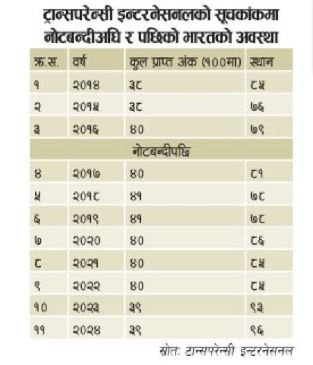
Another proof that demonetization has not had a significant impact on controlling corruption is the Corruption Perceptions Index published annually by Transparency International. The table shows India's score and position in the Corruption Perceptions Index from 2014 to 2024.
India had presented demonetization as a historic step against corruption. However, the Corruption Perceptions Index published annually by Transparency International shows that demonetization has not had any concrete and effective impact on controlling corruption in India in the long term.
This shows that corruption is not a problem limited to cash alone, but an institutional and policy challenge. Therefore, even if demonetization has a temporary effect on the flow of cash, corruption cannot be controlled without systemic transparency, strong regulation, and political honesty and willpower. More than a temporary popular favor like demonetization, significant reforms such as legal and institutional strengthening, independent investigative bodies, a strong judiciary, financial transparency, and the development of citizen awareness are needed.
 Since the nature of corruption is widespread, multifaceted, and multifaceted, it cannot be controlled by demonetization alone. Even when demonetization was implemented in India, various means were used to bring the black money accumulated through corruption into the mainstream. These included using the banking system, property transactions abroad, and using laborers to deposit money in banks and launder it. Similarly, it seems that demonetization is only a problem, not a solution, until the entire citizen is brought into the digital payment system. Because demonetization can bring economic instability and inconvenience to the common citizen. It increases the dissatisfaction of the common citizen with the government and the state structure.
Various studies have shown that the demonetization policy, which was done to control corruption, has more impact on the socially backward, those who are out of reach of education, and those who lack financial literacy than on corruption control. Moreover, in underdeveloped and developing countries with poor access to banking and exchange, farmers and workers living in deprived, poor, and remote areas are directly affected more than those who are corrupt and hoarding black money.
A study titled ‘Limiting the Use of Cash for Large Purchases’ conducted by the Harvard Kennedy School says that in theory, demonetization reduces financial crimes by reducing the transaction of cash that is earned illegally and is not in the banking system. However, the report has shown that it is not effective in controlling corruption and black money. Therefore, the study concludes that demonetization itself is not an effective and appropriate method for controlling corruption.
In this way, it can be said that demonetization does not contribute directly and effectively to controlling corruption. There are various reasons for this. First, corruption is multifaceted and multifaceted in nature. Demonetization does not stop corruption that occurs through other means than cash transactions – such as through the banking system, property-based (in the form of land, gold, company shares, etc.). Moreover, such demonetization does not affect cross-border transactions and transactions.
Second, the trend of adopting alternative routes for corruption has increased. In which, those who adopt alternatives such as trading in small-denomination notes, trading in foreign currencies, trading in crypto currencies, and trade-based money laundering cannot be controlled. Third, if the banking, administration, justice, and legal system are weak, then demonetization will only cause inconvenience to the common citizen. It will not contribute to controlling corruption and stopping black money.
However, studies have shown that if the demonetization strategy is implemented in an organized and smooth manner, it will yield positive results. A study conducted by the Harvard Kennedy School has also shown that demonetization, if implemented effectively along with other structural reforms, can contribute to money laundering and controlling corruption.
It seems that it will be effective if it is combined with policies such as policy reforms, institutional strengthening and making digital payments easy, simple, cheap and secure. Also, if citizens living in every place in the country can easily use banks and digital options, the economy can run smoothly and demonetization can be effective.
Conclusion
Based on foreign experiences, demonetization is not an effective option for controlling corruption in Nepal as advertised. If we study only the Indian experience, demonetization cannot be effective in stopping black money earned through corruption. Demonetization can neither stop black money nor control corruption in the long term without systemic reforms, strict legal action, financial inclusion and promotion of digital transactions to control corruption.
Therefore, it is appropriate to consider demonetization as only a very small part of corruption control. It is necessary to link it with a comprehensive system of comprehensive financial reforms, banking access, digital payment systems, transparency and accountability. Otherwise, it will only cause more suffering, hardship and hassle to the common citizen. If demonetization is to be implemented in Nepal, policies such as border control, monitoring of currency sources, expanding banking access across the country, promoting integrity, reducing cash transactions using information technology, and developing information technology to eliminate face-to-face service flows should be adopted. Similarly, it is necessary to make the necessary preparations for the success of demonetization - such as alternative means of transaction to cash, development and expansion of banking infrastructure, mobilization of mass media, and raising public awareness. If demonetization is carried out without preparation and in a hurry, it can become a factor in economic and social problems that are more frightening than controlling corruption.

