Due to the lack of quality participation at COP-30, the 'Sagarmatha Dialogue' organized by Nepal this year will now be limited to 'expensive advertising for the mountains'.
We use Google Cloud Translation Services. Google requires we provide the following disclaimer relating to use of this service:
This service may contain translations powered by Google. Google disclaims all warranties related to the translations, expressed or implied, including any warranties of accuracy, reliability, and any implied warranties of merchantability, fitness for a particular purpose, and noninfringement.
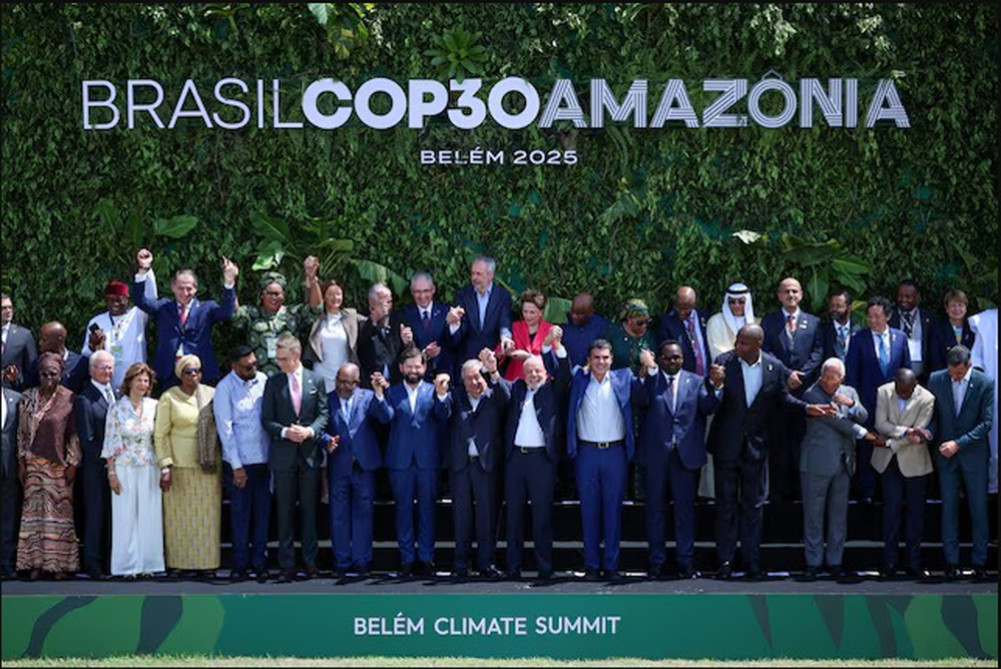
The 30th Conference of the Parties (COP-30) to the United Nations Framework Convention on Climate Change has begun in Belém, Brazil. However, Nepal's presence at the global climate conference appears to be weakened by the current government's desire to gain cheap popularity.
A 9-member team led by Minister for Agriculture and Livestock Development Dr. Madan Prasad Pariyar is participating in the conference on behalf of the Government of Nepal. Although it was decided to send ministers to the conference, which should be attended by the President or Prime Minister, the high-level meeting was addressed by the Secretary of the Ministry of Forest and Environment.
The issue of climate change justice is not only a matter of national concern for Nepal, but also a matter of existence. COP-30 is the highest opportunity for Nepal, which has been suffering from floods after the end of the monsoon, unseasonal rains and drought, to seek factual justice. However, the government did not take this opportunity seriously. The preparation for COP appeared to be extremely weak both internally and externally. Since there will be many negotiation issues, Nepal's presence in international negotiations will be weak.
National Position Paper
The country's national position paper should list priorities. The national position paper, prepared in a narrow circle, has not been able to list the agenda of contemporary needs. The national conferences and intensive workshops with experts that were held before COP in previous years did not take place this time. The government, which held discussions with the Gen-G group, kept climate experts, researchers, the private sector, local governments, etc. out of the preparation process. COP-30 is preparing to finalize the indicators to be implemented through the Global Adaptation Goals (GGA) plan. If COP-30 approves the GGA indicators, how will Nepal measure the indicators? What will be the monitoring system? How will it be made? It is impossible to benefit from the achievements without that preparation. How many problems related to the mountains and issues covering our territory are included in the GGA indicators? There is no such assessment. The lists of adaptation are nowhere to be found in the national position paper. It is the expectation of all Nepalis that fixed and determined indicators for the mountains be included in the GGA. Nepal has failed to create an environment and advocate for its issue to be included in the maximum indicator by collaborating with countries with mountains and hills through diplomatic negotiations.
The Adaptation Fund Board is ready to invest. However, the government should submit a proposal together with civil society to get grants from it. After the government showed no interest, international organizations working in Nepal are working with other countries to develop a system for measuring adaptation indicators.
Nepal has been suffering huge losses due to post-monsoon rains for the past few years. This year too, the rains damaged the rice during the import period. If there had been investment in agricultural technology, farmers would not have been forced to harvest rice and dry it in the fields. The increasing climate crisis shows that adaptation is essential. Small efforts have been made in various parts of the country with the help of civil society organizations in adaptation, but the government does not have the data. How much of the damage in the last two years is due to human infrastructure? And how much is due to climate change? There is no data on that. There is no alternative to implementing national and local adaptation plans to solve the growing climate crisis. It has been years since voices started being raised that a project bank should be established to bring in the necessary budget for the implementation of the plan. Complaints that the ministry is stalling proposals submitted by civil society have been heard in the past. Instead of passing the proposal quickly and helping to bring in finance, instead of keeping it stalled and passing the time to make suggestions, the amount received has already been returned without being spent on time.
Even though the change in political leadership has affected some other areas, it is the civil service administration that continues the initiatives taken in a particular area regularly and for years. Weakening and weakening the national position paper under the pretext of the Gen-G movement is irresponsible towards the citizens.
Impact on negotiations
Since the attendance is small, there is no way to be represented in more than 50 parallel meetings daily. There are agendas and sub-agendas according to the subject. Will the representatives participate in the high-level meeting or sit in on the negotiations? With no quality participation other than the cat-tying work, the 'Sagarmatha Dialogue' that Nepal held this year will now be limited to 'expensive advertisement for the Himalayas'. How will the expenses incurred in the 'Sagarmatha Dialogue' be reimbursed for taking initiatives for climate justice by making the Himalayas agenda a major issue at the global level?
To conduct effective negotiations in the thematic meetings of the conference, there must be a strong and shared understanding among the representatives on the priorities and positions at the national level. Who is representing the country on the issues included in the draft proposals prepared for COP-30 after the meeting in Bonn, Germany? What is our position and that of the national group we are involved in on the proposed agenda? The government has not clarified anything on these issues. What will be Nepal's position on the proposed agenda for discussion at the conference? The national position paper is also not clear on this. There will be no situation where a thesis-sized document can be read out verbatim.
Nepal's representation in important meetings including loss, damage, adaptation, finance, global stock-take, etc. There is a risk of zero attendance in discussions on economic and technical cooperation. Big countries have sent teams of dozens of experts to negotiate their positions. It would be pointless to expect Nepal's effective presentation from COP-tourists and quota representatives. Without a deep understanding, even the person given responsibility cannot play an effective role. In a negotiation meeting of COP-29, Nepal's representative had to face an embarrassing situation when he did not express his opinion on the subject at the appropriate time during the discussion. Nepal did not participate in the important negotiations that Nepal prioritized in COP-28. These are just a few examples of selected participants not playing an effective role.
Retrospective decisions
Those who have been understanding the process and content of COP for years are now unable to participate in COP. After the Ministry of Forests made it strict for those who wanted to participate in COP to provide a letter of commitment with a seal, many representatives of NGOs and subject experts were deprived of participating in COP-30. The government has called this good governance. However, this has caused losses to Nepal itself. In the name of gaining popularity, the government also closed the door to those who wanted to observe the conference activities virtually while staying in Nepal. Some experts were forced to participate in COP as representatives of other countries. The government should not have forgotten that international conferences are also an appropriate medium to present problems to the world, obtain information from others, exchange experiences and emulate good practices. The government should encourage, not discourage, citizen-level participation in the international arena. If it were thought that decreasing expert-level participation from citizen organizations would save a lot of money within the country, it would have sent only the head of state or the chief executive officer to high-level meetings.
Sagarmatha Dialogue Expensive Advertisement
Nepal has not lobbied for a new agenda in COP . If it does not set its own agenda, it will participate in discussions on other people's agenda . Only if many countries register the same topic or agenda can it become the agenda of COP discussion . If a country sets its own agenda, it does not mean that it will be on the agenda of COP Secretariat . It will only become a topic of discussion . Whoever is able to lobby for the issue, that issue becomes the priority of COP President and those issues become the main agenda of COP .
In fact, almost 80 percent of COP agendas are old . It is not that a new agenda is added every year and that all member countries' agendas are included . However, how were the Sagarmatha Dialogue, Mountain Dialogue and its conclusions held in the international arena, which prioritized the climate-related disasters, damage, losses and mountain conservation issues faced by Nepal in the last two years, to lead the group of Himalayan countries after 2026? This is the concern of all Nepalis. Where and how is the Sagarmatha Call, which was said to be placed in international forums, including the ‘Baku to Belém’ roadmap, included? How did Nepal become involved in the agenda setting for the past three months?
Nepal has failed to create a situation where it becomes the agenda of COP by reaching a consensus on its position with countries that share its priorities. After the Sagarmatha Dialogue, the government should have intensified consultations with countries that share its interests and taken diplomatic initiatives to enter the issues put forward in the ‘Sagarmatha Call’ into COP. Climate diplomacy should have been expanded through the Ministry of Foreign Affairs to make mountain conservation a national agenda. It is just a paper propaganda to say that the Himalayan issue was raised in COP without preparation.
Conclusion
How much money did Nepal receive from the decision made in Baku to mobilize 300 billion per year? How many of the adaptation plans we have made have been implemented? How much grant was brought in for climate action? How did the situation arise that the grant was returned? A thorough review is needed on many issues. Why could not a permanent expert team be formed in addition to high-level government representation to participate in international conferences? These questions have been raised at every COP. If a delegation consisting of some influential and some tourist members participates, COP will remain limited to participation only in the coming years. Nepal's participation in COP-30 should not be limited to formality. Ignoring representation in COP while being a country most affected by climate change is a question of national interest.
The issues raised in the pavilion do not have much meaning in COP's discussions and decisions. If Nepal always remains focused on participating in the conference no matter what, no matter how much fuss it makes, the achievement will be almost zero.