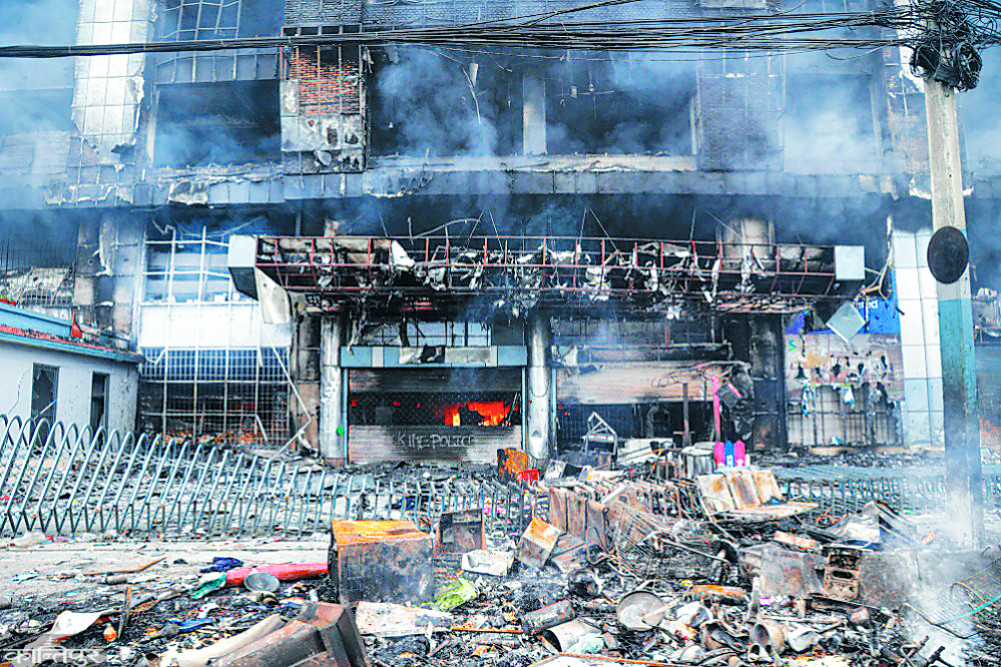
We made the 'holy' movement of the youth against looting 'profane' by committing looting. The youth movement was trying to raise its voice against political disorder, but it was overshadowed by our violent attitude.
We use Google Cloud Translation Services. Google requires we provide the following disclaimer relating to use of this service:
This service may contain translations powered by Google. Google disclaims all warranties related to the translations, expressed or implied, including any warranties of accuracy, reliability, and any implied warranties of merchantability, fitness for a particular purpose, and noninfringement.
The reason for quoting this statement of the 35th President of the United States, John F. Kennedy, ‘Those who suppress peaceful protests make violent protests inevitable,’ is precisely understood when viewed in this context – the peaceful protest of 23 Bhadra and the destruction of 24 Bhadra. The way the state brutally suppressed and repressed the peaceful protest of Gen-G youth on 23 Bhadra, 2082, made 24 Bhadra inevitable.
Indeed, some Gen-G leaders had been saying that there had been infiltration in the protest since 23 Bhadra. It is not that the then government did not also say that there had been ‘infiltration’. The American media outlet ‘New York Times’ has even prepared a list of suspects.
A report in ‘Kantipur’ daily has also conducted an in-depth investigation into the dialogue between youth on social media to find out ‘how a series of arson attacks were instigated’. Therefore, 24 Bhadra is also under question. However, the irrefutable truth is that the destruction of 24 Bhadra was made inevitable by the then government.
The events of 23 and 24 Bhadra have been collectively called the ‘Gen-G movement’. That conscious rebellion of the young generation that toppled the strong government formed by the country’s two major parties was in many ways a ‘movement’. However, one important issue has made me worried and serious – the movement launched by Gen-Ji against those who are looting state power was actually carried out by ‘looters’.
We are the people of this society, who want its progress and development. And, we keep saying – we should be good, disciplined, and abide by the law. However, on the 24th, we shamelessly picked up belongings from government, private, and commercial buildings that were vandalized and set on fire by some anarchists, and put them in our pockets. We picked up TVs, computers, furniture, utensils, and alcohol, whatever we could find, according to our status, need, and availability. It was sheer theft, it was looting. We became looters.
We made the ‘holy’ movement of the youth against looting ‘profane’ by looting. The youth movement tried to raise a voice against political disorder, but it was covered up by our violent attitude. This is the main issue that worries me – how did we, who do not like robbers, become robbers ourselves? Why did we resort to robbery?
It is said that in Kali Yuga, the qualities of truth and falsehood, good and evil are present within a single person. That is why, by repeatedly raising our voices against the looting regime, against injustice and inconsistency, we ourselves have become robbers, we ourselves have become the cause of destruction. There have been many incidents in the past when we resorted to robbery. Before telling about this, I will recall some recent incidents when the robbers within us have awakened.
February 1, 2022 – Transport workers protested in Gongbu, Kathmandu, demanding 10 points. When the demonstration became uncontrolled, not only did there be a scuffle between security personnel and protesters, but the police also used force. However, the situation was not under the control of the police. Then suddenly, a robbery took place at Gongbu Lhotse Mall. Some of the people involved in the robbery were criminals, some were participants in the demonstration. However, even more people who were not directly involved in the transport workers' movement were involved in the looting, who had not been involved in such incidents before.
To control the situation, the administration had to issue a curfew order at 9 pm. 15 Chaitra, 2002 – The demonstration organized by the supporters of the monarchy in Tinkune, Kathmandu, turned violent that day, and two people died. When the commander of the demonstration, Durga Prasain and others, incited the crowd, the protesters set fire to and vandalized commercial establishments, government and private property everywhere.
‘Kantipur’ Television and ‘Annapurna Media Network’ were attacked. People entered the Bhatbhateni supermarket and looted it. It was found that other people were involved in the looting besides the participants in the afternoon demonstration. The police could not control the situation. In the evening, the situation was finally brought under control after the Nepal Army was mobilized.
Now let's talk about – 24 Bhadau. Although looting had occurred only in certain places in the previous two incidents, this time the scene was horrific. The culmination of anarchy was seen to the point that we were ashamed of ourselves. The main administrative center, Singha Durbar, as well as local ward offices were destroyed, and police offices were burned. And, like the previous two incidents, people resorted to looting and theft in the same manner in various cities of the country.
This time, people were found transporting goods more easily. In videos circulated on social media, people were seen walking around without hesitation carrying furniture, electrical appliances, clothes, utensils, and toys - whatever they could find.
A group was singing the song 'Rato Ra Chandra Surya' in Koteshwor while playing a drum set that they had stolen or brought from somewhere. Elsewhere, people were also looting weapons and ammunition from police stations. The police are still investigating this matter. Although according to the details so far, the police say that at least 1,100 weapons have been looted across the country.
In essence, this is probably the first time that such a large-scale public looting has happened in Nepal on a single day. And, people who had nothing to do with any demonstration also participated in the looting. These incidents clearly show the attitudes and social deviations taking shape in our society. Before presenting its sociological analysis, let us look at the trending similarities of these three incidents—
1. In all three incidents, there was no movement or demonstration after the looting, but rather, it seems that the looting started after the demonstration or movement reached a climax.
2. In all three incidents, the looting took place after the security administration failed. The looting took place after the police failed to use force in their attempts to control the movement.
3. In all three, looting took place in large malls. In the first and second, it seems that looting took place in nearby malls or supermarkets after protests elsewhere. In the third, looting took place after arson and vandalism in the supermarket. This time, even the houses of leaders and businessmen were vandalized and set on fire. Even on the 25th, news was being circulated that people had reached the house of Nepali Congress President Sher Bahadur Deuba asking if they had found anything.
How did this attitude of looting develop? Let's discuss.
Looting should not be viewed only from a legal perspective, but should also be viewed in relation to the structure of society. Economic inequality, class discrimination, and unequal distribution of opportunities encourage crime. According to sociologist and philosopher Karl Marx, when the feeling of inequality and exploitation reaches its peak in the proletariat, the organized anger of that class can turn into rebellion. And, looting is one of the unorganized rebellions of that organized anger.
Another basis for the fact that looting is a result of class struggle is that the main theme of the protest on 23 Bhadra was the Nepo Baby Trend. A class has always been in power, capturing the sources of production and opportunities. The youth had questions about the lifestyle of the children of those people in power and in power and the opportunities they received. Should some live a luxurious life at the expense of their parents, while others struggle with poverty and inequality? The Nepo Baby Trend was a protest against this contradiction.
According to Marx, the means of production or economic system in any society determines the politics, law, media, art, culture, philosophy, and social psychology of that society. What kind of social psychology will an economy that is riddled with corruption and entrepreneurship be able to determine?
Other sociologists also view looting during uprisings not only as a crime but also as an expression of social discontent. According to sociologist Charles Tilly, looting during times of unrest reflects the economic inequality of society. Similarly, according to E.P. Thompson, looting during such times is a step taken to correct injustices committed by the state. Anthropologist Victor Turner says, ‘Looting symbolizes the end of the old order and the beginning of a new order.’ Another anthropologist, Jeffrey Juris, says that such steps are also a resistance and a challenge.
For example, during the 10-year armed rebellion, the Maoists looted state-run banks, seized land from landlords, and distributed it to the 'poor' through the people's government. Therefore, from a political perspective, looting is also interpreted as a rebellion against an unequal social and economic structure.
In this way, looting is not just theft but also understood as 'civil disobedience' in search of justice.
Now let's look at this incident from a social psychological perspective.
When people feel that rules, laws, and order are being broken in society, then chaos begins to arise in them. When the security forces that enforce the law fail, then the citizens feel that the law itself has failed.
On 24 Bhadra, when arson and vandalism broke out all over the country, from Singha Durbar to the Parliament building, after the posts were burnt down, when the police were scattered, and the houses and party offices of leaders were reduced to ashes, people had to say, 'Now the state system has collapsed.' At that time, people made their own rules and looted, mixed with fear and passion of creating a state of zero. After all, what is there to fear when the administration that arrests them is destroyed?
The social disintegration created by that state of ‘state collapse’ and the social psychology that guides it have been named – ‘anomie’ by French sociologist Emile Durkheim.
There is a concept of ‘folk justice’ in anthropology, where the community tries to do justice itself, considering the official judicial system to have failed. In Nepal, there is a tendency to view looting the property of corrupt and fraudsters as folk justice. The thefts that occurred in the homes of the then Prime Minister KP Sharma Oli, Congress President Sher Bahadur Deuba, and the then Energy Minister Deepak Khadka can be explained in this concept.
Similarly, according to anthropologists Henry Tajfel and John Turner, during protests, the feeling of ‘them’ against us becomes stronger. ‘Them’ means leaders, big businessmen, and government agencies. At such times, people consider it justified to raid the property of ‘them’. It may or may not have been planned. In some videos, people were heard saying, ‘This is our property. They have accumulated this property by robbing us. They have accumulated this property from our taxes.’
Not only those who were carrying goods from Singha Durbar, but also those who were leaving Bhatbhateni with sacks of rice were saying the same. Those who were collecting goods from the leaders’ houses were presenting themselves in a style that since those leaders had built their empire through corruption and illegal business, stealing or robbing such property was not a crime.
Some scholars, however, consider crime to be the natural nature of humans. Just as humans originated as Homo sapiens, there are many who believe that humans also progressed as Homo corruptus. What this means is that there is always a criminal attitude in humans somewhere or the other. By socializing themselves, humans gradually created not only values, norms, and beliefs for social life, but also envisioned a country and a state. Policies, rules, and laws were made for that.
All these have controlled the criminal attitudes of people and kept them in discipline and law, but whenever a person feels 'state collapse', he becomes criminal and violent again. When the presence of the state seems weak in any country, organized groups try to establish their dominance, while individuals try to satisfy themselves through criminal activities according to their qualifications.
Such examples are found in some countries where the state apparatus has been weakened by civil war. In Nepal too, there are examples of 'people's power' or 'people's courts' being established in areas where the security and administrative structures of the state were weak during the Maoist armed conflict.
The arson and vandalism of the 24th was one such sequence. When even groups born according to the laws and regulations under the current political system of Nepal manifested themselves violently.
Apart from this, 'de-individuation' also seems to have worked. That is, when a person becomes part of a crowd, he loses both personal identity and sense of responsibility. People stop thinking about ‘me’ and take many steps in the ‘we’ sense. In psychology, this is called mob mentality.
On 24 Bhadra, when some people started stealing goods from the supermarket, others also thought:
– ‘Everyone is doing it, why shouldn’t I?’
– ‘Who would care about me among so many people?’
In other words, the influence of the crowd on a person’s consciousness increased. Incidents like theft and violence could be ‘justified’. The feeling of ‘I am stealing’ was replaced by the feeling of ‘we are fighting against injustice.’
French sociologist Gustave Le Bon first presented the theory of de-individuation in his book ‘The Crowd: A Study of the Popular Mind’ written in 1895. According to Gustave, being in a crowd creates a kind of hypnosis in people. Just as if the front sheep in a flock of sheep jumps off a hill, almost all the sheep behind them jump off in the same way, in a crowd, the possibility of people losing personal awareness increases, their conscience decreases. In such a situation, people are also eager to create chaos.
Some scholars also explain this as the ‘effect of ignorance’. In cases of robbery, most people are seen carrying goods by hiding their faces or blending into the crowd of the group. The scenes we have seen of people hiding their faces with masks, helmets and backpacks and sitting behind people to pick up goods are an example of this.
Robberies that occur due to humanitarian crises during earthquakes, epidemics or any natural disaster are different. The act of robbing or stealing essential materials for oneself as part of the crisis rule theory or the struggle for survival is a manifestation of human ‘survival instinct’.
Such incidents can also be understood from the social learning theory of sociology. According to this theory of Albert Bandura, people also learn from observation. When scenes of looting are broadcast on media such as television and newspapers or on social media, it encourages other people. That is why for a few days after Bhadra 24, people were still going to the leader's house in the hope of 'finding something'.
There were also widespread looting incidents during the riots in Indonesia in 1998 during the fall of Suharto, the riots in London in 2011 after the police shooting of Mark Duggan, and the George Floyd protests in the US in 2020. Some of these included rape incidents. The student protests in Bangladesh in 2024 also witnessed numerous scenes of looting, just like in Nepal. In these and many other riots and protests around the world, many of the people involved in looting were ordinary citizens, not professional criminals. The more effective the investigations and investigations conducted by the state after such incidents, the more they were punished.
Conclusion
Sociology and psychology have developed different angles to study such incidents of looting. However, the main reason for the looting taking advantage of the sacred movement of Gen-G in Nepal is a combination of social, psychological, and cultural factors. Citizens have knowingly or unknowingly participated in looting due to reasons such as economic inequality and discriminatory distribution of opportunities.
The fact that the media's influence also played a role in this should not be ignored. The fact that the movement against those who looted state power itself turned into looting is the biggest irony of our society. This incident has exposed a deep structural problem in Nepali society. Looting is not just a legal crime, but also the dark side of our social structure and collective consciousness.
Therefore, along with political reform, we must also emphasize social values, education, and moral leadership. Strong laws and systems and the rule of law must be guaranteed. The need now is to reinterpret social values and norms and strengthen our beliefs, as well as build social structures.
The individual or collective tendency of looters is one issue, but the effective practice of the rule of law is our goal. No matter what interests or tendencies motivate people to steal and loot, those involved in such activities are not above the law.
It is necessary to improve the political and social systems of the country, but in the name of that, organized or unorganized groups taking advantage of complex situations to create chaos should not be normalized. It is the responsibility of the state to investigate, investigate and take action against such individuals, groups or trends. The current government, which was formed to ‘end impunity’, should think more seriously about this issue.