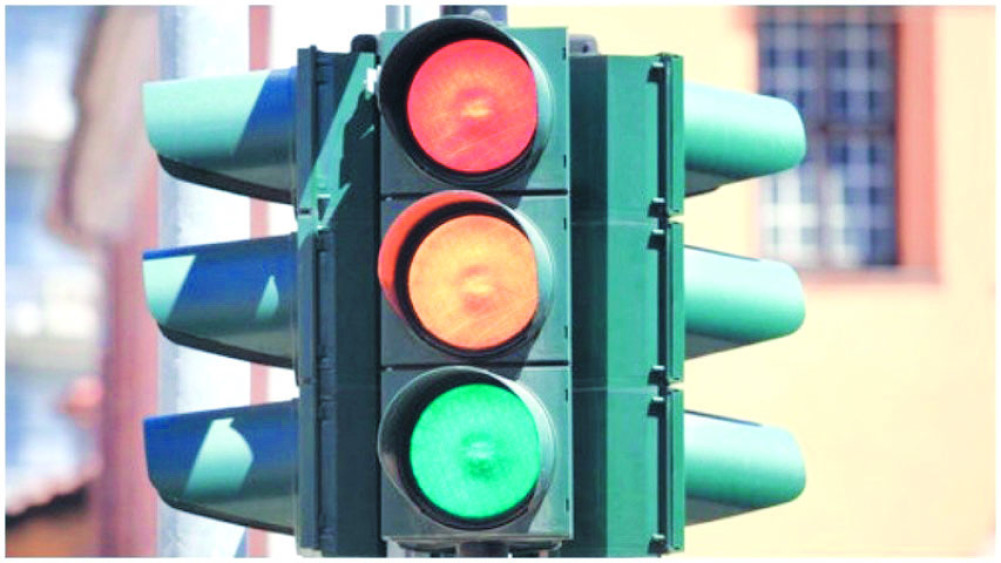
Traffic lights on the road are not accessible to the visually impaired. The visually impaired cannot see the lights while they are signaling to pedestrians. If they were to connect sound along with the lights, it would be easier for them to cross the road.
We use Google Cloud Translation Services. Google requires we provide the following disclaimer relating to use of this service:
This service may contain translations powered by Google. Google disclaims all warranties related to the translations, expressed or implied, including any warranties of accuracy, reliability, and any implied warranties of merchantability, fitness for a particular purpose, and noninfringement.
Traffic lights are installed on wide, wide and narrow roads to manage traffic flow. Traffic lights are also necessary for safety reasons as traffic flow is high. However, traffic lights are not widely installed on narrow streets and inner roads.
Red, yellow and blue traffic lights installed on road poles indicate the way. And, the green light on the road indicates the vehicles to move forward. After green, yellow lights up and within a few seconds red, which informs the vehicle to stop with caution. Green informs pedestrians to cross the road and red informs them of the danger of ‘do not cross the road indiscriminately’. Traffic rules always say not to cross the road indiscriminately and to cross only at zebra crossings.
However, there is a serious issue – traffic lights on the road are not accessible to the visually impaired. While red, yellow and green traffic lights are signaling to pedestrians, the visually impaired cannot see them. If sound was also installed along with the lights, it would have been easier for the visually impaired to cross the road. And, loss of life would have been avoided.
Every year, the slogan of Traffic Week is – Speeding kills lives, let’s follow traffic rules on the road, never drive vehicles in a hurry, do not cross the road in a hurry... However, the irony is that the number of pedestrian deaths in road accidents has not decreased. In addition to the loss of lives due to driver error, many passengers have to survive with disfigurement. Despite the installation of traffic lights, the traffic police are forced to manage the traffic of millions of vehicles at intersections with the help of their hands and whistles.
According to Nepal Police statistics, 40 percent of those who died in road accidents in the last 6 years are pedestrians. The statistics as of March 2081 say that out of 1,118 people who have been involved in road accidents, 434 are pedestrians. Pedestrians who are forced to cross the road haphazardly due to the lack of flyovers, traffic lights and zebra crossings have been involved in many accidents. In some places, there are pedestrians who cross the road haphazardly despite the presence of zebra crossings.
Under Chapter 7 of the Vehicle and Transport Management Act, 2049, Section 126 clearly states that pedestrians must walk on the sidewalk. On roads with pedestrian walkways, pedestrians must walk on the sidewalk. The section states that when walking on a road without a lane, one should keep to the right side. Similarly, Section 137 states that when crossing the road from a designated place, one should cross only at a zebra crossing, subway, overhead bridge or a designated place. However, pedestrians cross the road haphazardly. To reduce accidents, the Traffic Division has been working to fine passengers who cross the road haphazardly from 200 to 1000 rupees, provide on-the-road training, engage them in volunteer work on the road and take awareness-raising classes. However, accidents have not been reduced due to lack of implementation of the law.
Sadly, pedestrians who cross the road haphazardly in violation of traffic rules are getting away with it. In 2063 BS, the 'Road Safety Act' was brought to hold pedestrians guilty of accidents and take action. Therefore, to prevent accidents, pedestrians, like drivers, must follow traffic rules for their own safety.
Now it is necessary to teach traffic awareness education in the school curriculum. Not because I will be taken into action, but for their own safety, both pedestrians and drivers should follow the road rules. And, following traffic rules should be promoted as a road culture. This is also the way to become a good citizen.
As discussed above, the concept of 'traffic lights with sound' was introduced by a blind person, Ramesh Pokharel. In 2058 BS, the then Minister for Women, Children and Social Welfare, Rajendra Kharel, had also inaugurated the 'traffic lights with sound' program near the Akashe bridge in Bhotahiti near Bhadrakali. However, it is sad that the visually impaired-friendly traffic program of 3 decades ago has been forgotten. Despite some efforts, this campaign has not progressed effectively. And, 'traffic lights with sound' will also encourage people with disabilities.
– Acharya is the head of the National Human Rights Commission, Karnali Province – Jumla office.