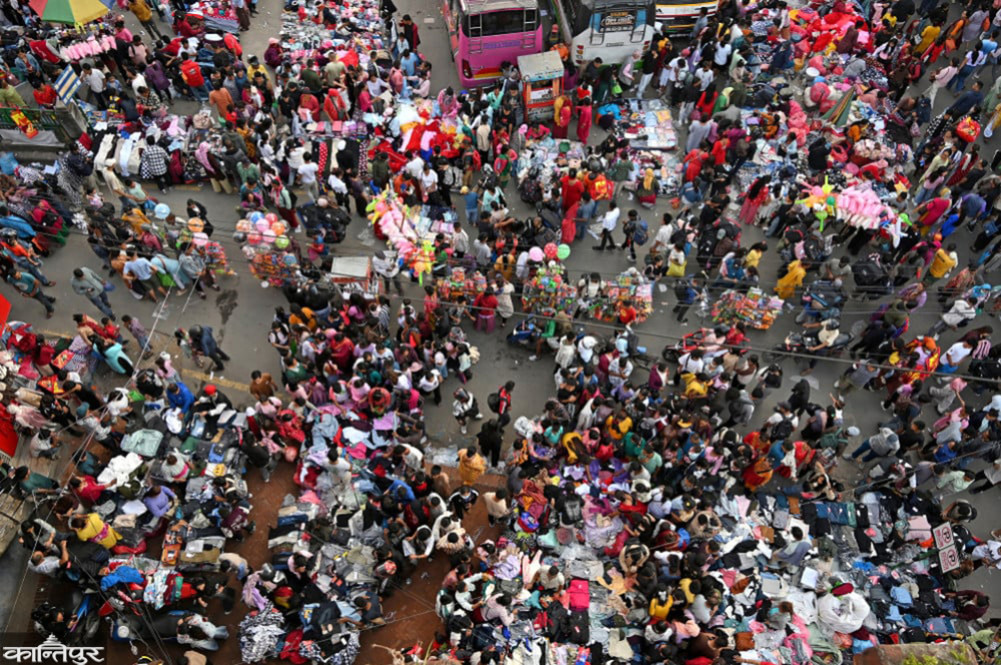
Corruption is intricately intertwined with social, economic, and cultural structures and the roles of individuals. The youth involved in the undisciplined activities of the Gen-G anti-corruption movement are influenced by Nepal's social background, values, and corrupt leadership.
We use Google Cloud Translation Services. Google requires we provide the following disclaimer relating to use of this service:
This service may contain translations powered by Google. Google disclaims all warranties related to the translations, expressed or implied, including any warranties of accuracy, reliability, and any implied warranties of merchantability, fitness for a particular purpose, and noninfringement.
The main demand of the protest led by Gen-G on Bhadra 23 was an end to corruption. The ‘Nepali Comprehensive Dictionary’ published by Nepal Pragya Pratishthan defines corruption as ‘degenerate conduct, corrupt dignity. Act of taking bribes and making biased decisions and actions that lead to moral degradation against the rules and laws, corrupt intentions or bribery.’ From this definition, corruption is conduct that goes against publicly accepted values and ethics. If so, then in the movement to end corruption in politics and bureaucracy, is it corrupt conduct in itself to engage in acts such as looting and stealing public and private property, and demanding shares for free? Many people have raised questions.
Not only in the Gen-G movement, but also in the protest organized by the royalists in the second week of last Chaitra, the protesters showed similar behavior. The protesters, wearing T-shirts saying 'May the corrupt be smitten', vandalized and looted public and private property. Looking at these incidents, the question arises - are only those in public positions in the country corrupt or has the society itself become corrupt?
Sociological perspective
Sociologist Emile Durkheim explained society as an organic system. According to him, only if every organ or institution in that organic system fulfills its role efficiently and in a balanced manner, such a society can function stably, otherwise the balance of society will be disturbed. Corruption is a state or indicator of this imbalance in society, where the system is not functioning properly. Where political corruption has made political, administrative, security, economic, cultural, educational and other institutions unbalanced. Where the absence of a rule of law has led to a state of disturbed behavior, corrupt conduct, social chaos and lawlessness. At the same time, the citizens themselves being involved in the looting of public property is another state of imbalance in society. From Durkheim's perspective, society and leaders have not become corrupt separately, but rather, both are part of the same structure and have become corrupt together.
Durkheim has analyzed society on the basis of mutual agreement and functional balance. However, when social values and morality are weak, a state of lawlessness (anomie) arises. During the movement, the rules and laws of the state could not be implemented in Nepal too. There, collective values, morality and honesty were replaced by personal, profit, self-interest and corrupt tendencies. As such a situation is reproduced, it has become clear that corruption remains in the collective consciousness of society.
Durkheim's theory of anomie explains the state of lawlessness that arises when existing social values and morality in society are weak. In Nepal, dissatisfaction and frustration have increased among Gen-G due to lack of education, employment, and equal opportunities. The chaos including looting and theft seen during the movement is the result of this anomie. As society itself behaves erratically and morally declines and becomes unable to function according to laws, it is corrupting everyone from leaders to citizens.
When the state system fails to establish good governance, not only the leader but also the society becomes corrupt. And, corruption is not limited to a single incident, it takes the form of a culture. On the other hand, according to the dialectical theory, there is a constant struggle for resources and power between the haves and have-nots in society. This theory does not consider corruption as a question of morality alone but as a condition created by structural reasons. According to Marxists, corruption is a tendency for the ruling powerful class to exploit the resources of the state, in which the powerless common citizens are exploited. From this perspective, state exploitation is based not only on the leader but also on the unequal distribution of production relations, economic structure, and power in society. When production relations and economic structure are corrupt, it corrupts not only the leader but also the entire society. Whoever is a little more powerful or uses power becomes corrupt.
Another sociologist Max Weber has mentioned that the ideal bureaucracy is rules, efficiency, transparency, and discretion. However, Nepal's bureaucracy seems to have become more focused on personal interests than on acting wisely. Where the behavior and understanding that to work and get work done in any office, one must have one's own people or pay a bribe has become institutionalized. Since the bureaucracy itself has made corruption a culture, it can be said that the common citizen could not remain untouched by it.
Another sociologist R.K. Merton has the view that when a legitimate means to achieve the goal set by society, i.e. wealth or power, is not available or when no such alternative is available, any person can adopt a 'new means'. From Merton's perspective, everyone has the desire to acquire wealth and power, but equal access and possibilities are not available for that. In this situation, every character in society searches for alternative means. In Nepal too, it seems that corruption and robbery are being used as an alternative means when it suits them. As everyone keeps repeating the accidental alternative path of corruption over and over again, corruption has developed into a culture as well.
Another French sociologist, Pierre Bourdieu, has explained in the 'Habitus' theory, 'How are the habits and behavior of an individual formed?' According to this theory, human behavior is shaped or constructed by social structure and daily practice. In Nepali society, children who have grown up hearing and practicing the saying 'you should pay a bribe to get something done quickly' have become accustomed to taking it as normal. In this way, when a social practice that has entered the individual lifestyle returns to the social structure through the next generation, it takes the form of culture.
Another sociologist, George Herbert Mead, believes that human behavior is strongly linked to social meanings and symbols. From his perspective, it seems that young people who have not understood that corruption or looting are wrong and immoral acts have taken burning and looting of public property as a symbolic meaning of revolutionary action to shake the corrupt system from the past. Since they could not understand this as an 'immoral and depraved act', it can be said that they too have become an integral part of the same corrupt culture.
When analyzed from a sociological perspective, corruption is intricately interconnected or entangled between social, economic and cultural structures and the role of the individual. The social background, values, lawlessness, and corrupt leadership have an impact on the behavior of the youth involved in undisciplined activities during the anti-corruption movement. The corruption spread in the governance system has eroded the trust of every individual in the rule of law and the legal system. When the state system fails to establish good governance, not only the leaders but also the society becomes corrupt. In such a situation, corruption is not limited to an event, but rather it takes the form of culture. In fact, in Nepal, corruption is now not just a series of irregular activities, but has become a common culture with social structure, daily behavior, and common mindset.
In Nepal, corruption is no longer an exceptional event, but is becoming a cultural practice and daily life intertwined with social relations and political structures. From ward offices to political appointments, from the judicial sector to educational institutions, corruption is becoming normalized. From a sociological perspective, it should be explained not only as a legal or moral problem, but also based on social structure, culture, and power relations.
Are only leaders corrupt or society too?
There is a dual role between leadership and society. Leadership should establish a culture of morality, high-level social values, and adherence to policies and rules, while society should also develop a culture of adherence to and implementation of the legal system. However, in a country and society like Nepal, the leadership has not been able to demonstrate a high level of morality, and society has not been able to accept adherence to the law as its way of life. In such a society, both leaders and citizens seem to be waiting for opportunities for corruption. Leaders have become more corrupt because they have more opportunities, and citizens have become less corrupt because they have fewer opportunities. As soon as the opportunity arises, the behavior of all but the exception is almost the same.
Corrupt behavior deeply entrenched in the social structure and leadership style makes unruly political leadership and citizens corrupt at the same time, where on one hand morality and values decline, and on the other hand, formal law becomes impossible to enforce. It can also create social chaos.
Any person (who may be a leader) is corrupted by the society, social structure and social relations. A leader is always hungry for votes. A leader does whatever he does to get votes from the voters of the society. Most voters vote for such a leader if the leader gives them money, food or some goods, gives them a job or protects them from any criminal action. Moreover, they do not vote for honest and virtuous people except with exceptions, but rather insult and despise such people under various names. As a result, leaders are becoming corrupt in the name of becoming practical and voter-friendly. As the society is, so will the leader be. Citizens or voters will get a leader according to their status and merit.
Leaders or high officials have seized the resources of the state. The corruption they have committed is clearly visible in the policy-making level, contracts, appointments and other activities. Leaders themselves are trying to normalize corruption by destroying social values, ethics, methods, systems and laws. In such a system, the idea that 'nothing can be done without bribery' is being normalized in society even at the citizen level. Citizens have taken it as normal to assimilate the corrupt culture affected by this. In this way, society and leaders are not separate. Every leader is born and raised in the same society, social relations, behavior, understanding and perspective. Therefore, the problem lies with both the leader and the society.
The way forward
From a sociological perspective, corruption is not only the personal fault of the leader, it is the product of the integrated weakness of the social structure, cultural values and institutional incompetence. Every leader, employee, teacher, professor of the country is born from this society and is socialized. And when corruption has generally taken the form of culture, the character of the society is also reflected in such individuals. In such a situation, if corruption is to be eliminated from society, transformation is necessary in both the leader and the society.
It is extremely challenging to improve the situation where corruption has taken the form of social behavior and cultural practice. It should start with the construction and reconstruction of the existing education system and social values. Issues such as morality, honesty, and integrity should be made mandatory in the school curriculum from the pre-primary level. Only by teaching every child to reject corruption from an early age can the corrupt culture be broken. Similarly, it is necessary to conduct a citizen awareness campaign to change the mindset that considers corruption normal behavior and to transform the culture.
Similarly, some structural reforms should be made. The country's chief executive should consider corruption control as his main agenda, make strong laws and take the lead in effective implementation. Similarly, a system of transparent service delivery should be developed by implementing an electronic governance system from the local level to the federal level.
As Max Weber said, a bureaucracy based on rules, laws, procedures, and systems should be built. In the coming days, the anti-corruption movement should be based on rational debate and alternative policies, not violence. As sociologist Jurgen Havermas has said, the culture of dialogue in the public sphere should be strengthened. The necessary code of conduct should be implemented to increase ethical conduct in political leadership. The common mindset that it is normal for everyone to take and give bribes should be broken. Efforts to reform leaders alone will not end corruption, but rather the reconstruction of society as a whole is necessary.