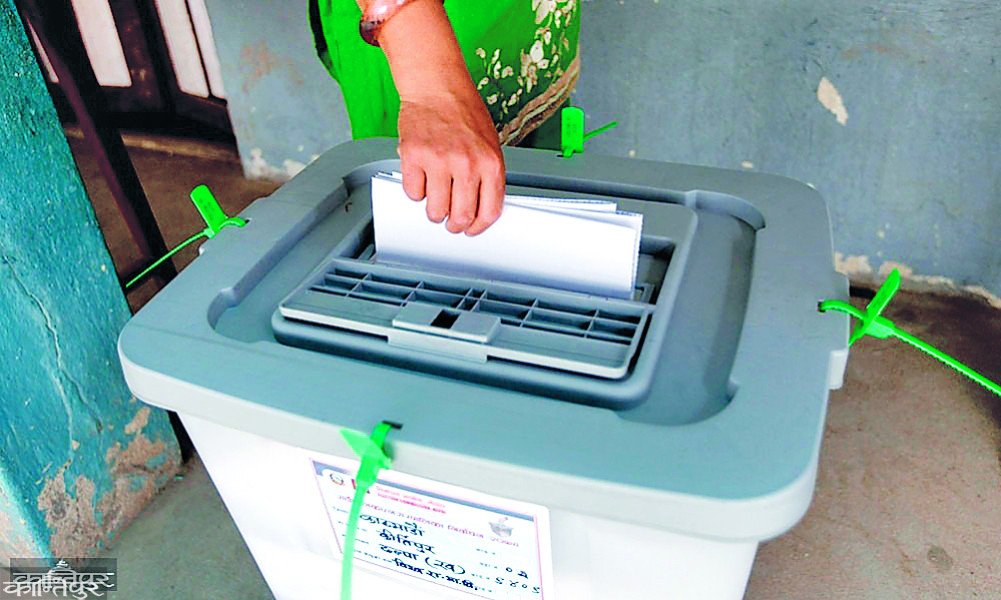
Since even minor disputes and doubts can hinder elections, it is appropriate to adopt methods that can be done easily with a small budget and time. Now, the new generation should not delay in bringing good governance, development, and prosperity by holding elections as planned.
We use Google Cloud Translation Services. Google requires we provide the following disclaimer relating to use of this service:
This service may contain translations powered by Google. Google disclaims all warranties related to the translations, expressed or implied, including any warranties of accuracy, reliability, and any implied warranties of merchantability, fitness for a particular purpose, and noninfringement.
.
The Gen-G rebellion has created a different situation in Nepal. Although the constitution, system and structures are the same now, there has been a change in the political situation and thinking.
The House of Representatives has been dissolved and mid-term elections have been announced to be held on 21 Falgun. The issue of voting rights for Nepalis living abroad has once again come into the spotlight in the elections.
The government has also announced that it will amend the law to grant voting rights to Nepalis living abroad in this election. The idea of ensuring the political rights of citizens living abroad had been under debate for a long time. This issue was also raised during the first Constituent Assembly elections held after the 2062/63 People's Movement.
There was pressure in the subsequent elections that citizens living abroad should be given voting rights. However, due to the inability to establish a political consensus, the lack of constitutional and legal provisions, the managerial aspect being too complicated, and the lack of financial resources, it has not been implemented.
The concept of the right to vote for citizens abroad was first developed in ancient Rome through the voting process of provincial mayors. Then, in 1862, the right to vote was granted to soldiers deployed in the United States, in 1890 in New Zealand and in 1902 in Australia, and in 1915, when Canada gave soldiers the right to vote by mail, external voting seems to have developed. In today's era, due to the global democratic wave, changes in public consciousness, the highest development of technology, and the impact of globalization, democratic governments are being forced to legalize external voting. More than one hundred and fifty countries in the world have assimilated this concept in one way or another. It seems that neo-democratic countries are taking the lead in building strong nations by institutionalizing democracy by maintaining high citizen participation in elections.
The Universal Declaration of Human Rights, 1948, also considers adult suffrage as an important aspect of human rights. There is an international convention to ensure the unhindered exercise of political rights by all citizens of their country. It recognizes the right of migrants and their families to vote and provides for the exercise of this right by the concerned country. Although most countries have made provisions for external voting in their constitutions and laws and have practiced it in various forms, some countries have not yet been able to practice it. Although some countries, including Armenia, have introduced it into practice, there are also examples of removing it from the law due to low voter turnout. It is not possible to implement external voting without making provisions in the constitution and law. Some countries have mentioned it in the constitution itself, while some have implemented such a provision by including it in the election law.
It is not that external voting is not being practiced in Nepal. In the referendum held in 2037, Nepal had made a provision in the Referendum Regulations, 2036 that government employees abroad, employees working in government-owned organizations, and their family members who were eligible to be voters could vote at polling stations located in Nepali diplomatic missions in the country where they reside or in the nearest country. A joint bench of the esteemed Supreme Court issued a directive order on 7 Chaitra 2074 in the name of the Government of Nepal, the Office of the Prime Minister and the Council of Ministers to provide the opportunity to vote in the elections of Nepal to Nepalese citizens living abroad. The State Affairs and Good Governance Committee of the House of Representatives has directed the Election Commission to implement the order, and the Commission, after studying it in various stages, prepared a draft of the Election Management Act, 2080 on 18 Ashad 2080 and sent the bill to the Ministry of Home Affairs of the Government of Nepal for parliamentary approval, which contains a legal provision that voters living abroad can vote in the proportional representation of the House of Representatives in Section 204.
The globalization of political, personal and professional life and the expansion of democracy and the significant increase in the number of citizens living abroad have seriously raised the question of the voting rights of citizens living abroad permanently or temporarily. The current situation, where more than 25 percent of voters are deprived of the opportunity to vote while living outside the country, cannot be considered a good practice of democracy.
Even though they are living abroad, their contribution to the political and economic development of the country is significant. Advocates for external voting have cited the significant contribution made by citizens living abroad to the country's economy as an example, arguing that proper mechanisms should be put in place to enable them to exercise their voting rights. It seems that the arguments against it are that it would be financially difficult to implement this system in a country like ours with a weak economy, that it would add new burdens to management, that political consensus could not be reached for the legal system, and that the integrity, fairness, transparency, and credibility of the elections would not be maintained.
The task of external voting is indeed important and very sensitive. It does not seem impossible if there is a policy consensus and commitment to implementation. However, before managing external voting, it seems necessary to have extensive discussions among stakeholders on the anticipated public participation in it, transparency and credibility to be maintained in voting, fairness and impartiality, equal access opportunities, cost-effectiveness, etc.
There are various methods of external voting. The method is selected based on the political, economic, social, and technical conditions of the country and its foreign relations. The main methods currently in use are as follows:
(a) In-person or in-person voting: Under this method, citizens in a country go to the embassy or designated location of their country and vote in the same way as at a polling station in their home country.
(b) Postal voting: Under this method, ballots are provided to voters who are listed in the voter list but are abroad through post or email, and the concerned voter must mark and seal the ballot and return it to the designated address through post.
(c) Online or Internet voting: Under this method, voters cast their votes online or through the Internet. Voting can be done within the software developed by the Election Commission using technology.
(d) Proxy voting: Under this method, voters cast their votes in their absence by giving a power of attorney to another close and trusted person. The authorized person votes on behalf of the voter who gives the power of attorney at a polling station in their home country.
(e) Mixed method: This is not a separate method in itself, but a mixed practice of these methods. Under this, citizens living abroad are given the right to vote by using two or more of the above four methods.
Nepalis have a significant population in many countries of the world. Government statistics show that there are around 2.2 million Nepalis in other countries except India. Experts say that more than 4 million Nepalis have settled for various purposes. It is estimated that about ninety-five percent of the Nepalis living abroad are Nepalis in six Arab countries and Malaysia alone. The reality that the results of elections conducted ignoring such a large number have not resulted in sustainable peace, stability and development in the country is not hidden.
The votes cast by this number can be decisive in Nepal's elections. Therefore, its proper, reliable and trustworthy management is necessary. Important issues such as how long this right should be given to those living abroad, what method should be used for voting, how long the voting process should be completed, giving such a right to Nepalis living in all countries or giving the right to vote in elections under which level and system should be selected, should be discussed with stakeholders. Our country is different from others in terms of geography, demographics, politics, economy, society and culture. We can immediately start the practice of external voting in the upcoming mid-term elections of the House of Representatives by developing our own model that suits our climate, soil, life and environment.
How to do it?
Legal system: The Election Commission Act, 2073, the Voters' Roll Act, 2073 and the House of Representatives Member Election Act, 2073 should be amended through an ordinance to include provisions regarding the voting rights of Nepalis living abroad.
Risk management: Various types of obstacles and risks may arise when conducting the voting process even abroad for the first time. Due to the lack of adequate peace and security arrangements, disputes and conflicts may arise and the voting process may have to be postponed or canceled. In some places, a situation may arise where it is not possible to conduct re-voting. This should be regulated in the law so that it does not affect the voting held within Nepal.
Voter List: The first process that is essential for elections is the voter list. A separate voter list should be prepared for Nepalis living abroad so that both those who are included in the current voter list with a photo and those who are not, can register their names through the online process. This list should be verified with the help of relevant agencies on the basis of the registered name, details, citizenship, passport, etc., published on the internet, and the process of contesting claims should be conducted to prepare the final voter list.
Polling place or center: Polling places should be arranged at the places where Nepal's resident embassies and consulates are currently located, and polling centers should be designated according to the number of voters who will vote. Arrangements should be made for Nepali voters in countries where polling places have not been designated to vote in their nearest country. Additional polling places can be arranged in some countries with a large number of voters.
Ballot papers and voting materials: The necessary ballot papers for voting should be printed in Nepal and the materials such as ballot boxes, seals, swastika stamps, etc. should be sent to the polling place along with the team going from Nepal to conduct the voting.
Voting method: The method of voters voting in person should be used. In countries with a large number of voters, a mixed method should also be used. In such countries, arrangements may need to be made for voters to vote in turns for five to seven days. Arrangements should be made for Nepalis living abroad to vote secretly on a single ballot paper in the proportional representation system of the House of Representatives.
Election/Voting/Counting Representatives: Political parties that have fielded candidates for the proportional representation system in the election of members of the House of Representatives should arrange for one such representative from among the voters in the respective country for each polling station. Voting and counting should be completed in the direct presence of those representatives.
Obtaining assistance: The Government of Nepal should seek assistance from the respective country where the voting will be conducted through the Ministry of Foreign Affairs for the management of the polling stations and election security.
Manpower: Depending on the number of voters and the geographical location of the country, three to five staff including polling officers should be deployed at each polling station. The head of the embassy or mission where the polling station is located should be designated as the election officer.
Counting and Results: After the voting is completed at all polling stations, the employees assigned to the voting should count the votes at each polling station under the leadership of the election officer and in the presence of representatives of political parties, and arrangements should be made to enter the vote results into the software and send them to the central server of the commission. Seats should be distributed to the parties using the formula for determining seats in the proportional system by integrating it with the results obtained in the country.
Election Observation: Arrangements should be made to allow domestic and foreign organizations that want to observe external voting by specifying the country and polling station.
Voting expenses: It is appropriate to use the materials prepared by the commission for the voting in the country, including ballot papers, ballot boxes, swastika stamps, and other materials required for voting. The daily travel allowance, food and accommodation expenses, etc. of the employees deployed, including the head of the embassy or mission, should be handled with the support of NRNs and the donor community.
Conducting voting for Nepalis living abroad in the above manner will definitely fulfill the wishes of Nepali voters living abroad for years. Technology-based external voting may not be reliable, less expensive, easy and universally accepted right now. Since even minor disputes and doubts can hinder elections, it is appropriate to adopt a method that can be done in a small budget and in a timely manner. Now, the new generation should not delay in bringing good governance, development and prosperity by conducting elections as planned.
– Ghimire is the Information Officer of the Election Commission .