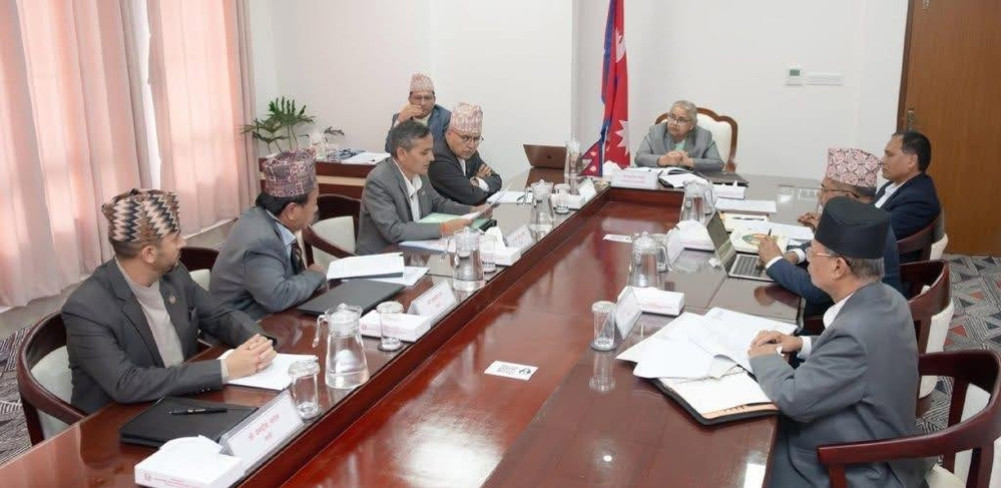
Elections are not only the responsibility of the government, but also a common test of the entire political system. Therefore, the interim government should create an environment of continuous dialogue and trust building with the parties. Only a common code of conduct, transparent electoral process and guarantee of equal opportunities will reassure all parties.
We use Google Cloud Translation Services. Google requires we provide the following disclaimer relating to use of this service:
This service may contain translations powered by Google. Google disclaims all warranties related to the translations, expressed or implied, including any warranties of accuracy, reliability, and any implied warranties of merchantability, fitness for a particular purpose, and noninfringement.
Nepal is once again standing on the brink of political uncertainty. Another is caught in a political transition. On August 23rd and 24th, young people staged large protests and demonstrations in major cities of the country, including the capital, as the instability, internal mistrust and frustration with the leadership created by the power equation between Nepal's political parties is creating deep dissatisfaction in the society.
This demonstration, which received the name of the Zen-G movement, raised many concerns about irregularities. A direct reflection of this was seen on the streets of Kathmandu, where representatives of the new generation expressed their anger not only at the political leadership, but at the entire systemic failure. These youth were looking for more transparency, accountability and a clear path to the future than the temporary alignment of parties.
A new interim government has been formed after more than 75 youths gave their support during the two-day protest and demonstration. An interim government has been formed under the leadership of former Chief Justice Sushila Karki based on the principle of necessity rather than the constitutional process. This arrangement has raised the question of the legal justification, but it has also been presented as an inevitable measure to contain the current crisis. However, such a move is only a temporary solution, for long-term stability it is imperative that the interim government focus on transparent elections.
The interim government formed after the Jen-Ji movement has a great responsibility to clear the country with the challenge. Its main 'mandate' is to conduct fair elections, conduct fair investigations into Gen-G performance and ensure good governance. But all these tasks are equally challenging. Escape of prisoners from prisons has increased insecurity in the society. While the major parties accept the need for elections, they are questioning the constitutionality and procedural legitimacy. This has further deepened the political confusion. The party supporting the government only wants to see drastic measures, while the parties are caught in a dilemma about their existence and future.
Furthermore, the problem has become more complicated due to the weakening of internal democracy within the parties. The decision-making process of leaders is often limited to a small circle, due to which neither adequate discussion is taking place within the organization, nor participation of members is ensured. It has also increased mistrust among people outside. As a result, public trust in leadership and institutional structures continues to erode. On the one hand, there seems to be a desire for the intervention of youth within the party, but the legal path within the party is entangling it.
Now the parties are losing their own basic principles and internal accountability. When the decision-making process is not transparent and deliberation is devalued, the parties are reduced to mere tools of the power equation. If this trend continues for a long time, democratic institutions will weaken and people will start looking for alternative power, which will eventually threaten the stability of the system.
Along with the political changes, 'conspiracy theories' have also increased rapidly in Nepal, which has increased the flow of lies and misinformation. While some have called the Gen-G demonstration a spontaneous mass movement, others have claimed it was a planned 'hijack' by an external force. There are numerous explanations and analyzes on social media, in which some claim that the political parties themselves opened the door to the interim government by diverting the movement, while others say that the interest of regional and international powers intensified the incident. Such statements are still raising more questions and doubts at the civilian level. Along with this, the discussion of geopolitical conspiracy is also connected.
Since Nepal is located in a geographically sensitive area, competition between India, China and Western powers is naturally a topic of discussion. Therefore, the current political changes are being characterized by some as a 'strategy of external powers'. Such statements, based on speculation rather than evidence, are strengthening mistrust and polarization in the society. If the state fails to conduct transparent investigations and disclose clear facts, such 'conspiracy theories' will deepen, threatening to overshadow the real problems, impunity, weak governance and the importance of democratic institutions.
To solve the current problem, national reconciliation and collective commitment against corruption is necessary, which should be accepted by the entire political system, not just one party or leader. Efforts to free the administration and judicial system from partisanship should be started immediately. Conducting fair and successful elections while preserving the spirit of the Constitution is also the main way out of the status quo. Stability is not possible without the active and responsible participation of parties in transition. In this process, the parties should not be left out, but it is necessary to bring them together.
The solution to Nepal's political problems lies in getting a new mandate through elections rather than a 'numbers game'. This is also the main message of the youth on the streets. Parliament is the institution that hears our voices, so we should be allowed to speak through votes. They demand accountability and what they seek is accountable leadership. If national consensus cannot be built through elections this time, an even bigger transition may occur. The non-party collectivism shown by the youth through their movement is a serious warning to the parties. Parties that cannot win trust based on social issues and tolerance are increasingly likely to be sidelined. Political parties should improve themselves effectively to prevent anti-party commentary from being established in the society.
The challenge this time is not only of the government or parties, but of the entire society. Civil society, media, educational sector and local levels all need to redefine their roles in order to regain trust in the political system. If the activism and desire for change shown especially by the youth can be transformed into an institutional way, democracy will get new energy. It does not take time for the country to change its face and this is the characteristic of Nepali society.
Nepal's political culture has normalized 'conspiracy theories' and 'secret games' for a long time. But the new generation is rejecting it and demanding direct answers. Why is there always a power play behind the scenes? This question will force the current leadership to self-analyze and return to transparent political practices. So now the parties have no choice but to proceed through political honesty, transparency and reconciliation. Only this path can ensure a stable future by addressing discontent.
Elections are not only the responsibility of the government, but also a common test of the entire political system. Therefore, the interim government should create an environment of continuous dialogue and trust building with the parties. Only a common code of conduct, transparent electoral process and guarantee of equal opportunities will reassure all parties. When elections are undertaken as a collective project, shared ownership and long-term sustainability are ensured even over the outcome.