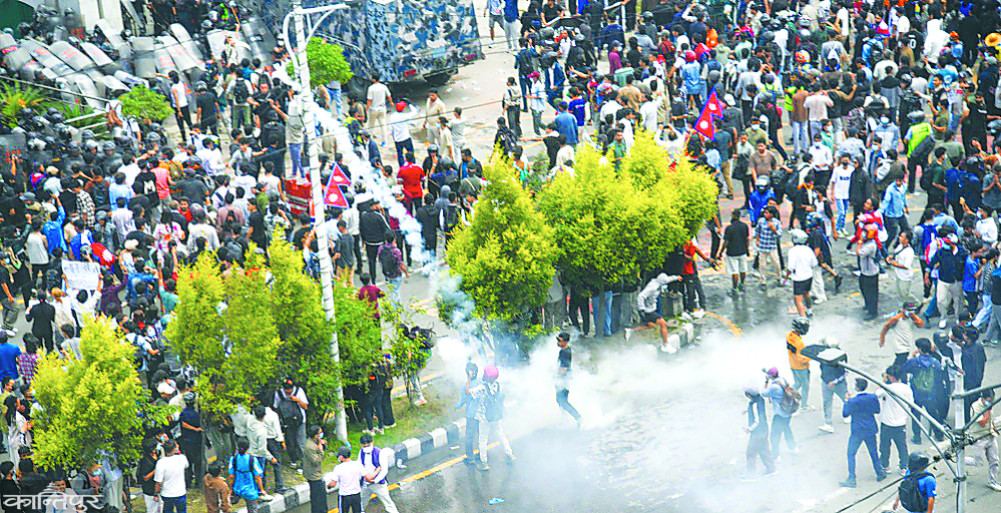
The despotic government mindset, which considers only the mechanical election process as democracy, turned the constitution into a pile of paper, and Nepal was reaching a state where democracy was only a cover.
We use Google Cloud Translation Services. Google requires we provide the following disclaimer relating to use of this service:
This service may contain translations powered by Google. Google disclaims all warranties related to the translations, expressed or implied, including any warranties of accuracy, reliability, and any implied warranties of merchantability, fitness for a particular purpose, and noninfringement.
Taking the basic slogan of 'youth against corruption', more than 70 youths are helping to build a corruption-free society, good governance, equal access to the opportunities given by the state and a governance system that is accountable to the people.
No matter how much we condemn the destruction done by various criminal elements in the Gen-G movement on August 24, it is not enough. A judicial commission has been formed to investigate the culprits of these incidents. The purpose of this article is to present the factors of Gen-G movement, some of the observed scenarios and some suggestions for sustainable governance reforms by maintaining the direct rule of the common people in Nepal. Before entering the topic, all the leaders of the Zen-G movement are requested to be alert, not to destroy the achievements of the democratic movement so far and to always move forward in the direction of establishing a comprehensive democracy.
Factors of Gen-G movement
Plunder created by parties under the cover of democratic constitution, extreme abuse of state resources and exploitation by party leaders and close people, centralization of power in the elite class, shadow of corruption everywhere, partisanship and lack of expertise/skills prevalent in courts, constitutional organs, civil service, universities, media and civil society, gross negativity towards decentralization and federalism and real democracy that people can feel The Gen-G movement seems to be targeted against scarcity.
The ban on social media, the bill brought to curtail the voice of civil society, the insensitivity shown by the then Prime Minister even when a minister's car ran over people, and the removal of both the age and term limits for the president at the UML legislative convention on the morning of the movement may have added fuel to the
movement. The people had been won over by the game of musical chairs where only three nobles became the Prime Minister.
In spite of the prevailing depressing messages of having to win the election, not having to deliver what was said in the election, not having to answer to the people, looking at their relatives and party workers, making the government system a recruitment center for party workers and forcing the children of the common people to sell labor abroad, the despotic government mentality that is not close to the common people and does not communicate with the people and considers the mechanical election process to be only democracy is turning the ideal constitution of Nepal into a scrap of paper. Nepal was reaching a state where democracy was only a facade democracy.
The leaders of the ruling party, especially the then prime minister's anarchic arrogance and the opposition leaders' constant rejection of reconciliation, national consensus and the sense of responsibility towards the common people were rapidly slipping away. What is surprising is that even after such a national situation, the ruling leaders of Rome were oblivious, content to indulge their anger and yet again dream of winning the election and reigning forever, as if they had won the race in some league to rule forever.
Let's not talk about our complicated geopolitics and foreign powers who are always ready to play us and take advantage of the division. In short, the parties that preached the democratic constitution and preached to the people never looked at their faces in the mirror. They did not understand that people stopped believing as they grew older, they did not practice internal democracy within the party. The people did not give a candidate they liked. They were not responsible for their own manifesto and did not realize their duty to the people, but the tendency to cling to power only for the benefits of satalipsi and corrupt practices prevailed and today they were overthrown by the storm of Gen-Ji movement.
Some scenarios that appear before Ideal scenario:
If the agitating forces, all political parties, broad civil society and stakeholders make joint efforts and cooperate, the current interim government can complete the elections within 6 months. A judicial commission has been set up to investigate murder, robbery and arson. The immediate demands of the citizens will be fulfilled by the interim government and long-term constitutional amendments will be done by the elected representatives. New parties will be formed and the mandates of the current movement will be taken to the people through the election manifesto and will be implemented after winning the election, the current liquid politics will end, peace, stability, prosperity and direct rule of the people will be implemented in the country. Desperate scenario :
The political situation will become more chaotic. Old political parties will also hit the streets. All the ancient powers, including the monarchists, will also test their strength, creating a situation of sporadic civil war. Nepali army will take over the power. Terrorist maneuvers by foreign powers may increase. Common citizens will live in fear and panic. Peace and security cannot be maintained. There will be serious violations of human rights. Another constitution will not be able to be formed and the existing constitution will not be able to work. There won't be an election for years. potential medium scenario:
potential scenarios will be neither ideal nor extremely frustrating. But assessing the moderately mixed scenario is complicated. Elections may be held in the next one to one-and-a-half years, but the political fluidity may last for years. Constitutional reform can again be challenging if a political power does not have a sufficient majority. Even if the new parties win elections, they may not be able to run an effective people-oriented administration due to lack of maturity. New political parties can also get involved in the power game like now.
Likewise, current reformist political forces may press the existing interim government to elect a direct chief executive and may wish to suspend or abolish the existing constitution altogether. These forces may prohibit dialogue with the old political parties. If this happens, the current political fluidity will be prolonged and the country may have to bear another political movement and instability after ten years as before. And, there is an interesting possibility in the possible scenario.
The interim government It will initiate dialogue with new political forces like Jen-G, Balen Shah, Nepali Congress, UML, Maoist Center, Madhesh parties, National Independent Party, tribal political forces, RPP, Nepali Army and various interested groups and get everyone to agree to participate in the upcoming elections. Giving foreign powers adequate information about the electoral process will gain their moral and material support but will succeed in maintaining the necessary distance from foreign powers to keep national sovereignty intact.
The upcoming election will be held for the House of Representatives according to the current constitution, even though it will be delayed. In general, there will be an election in the country. Anti-corruption campaigns and good governance will become the main pillars of political reform. After the elections, the country will experience peace, stability and direct rule of the people through gradual constitutional reforms.
Some suggestions for common people's access to state power
As suggested by the Nobel laureates Akemglu and Robinson in the book Why Nations Fail, constitutional, administrative and behavioral reforms are necessary to prevent Nepal from turning into a failed state, to establish fair and equal access of the common people to state resources and to develop inclusive institutions. Towards constitutional reform, this article does not wish to enter into a debate on parliamentary supremacy or the use of the direct executive. Because British parliamentary practice or France's executive presidential practice, both are successful but in the current environment both these countries are facing political challenges.
The current status of the executive authority and power checks and balances of the US executive president is well known. The path of constitutional reform in Nepal should ensure the cleanliness of the electoral system and the accountability of political parties to the people.
For this, no one can run for more than two terms continuously or repeatedly in any position, no one over seventy years old can hold an executive position, fixing the voting age at sixteen years, anyone who has reached the age of twenty one can be elected to any executive position including parliament, forty percent seats in all legislative elections will be reserved for young people under forty years old, arrange for secure online voting, all Nepalese citizens abroad can vote online. Arrangements should be made to do so. In the current proportional system, forty percent of the seats should be reserved for youth within their respective groups.
Election expenses of all political parties and candidates should be disclosed online. Based on the votes obtained in the previous elections and the percentage of implementation of their manifesto, the state should give expenses to the parties and independents who want to participate in the elections. Apart from this, the parties should not take any financial benefit from the people. Provision should also be made for independents to be elected in a proportional system. Political parties must
Internal democracy must be fully guaranteed within your party. Mandatory primary system (system of direct election by people's assembly) should be done when political parties put up candidates in any legislative or executive office election. All party posts should be appointed by election only. No person should be in the executive position of the party for two terms and above the age limit of seventy years.
parties must publicize their manifestos and be evaluated by established mechanisms of civil society. Political parties or individuals who do not fulfill manifesto promises should be dealt with through public hearings and court proceedings. The provision to impeach the executive who does not fulfill the promise should be written in the constitution.
To ensure public access to courts, constitutional bodies and all institutions of the state, appointments to these institutions should be made only on the basis of meritocracy, inclusiveness and public hearings with direct participation of civil society. None of these posts shall be tenured or reassigned. Conflict of interest Strict legal arrangements should be made to prevent
(conflict of interest). The age limit for these posts should be reduced to twenty five years. Citizen evaluation of all public office holders should be implemented. To make the current civil service and all government services accountable and effective to the citizens, the morale of the members of such services should be increased and the system of evaluation based on work should be adopted and the feeling of 'no one can remove them from the permanent administration' should be uprooted.
For this, instead of the stability of staying in the job until a certain age, appointing a job and a period of time and after the work is evaluated, the service period should be added only if it is deemed suitable, and the evaluation system conducted by citizens should also be applied to all employees. Corruption control is not possible only with the efforts of a designated organization, so all public organizations should implement anti-corruption and ethics promotion strategies.
The current federalism and decentralization of government power should be deepened and the government should reach the doorsteps of the citizens. For this, the existing provinces should be developed as the conductors of regional development, municipalities and wards as centers of all government support related to people's daily lives, and self-made (non-political) organizations of citizens should be developed as organizations that communicate with governments and monitor public affairs.
Every citizen should be connected to the governance system through accessible digital democracy and the state should guarantee the direct governance of the people. The future economic policy should focus on eliminating economic inequality and increasing the purchasing power and consumption capacity of the poor people. The state should guarantee equal opportunities and fairness (level playing field) for open competition by developing special protection for weak and marginalized citizens and responsible market towards society.