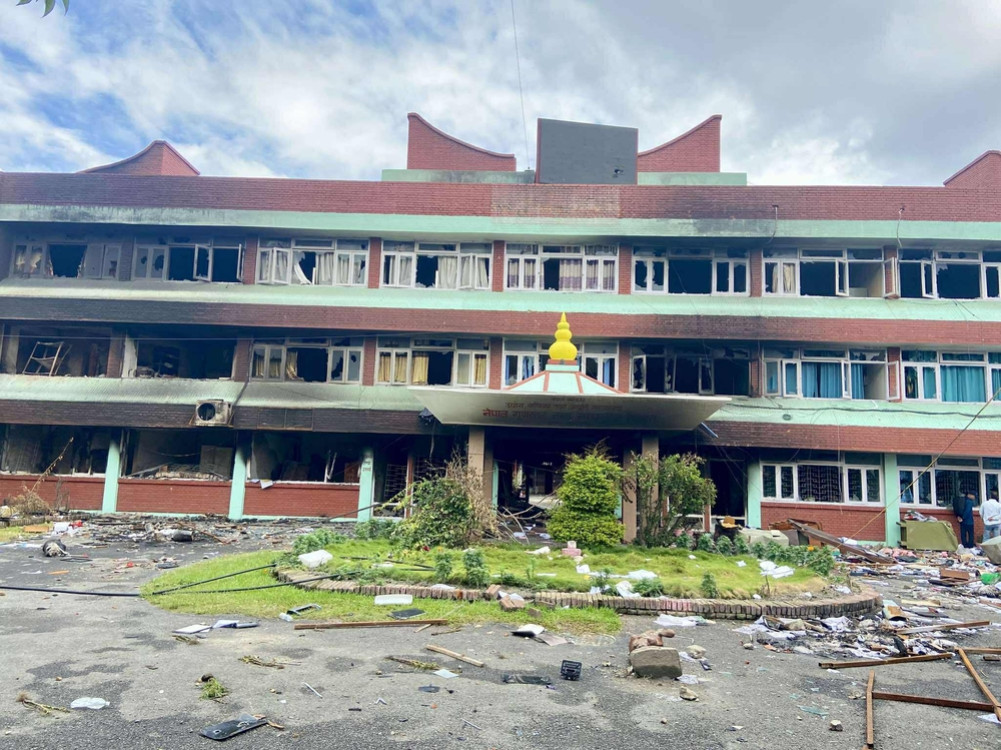
With restraint, prudence and long-term thinking, Nepal should learn from the major reconstructions in the world and the reforms adopted by neighboring countries after the crisis.
We use Google Cloud Translation Services. Google requires we provide the following disclaimer relating to use of this service:
This service may contain translations powered by Google. Google disclaims all warranties related to the translations, expressed or implied, including any warranties of accuracy, reliability, and any implied warranties of merchantability, fitness for a particular purpose, and noninfringement.
After the Gen-G movement on 23 and 24 August, the issues of reconstruction of Nepal are prominent. After the movement, which is considered to be against misrule, corruption and the monopoly of the governance system, the work of rebuilding the nation as a whole has to be carried forward.
Issues of political, social, legal, administrative and economic reform naturally came to the fore. The new government faces more challenges than any government in history to date.
In this article, an attempt has been made to discuss the issues of economic revival. The economic data before the movement showed the situation of price increase, foreign exchange reserves, the amount that can be given loans to the banking sector, interest rates, etc. Before the Gen-G movement, the only issue in debate was to achieve more economic growth by using the strong base of economic stability.
An important topic of the upcoming debate is reconstruction and economic revival. It is yet to be determined how much additional expenditure will be incurred on the state exchequer due to the loss of important infrastructure across the country and especially in the capital. Damage assessment and compensation for commercial and private structures is another issue. Due to the great damage to the physical infrastructure, there is a need to proceed like the implementation of the Marshall Plan when making a reconstruction plan in the context of Nepal.
In order to rebuild the Europe that was devastated by the Second World War, the United States advanced the European reconstruction program according to the idea of the Secretary of State, George Marshall. During his address to Harvard University students in June 1947, Foreign Minister Marshall put forward the concept of rebuilding Europe. Accordingly, in 1948, the reconstruction program went ahead. Its main goal is to rebuild the destroyed infrastructure in Europe, agriculture There was a
and restoration of industrial production and an end to poverty and hunger. The European Cooperation Agency was established for the implementation of the Marshall Plan. This agency was freed from political influence and people with professional experience were entrusted with running the agency.
Paul Hoffman, who has been the president of the American car manufacturing company Studewaker, has been given the responsibility of the administrator of the European Cooperation Agency. Hoffman was one of the men who saved the American car company Studewaker from bankruptcy during the Great Depression of the 1930s.
There have been various comments about the effects of the Marshall Plan. However, the economic revival of Europe did not take long due to the implementation of the program under the plan. Within 4 years, Europe's economic output reached pre-World War II levels, and despite economic growth, price stability was maintained. After the implementation of the Marshall Plan, Western Europe's agricultural production increased by 11 percent and industrial production by 40 percent, and overall production increased by 32 percent.
The effect of the Marshall Plan on mechanization was so great that in 1945 there were only 25,000 tractors on agricultural farms in France, but after 4 years, 200,000 tractors started plowing the fields. The impact of the Marshall Plan was also seen in sustainable economic growth. Europe averaged 4.8 percent annual economic growth from 1953 to 1973.
Never before has Europe achieved such great economic growth. This proves how qualitative the importance of the reconstruction in the economy if it can be carried out properly. It is also an important opportunity for today's Nepal.
If economic reform programs cannot be implemented after the collapse, there is fear of economic-political disorder. Due to the devastation of World War I, countries such as France and Germany suffered from uncontrolled hyperinflation in the immediate aftermath. The
resulted in Germany paving the way for an authoritarian regime with militant nationalism instead of a democratic one. As a result of a weak economy and authoritarian rule, Germany was also badly defeated in World War II. Once an important power, the country ended up being divided into East Germany and West Germany in 1949.
In the context of today's Nepal, the experience of Sri Lanka and Bangladesh, which experienced economic-political crisis just before us, is also remarkable. Sri Lanka fell into a major economic crisis in 2022 due to corruption, stubbornness of power and immature economic policies. Within a few years after the civil war, Sri Lanka was forced to face an extreme economic crisis due to the extreme lust for power and short-sighted economic policies of the Sri Lankan rulers.
The devastating bomb attack targeting those who gathered to celebrate the Easter festival in 2019 and the 2020 Covid-19 pandemic devastated the tourism sector, the mainstay of the Sri Lankan economy. Meanwhile, the Gotavai Rajapaksa government adopted a policy of gaining cheap popularity without thinking in the frenzy of the overwhelming majority. The economy collapsed as a result of massive cuts in tax rates and forced unprepared farmers to switch to organic farming in a hurry. The economic crisis eventually became a political crisis.
In the last two years, Sri Lanka is on the road to economic recovery with the help of international donor agencies and the structural reforms, the creation of important laws and the discussion of political reforms.
Talking about political reforms, the failed use of executive presidential system with centralization of powers started by the then President Junius Richard Jayawardene in 1978 is also under discussion. There is a discussion to address this issue in the upcoming constitutional amendment. Sri Lanka, which has defaulted due to lack of foreign exchange reserves and is unable to pay its foreign debt, is on the way to economic revival with the help of the International Monetary Fund.
What is the message for us from the experience of Sri Lanka in the current situation of Nepal is that we have to look at the long-term effects of political reforms. At the same time, if we are not agile in economic management, if we do not use the foreign exchange reserves correctly and if we lose the economic balance, we may have to accept some unpleasant conditions from international donor agencies.
Sri Lanka is another example, Bangladesh. After the political change in Bangladesh in August last year, the interim government is running the government. The then Prime Minister Sheikh Hasina's lust for power and the politics of prohibition against the opposition were on fire in Bangladesh.
On this occasion, a student movement began in July 2024 against the reservation in government jobs that had been introduced since the independence of Bangladesh. Extreme repression to control the movement made the situation more chaotic. Finally, after 15 years of continuous governance, Sheikh Hasina was forced to leave the country.
Bangladesh is currently under the leadership of Nobel Prize winning economist Mohammad Yunus. Elections have not been held for a year since the formation of the interim government. Based on the consensus of thirty political parties and the interim government of Bangladesh, the July Declaration, which was announced in July, has put forward the issue of constitutional, political and administrative reforms.
However, political instability remains. As structural reforms are underway under the 'Extended Credit Program' with the support of the International Monetary Fund, macroeconomic stability is maintained.
Most of the foundations of Nepal's economy are still strong today. Nepal's situation is different from that of Sri Lanka and Bangladesh in that Nepal has a base from which available foreign exchange reserves can be used for reconstruction. In today's situation, the first requirement is to proceed by forming a competent body for the reconstruction of the physical structure. It will be easier to collect support for reconstruction if the agency can be given the authority to directly contact and collect support from international donor agencies.
reconstruction can also be an opportunity to make maximum use of Nepalese labor and skills. It also plays a role in increasing domestic demand in the economy. This is also confirmed by the contribution that the reconstruction made after the 2072 earthquake has boosted economic growth. Along with this, how to sustain the agricultural sector, which is considered as an important base of Nepal's economy, how to prevent high internal migration and investment in commercial and industrial infrastructure. Equally important is how to ensure
security. How to attract investment is now a challenge for Nepal, which is a country with low foreign direct investment in the world.
The general public's desire for government reform has been voiced by the Zen-G movement. Along with this, the unexpected destruction of infrastructure has added a major challenge to economic recovery. Therefore, with restraint, prudence and long-term thinking, Nepal should move forward by learning from the major reconstructions in the world and the reforms adopted by neighboring countries after the crisis. For this, cooperation, coordination and understanding with all stakeholders, donor agencies and general public at home and abroad is important.