In order to control corruption, it is necessary to identify its areas of risk and to plan policies, laws and strategies for its control.
We use Google Cloud Translation Services. Google requires we provide the following disclaimer relating to use of this service:
This service may contain translations powered by Google. Google disclaims all warranties related to the translations, expressed or implied, including any warranties of accuracy, reliability, and any implied warranties of merchantability, fitness for a particular purpose, and noninfringement.
Corruption scandals are becoming public every day in Nepal. But there is confusion as to which are the most risky areas. In 2075, the Commission for Investigation of Abuse of Authority identified high-risk areas of corruption. In which there are basically only public service provider offices.
Moreover, in order to identify areas with a high risk of corruption, the number of complaints received in the Commission throughout the year and the number of cases filed in the special court has been taken as a basis. However, it is not possible to identify the risk areas of corruption only based on the study conducted by the commission and the areas where complaints have been made to the commission. Instead, there is a high risk of corruption in areas that are not reported to the authority, are not in its jurisdiction or are not known to the general public. Which this article has tried to clarify.
First, corruption in policy-making. There seem to be two branches of political corruption in Nepal. First, corruption through the decision of the Council of Ministers, and secondly, corruption through creating policies or laws to benefit certain interest groups and business houses. The importation of corruption through the decision of the Council of Ministers is wide . Although the entire decision of the Council of Ministers is considered to be a policy decision, the authority has filed a case against former Prime Minister Madhav Nepal for the first time on May 22, based on the decision of the Council of Ministers.
Looking at the available facts and data and the experience of experts, it seems that the first area where the risk of corruption is high is the decisions made in the Council of Ministers. Even the decisions to be made at the staff level are taken to the Council of Ministers, and some of the public procurement activities are decided by the Council of Ministers.
In the annual report of the authority for the year 2079/080, although there is a clear provision in the relevant laws that can be edited by the officials, the tendency to make decisions from higher bodies on matters such as public procurement increases corruption. Similarly, there is a distorted practice of designing some policies to benefit certain interest groups. 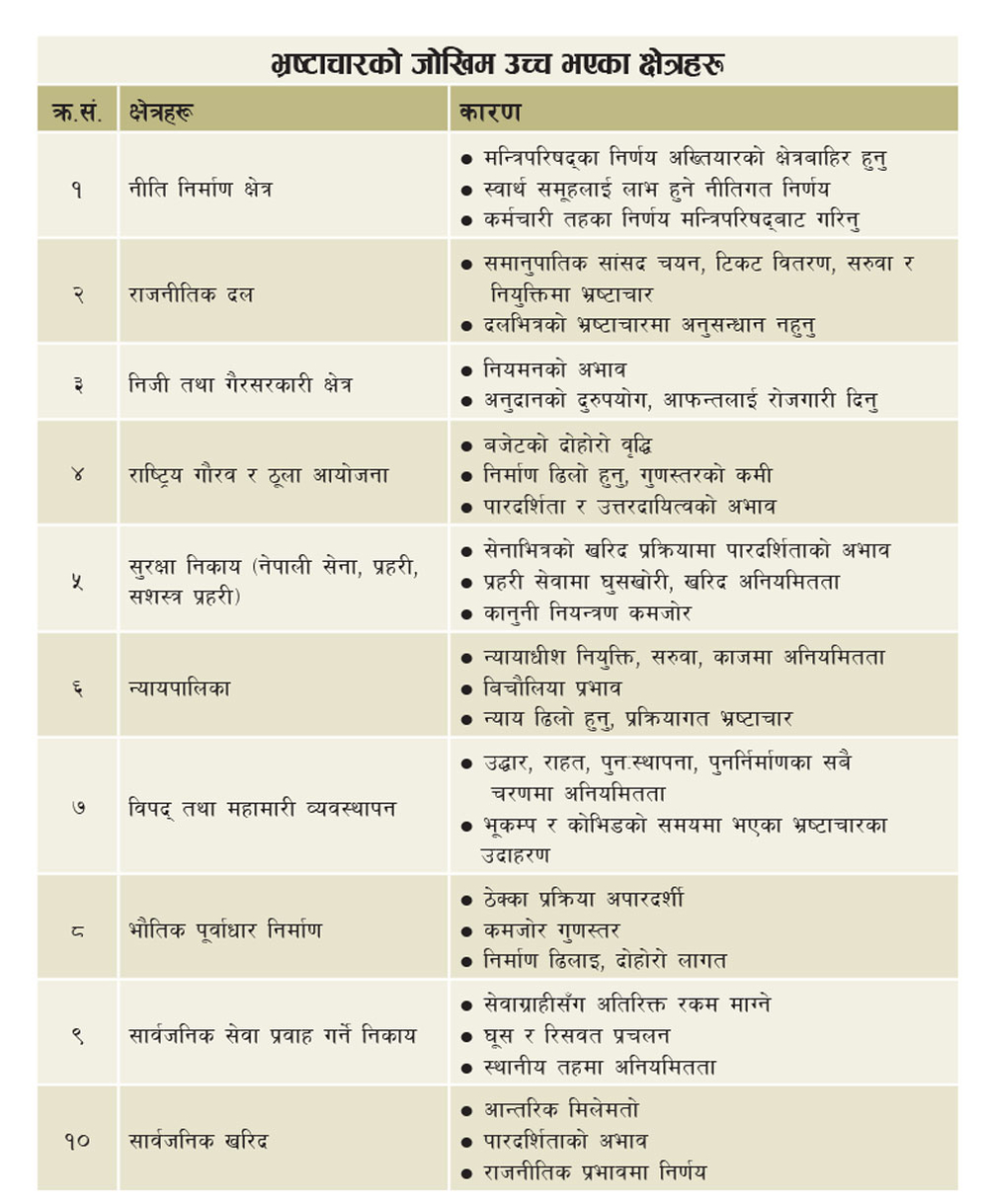
Second, the political field . A study conducted by the Authority in 2075, the 'Global Corruption Barometer' published by Transparency International in 2013 has pointed out political parties as areas with high risk of corruption. Corruption happens when political parties make proportional MPs, distribute tickets, transfer employees, and give political appointments. But the authority has not yet investigated the corruption within the political party.
Third, private and non-governmental sector . In the annual report of the National Vigilance Center for the year 2075, the fact that there is a high risk of corruption in the private and non-governmental sectors has been pointed out. There is no clear legal framework for investigating corruption in the corporate sector, which has exacerbated the problem. Similarly, the fact that the grants received by non-governmental organizations opened across the country with the purpose of social service, development, etc., are being irregular in various forms such as financial irregularities, private use of public property purchased in the name of the organization, selling, submitting reports without conducting the program, making high bills without purchasing materials or purchasing low-quality goods at low prices, employing only relatives, etc. are being made public.
A study conducted by the authority regarding the economic aspect of foreign aid in the year 2060 states that the funds being spent through non-governmental organizations are at a high risk of corruption. The regulatory body of this sector, the Social Welfare Council, has not been able to work effectively.
Fourth, projects of national pride and large projects are at high risk of corruption. The budget of the national pride project is more than 16 billion. But so far none of these projects have been completed within the stipulated time . After project verification, the cost of such big projects has been increased many times . For example, the construction of the Melamchi water supply project started in 1998 with a loan of about 15 billion rupees from ADB has not been completed even after spending more than 35 billion rupees in 27 years . It took 12 years to complete the Upper Tamakoshi project, which started with a total capacity of 456 megawatts and a cost of 35 billion, but the cost reached more than 75 billion. Cases of poor quality and corruption of such large projects are becoming public.
Fifth, security agencies . Among which, the first is the field of procurement and physical infrastructure development within the Nepali Army . In the 52nd report of the Auditor General, it is mentioned that there have been financial irregularities within the Nepali Army, from biscuits to the purchase of helicopters, and violations of the Public Procurement Act in most of the contracts.
Similarly, the estimated cost of the Kathmandu Terai Madhesh Expressway, which Nepali Army took responsibility for construction on 21 May 2074, was 75 billion rupees and the construction had to be completed by May 2078. When the foundation stone is laid, the estimated cost has increased to 1 trillion 75 billion. It seems that the risk of corruption is high because the Prevention of Corruption Act does not attract the involvement of the Nepali Army. However, there is a provision in Section 62 of the Military Act, 2063 to investigate and take action on corruption within the Nepali Army. But this body is not effective.
Similarly, Nepal Police and Armed Police Force are high risk areas of corruption. According to a study by Transparency International, it is mentioned that corruption occurs in the public procurement process within the police where the general public has to pay bribes while taking services from the police. The fact that the level of corruption in the police is made clear by the Sudan scandal.
Sixth, judiciary or bodies under it . The study report submitted in 2078 by the committee formed under the leadership of Supreme Court Judge Harikrishna Karki regarding distortions, anomalies, irregularities or corruption and activities that may be done by middlemen and the measures to be taken to prevent the same has shown that the judiciary is an area with a high risk of corruption . The report mentions that there are financial irregularities and corruption in eleven different areas including judge appointment, transfer and employment, intermediaries, delay in judicial operations, irregularities in judicial process.
Seventh, disaster and epidemic management work . After a natural and human disaster, there is high corruption in the expenditure of public bodies in the management of its management . The whole phase of 'Four-R' ie 'Rescue, Relief, Rehabilitation and Reconstruction' in the disaster management cycle is at high risk from the point of view of corruption . The earthquake of 2072, corruption in the covid-19 pandemic are examples of this.
Eighth, the field of physical and infrastructure construction . Roads, irrigation canals, river embankment construction, water-borne disaster control works, bridges, culverts, building construction and other physical infrastructure works are highly risky from the point of view of corruption . It seems that there are more complaints related to the construction of physical infrastructure among the complaints about irregularities in public procurement.
Ninth, there are public service delivery agencies. Most of the past studies in Nepal have shown that public service delivery agencies are at high risk of corruption. It seems that the customer has the nature of taking some additional money, bribery and extortion for providing services and goods . Areas and entities that are at high risk of retail corruption are those who ask for additional money from such service providers in service provider offices such as land, land reform, surveyors, transport management office, internal revenue office, district education, health, and district administration. In addition, the construction through the local level, the work through the consumer committee are also at high risk from the point of view of corruption.
Tenth public procurement . Various study reports of the World Bank and Transparency International have shown that corruption occurs through opacity and internal collusion during public procurement in Nepal. A study report on public procurement monitoring has shown that about 70 percent of the contract process is not done in a transparent manner but on the basis of collusion or political influence . It has institutionalized corruption. The number of complaints related to public procurement is also high in the annual reports of the Authority.
Finally, these are just a few examples . The risk areas of corruption in the country are at higher levels, institutions and areas than citizens see or experience. Therefore, in order to control corruption, it is necessary to identify the areas of risk and plan the policy, law and strategy for its control. It is necessary to thoroughly study these and other risk areas of corruption and strengthen the relevant regulatory agencies and increase their effectiveness.
In addition, some risky areas should be brought under control by making laws or amending existing laws. In this process, a clear definition of the policy decision should be decided and the decision of the Council of Ministers should also be brought under the jurisdiction of the authority. Likewise, it is appropriate to give the authority the responsibility of investigating the irregularities in the non-military and development work within the Nepali Army, setting specific definitions and criteria for corruption within the private sector and non-governmental organizations.
In addition to corruption within the courts, it is appropriate to give the investigation and investigation of officials other than the appointment through the Constitutional Council and the Judicial Council to the authority.