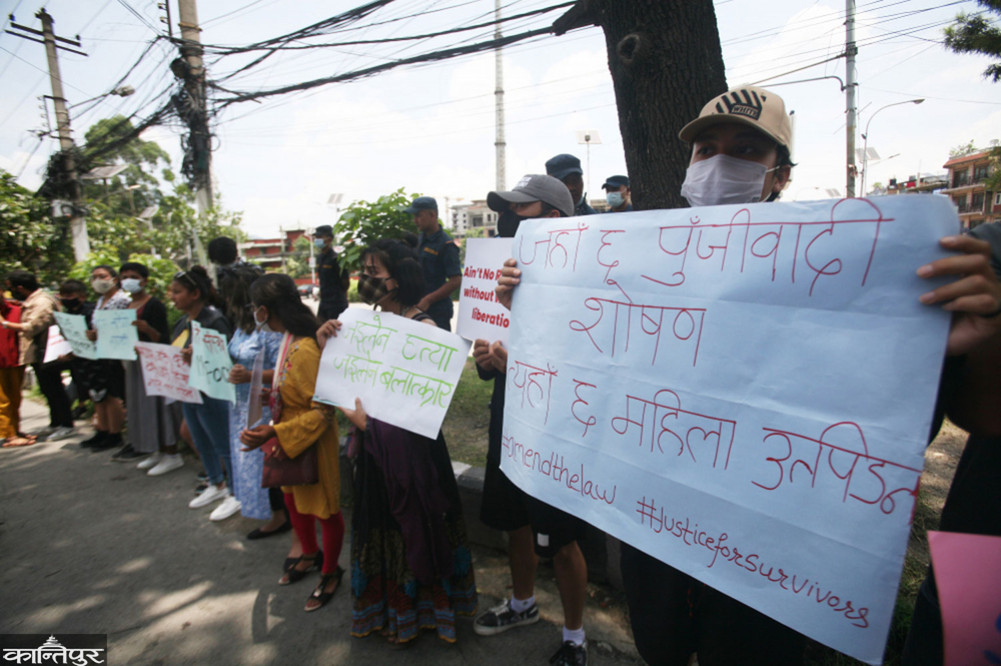
We are claiming that ten-year-old girls should not do Suryadarshan when they are menstruating with their iPhones and Ph.D.
We use Google Cloud Translation Services. Google requires we provide the following disclaimer relating to use of this service:
This service may contain translations powered by Google. Google disclaims all warranties related to the translations, expressed or implied, including any warranties of accuracy, reliability, and any implied warranties of merchantability, fitness for a particular purpose, and noninfringement.
For some time now, one after the other issues have been strewn before us, especially issues directly affecting women, children and marginalized communities are at the center of discussion. Not being able to focus on one topic and understand what it is, another topic comes like a storm and waves the society. People's opinions are divided into pros and cons through social media.
Such issues often come with the aim of narrowing the constitutional rights of citizens, especially women's rights, which has caused concern. Such issues raised as law changes are insensitive and insulting, disrespecting the achievements of women and marginalized groups. Even after the advent of the Republic, Nepali women put aside all their other agendas and are struggling in the streets and in the house to fight against the same backward tendencies.
Some time ago, regarding the population policy, the Prime Minister announced the idea that women should give birth to three children early. How to keep the population balanced is a serious issue in the context of declining population in the country. However, the mild comments made by the Prime Minister on such a serious matter, was it fair, respectful of women's reproductive rights and self-respect? Studies have shown that on an average, two maternal deaths occur every day in Nepal and five percent of them are due to complications of abortion.
When the Prime Minister was suggesting women to give birth to three children, how much attention was given to the protection of women's rights provided by the constitution, the assurance of women's right to have children safely, at the desired time and in the desired number? Nepal's Safe Maternal and Reproductive Health Act, 2075 has clearly given women the right to decide how many children they will have. Such expressions show that women are child-bearing machines and that marriage cannot be seen from a separate and multifaceted perspective from the process of producing children. Such expressions aimed at women are misogynistic and insulting.
There is news that the government is preparing to amend the current law following the Romeo and Juliet law to reduce the age of marriage from 20 to 18 years. According to the policy maker, the current minimum age of marriage is not suitable from our perspective, especially Madhesh and Karnali. This has led to increased rape, mismatch between citizenship age, voting age and marriage age, pregnancy due to having sex at a young age, problems in birth registration of such children, etc. and many Dalit youths have to stay in jail because of this.
But the thing that the policy makers are unable to understand or explain is that sex and marriage are the same thing? How did getting to be a citizen of Nepal and deciding the age of marriage become the same issue? It is true that in today's society, children's physical development is relatively early, attractiveness increases, and there is a risk of physical contact without adequate knowledge of emotionally mature and safe physical relationships. However, how can marriage be the solution to the complications caused by these problems?
How is it thought to solve many other problems caused by marrying at a young age and giving birth to children, the effect on women's reproductive health, the children's social, economic, emotional and many other problems caused by marriage? What are the government's plans for sexual education, reproductive education, family building, economic self-reliance? If many Dalit youths and children are kept in jail due to caste discrimination, how will marrying at a young age solve the problem? What are the plans of the state to end caste discrimination at the level of society and family? No answer anywhere. Without adequate study and analysis, such laws, which are tried to be changed on the basis of emotion and emotional impulse, are sure to cause more complications rather than solving the problem.
The proposal to amend the law on polygamy can be considered as the most shameless and insulting change of recent times. After widespread protests, the government has indicated that it has relented a bit, but still wants to form a committee to study it. The basis of this law, which is said to be taking care of the interests of children who have not received legal recognition, is intended and rude from a very shameless and masculine thought. It has perpetuated the inferior mentality that women are objects, that their existence is inferior to that of men, and that men are the masters of women. This has not only deeply affected the self-esteem of women as a whole, but it has reaffirmed that the creation of laws is not the final indicator of change.
According to the statistics of Nepal Police, in the last one year, there are 2 thousand 507 cases of rape, 54 cases of rape after kidnapping, 653 cases of polygamy, 16 thousand 416 cases of domestic violence, 81 cases of murder after domestic violence, 166 cases of human trafficking, and 23 cases of witchcraft.
According to the data of the Nepal Police, 3,441 cases of sexual violence have been registered, of which 451 are family members of the accused. In this way, the largest number of victims of violence are girls aged 11 to 14 years (777), while the number of perpetrators are men aged 19 to 25 years (1281). Has the attention of the policy makers, administrators and political leadership gone to this or not? If so, which laws are being improved or where are efforts being made to analyze and address these data? This question is for everyone concerned and also for you the reader.
Before that, the news has also come out that the government itself is trying to amend the law by removing the said list and provision to give amnesty to people convicted of 11 types of heinous crimes such as corruption, torture, coercion, murder, explosives, kidnapping, body hostage or missing persons, human trafficking and trafficking, money laundering and drug trafficking or trading punishable by imprisonment for more than three years.
Are the above topics of interest only to women or those who are suffering or affected? This question is for the political party leaders (especially men) who hold the contract of society, country, democracy, civil society leaders who protect civil rights and human rights, policy makers who make and implement policy rules for the benefit of the people, and administrators who control the administrative mechanism of running the country, new political parties who cultivate confusion by declaring that we are the alternative to the old political parties, independent politicians and analysts.
Even after the advent of democracy, why are women forced to leave all their jobs and go down the streets for the right to live as human beings with their minimum basic rights? Why are political parties, majority men (with exceptions) silent on this issue?
No matter how progressive we call ourselves, our mindset is plagued by patriarchal beliefs and thinking. We are claiming to have saved sanskar by saying that ten-year-old girls should not do Suryadarshan when they are menstruating, with iPhones and PhD degrees in their hands. It is clear from this - how poor and weak our mentality is. For us, development still means big houses, roads and view towers.
Rather than getting to the root of the problem and finding a solution, we enjoy sidelining the problem and exaggerating that it is not a problem at all. We do not understand the debate on prosperity other than counting how many remittances have come in and how many citizens have been agreed to be sent to the Gulf. Our mentality, which considers itself to be very developed physically, is locked in the shell of a rusted iron patriarchy. The tragedy of our society is entangled in this.
Sometimes it feels as if the women's movement in Nepal has gone astray or weakened. However, in every change movement in the country, whether it is fighting with a gun or shooting on the streets, women are also seen at the front. Therefore, seeking to exclude and shrink women is an affront to both history and the present.
Overall, today women are more aware, empowered and interventionist both numerically and qualitatively than yesterday. Whether it is the laws brought to cover up their crimes or expressions and behaviors that affect the constitutional and natural rights, women do not accept them anymore.
The women's movement is being empowered and organized in a different way than yesterday. In this transitional period, women's organizations and leaders of political parties, rights activists and advocates of social justice are united to protect their rights. If the political party or anyone else ignores it and continues to try to be the boss, he is sure to find it burdensome.