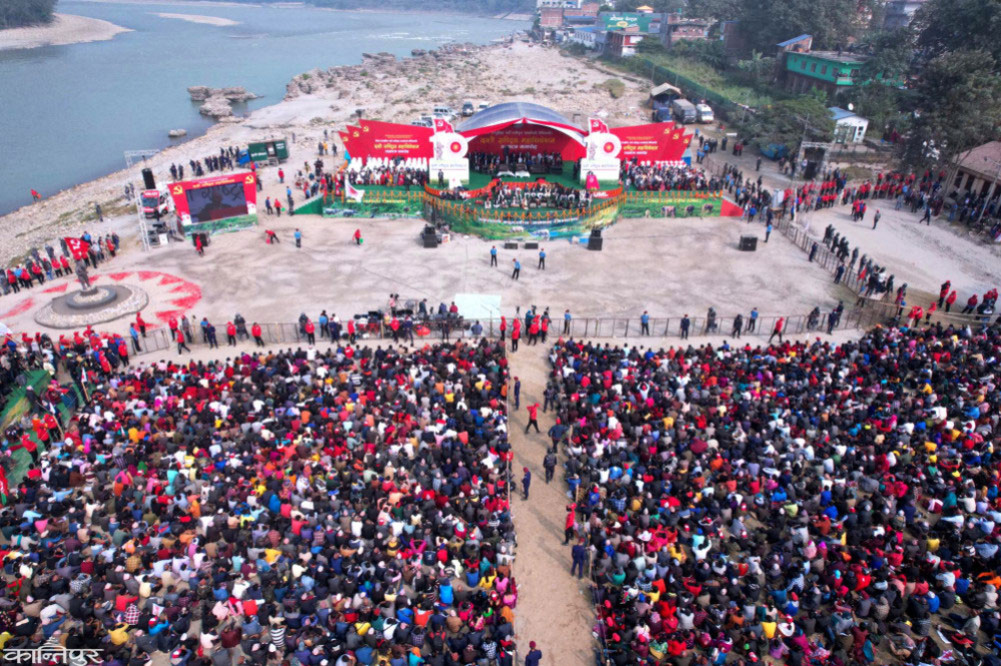
Since the political party is the organized form of a selfless, selfless and active person for the transformation of the society, the basic basis of his survival is his sincere dedication to the people and the nation.
We use Google Cloud Translation Services. Google requires we provide the following disclaimer relating to use of this service:
This service may contain translations powered by Google. Google disclaims all warranties related to the translations, expressed or implied, including any warranties of accuracy, reliability, and any implied warranties of merchantability, fitness for a particular purpose, and noninfringement.
A political party is an organized form of people who believe in the same ideology, purpose and policy. All citizens who accept the constitution and program of the party can become members of that party, except in cases where it is prohibited by the constitution. The constitution of the party cannot make any citizen without a party by establishing an unconstitutional basis, except in cases where the constitution prohibits it.
A citizen's affiliation with a political party is a very sensitive issue. Faith is linked to party affiliation and life as a whole to faith. A man is ready to lay down his life for faith. People get involved in politics by giving up family, future and many comforts. People are ready to live in prison for decades to protect and defend faith. Nelson Mandela is probably the politician who has spent the most time in prison for his faith.
The fact that Mohanchandra Adhikari, known as Nelson Mandela of Nepal, spent about 18 years and KP Sharma Oli spent 14 years in prison is illustrated before us. If they had announced their resignation from the party, they probably would not have spent a week in jail.
The number of people who have been imprisoned, tortured, underground, exiled and disappeared during the past monarchy in Nepal is still not less than 100,000. All these faiths and beliefs related to the birth of the political party of their choice were and are the emanations made for the upliftment, promotion and development. Political parties were born, grew up and rose to power and power on the foundation of those emanations. Therefore, the political faith of citizens is an impregnable fortress, which does not die suddenly. Russian Communist leader Vladimir Ilyich Lenin said, "Faith is like water, which never dies." Sometimes it is dormant and sometimes it blooms.'
Political parties are basically born, grow and live on the basis of political beliefs. Political belief is linked to philosophy. Philosophy is the overall form of policies, plans, programs and actions to change life and the world.
Even now, world politics revolves around two political philosophies, namely Marxist and non-Marxist schools of thought, and political parties are born, raised and fallen based on them. Capitalism, liberalism, neoliberalism, postmodernism, political nihilism or populism are all ideologies guided by non-Marxist ideology and socialism, communism, Maoism, all parties that consider multi-party democracy as the guiding principle of the people are guided by Marxist ideology.
Apart from these two parts related to the philosophy of the political party, the third part has not been found yet. Therefore, the basic starting point of political parties is political philosophy and ideology. That ideology is not only a means of gaining power, but also an overall approach and plan for economic-social transformation.
Political parties are organized by people who have a clear vision and sense of sacrifice to transform the society economically and socially. That 'blue print' of transformation can be retrogressive for some and progressive for some. Joining politics should be understood as joining for the purpose of service. That is why it is said that people who belong to a political party do not belong to take but to give and give their life and time for the party regardless of their future, family and wealth.
Since the political party is the organized form of such a selfless, selfless and active person for social transformation, the basic basis of his survival is his sincere dedication to the people and the nation. Considering such dedication as the ideal and basis, thousands, millions of people yearn to become members of that party. This is why political parties survive for centuries.
After passing through a long stage of social development, the feudal political system has come to an end. Political parties were born as an alternative to feudalism. Feudalism is a system rooted in individualism, religion, fate and superstition. Before the birth of political parties, the system of governance was governed by the orders of kings, maharajas, priest-popes and guru-priests, pandits and zamindars. Where orders, hymns, clan traditions and praise were the only ones who spoke. There was no scope for human values, recognition, consciousness, argument, agreement and disagreement.
As an alternative to such a system of government, a conscious society, a value-based system, a selection system based on conscience and freedom, i.e. a system of selecting representatives from periodic elections, was born against feudalism, and a party system operated by a political party was born. This was the initial stage of the development of capitalism.
The birth of the party system against feudalism has become the foundation of capitalism to this day. Over time, that capitalism also became a means of extreme exploitation. It made class discrimination and labor exploitation the basis of their lives, making money instead of human values and widening the gap between the rich and the poor, so Karl Marx and Friedrich Engels envisioned a socialist system for the construction of a classless, exploitation-free and egalitarian society as an alternative to capitalism. They insisted that
is where more human values and freedom can be practiced than in capitalism. Based on the basic belief that society and political parties are and should be run on the basis of logic, debate, controversy, criticism, self-criticism and dialectical materialism, Marxist ideology and political parties spread throughout the world.
The essence of all this historical background is that parties are basically born and live on the basis of philosophy, ideas and human values. If these issues cease to be recognized or ignored in the practice of political parties, then the justification for establishing a political party ends.
If we analyze the practice of our major political parties in this theoretical light, there is no need to name this or that party, it seems that all parties are gradually losing their base of survival. Be it in party practice or in the exercise of state power – the majority rules and the minority is respected. Due to this democratic character of the ruling style of the party system, people are attached and active in the party. Even after being in the minority, he remains in the same party because of the awakening feeling that even the minority can turn into a majority in time, which motivates him to remain active.
A vivid example of the fact that a minority can reach a majority at any time is evident from the fact that the agenda of democratization of party life put by Comrade KP Sharma Oli in the seventh and eighth congresses of UML reached the majority in the ninth congress. Similarly, the fact that Girija Prasad Koirala's opinion that there can be no functional unity with the communists in the 2062/063 movement was in the minority is also well known.
is another basis for the party to be active or for the parties to be alive - even if they are in the minority of opinion, there is an equal distribution of opportunities and there is a guarantee that the issue is not differentiated as establishment or non-establishment in the occasion. If they are discriminated against due to having a different opinion or being in the minority, such member, supporter or leader-activist will end up being active in that party.
The opportunity given by the party power to the leader-activist who is in the minority or if the party has reached the state power, if ideological or factional or any other kind of discrimination is evident in the opportunity given by the state power, it is futile to wish that such a worker will remain in that party forever by enduring such discrimination or losing self-esteem.
Citizens join or become active in the party based on the belief that the party values their self-esteem and ability or does not discriminate. Even so, the issue of self-respect becomes a primary issue in Marxist parties or their workers because they have more critical consciousness and philosophical beliefs and awareness against discrimination than in capitalist parties. Another basis for the survival of
parties is that the opportunity of leadership is obtained through free competition under the constitution of the party, and through leadership, the campaign of social transformation can be carried forward. Students, youth and adult members of any age group are motivated to join the party and get the responsibilities and opportunities according to their ability through fair competition, and that motivation is also a lively way to join or be active in the party.
In a party where the percentage of old leaders-activists starts to be higher than the percentage of new entrants every year, questions about the future of that party start to arise. And in a party that does not have the opportunity to compete fairly or even if the party power controls that opportunity on the basis of ideas or factions or is not a fair competition, when it is clearly seen that the party power or the state power is being abused to defeat him, then such a person is forced to choose the path of either fleeing or rebelling. Another basis for the survival of
parties is the continuity of public support for the leader or party. It cannot be said otherwise that the public support decreases in periodic elections in the party system. Even if the party he belongs to suffers defeat in one or two elections, if he has the ideological base, leadership ability and public support to win again in the next election, such a party can survive. But when the ideological base, leadership ability or ability or the possibility of regaining public support and the base are not clearly visible, the number of citizens who join that party gradually decreases, looking at the future of such a party. Popularity and skill of
leadership is another important basis for party survival. Sometimes the party's popular support continues to grow even when the leadership is unpopular. But on the contrary, sometimes the party's policy, ideas and principles are right, even if the leadership is not popular, the future of that party may be questioned. In parliamentary politics, the popularity of the leadership makes even a person who does not like the ideological ground of that party eager to vote for that party. I vaguely remember an example. In the general elections of 2048, the then UML won such number of seats and votes, the miraculous leadership ability of Madan Bhandari, the leader of that party, was a major basis.
I would like to quote an incident a few days before the election. Well-known constitutionalist and close senior advocate of BP Koirala Ganeshraj Sharma said to me on Putli Sadak while he was returning from arguing from the Supreme Court, Tikaji! I will not vote for UML this time, but for Sun Symbol.' He also revealed the reason, 'I was impressed with Madan Bhandari's personality. It does something in the future. When the Congress is strong, nationalism is weak, only Madan Bhandari's leadership can check it.
Many nationalists like Ganeshraj Sharma but non-UML voted for UML at that time, due to which UML became powerful. What I am trying to say here is that the survival of the parties is based on who is leading the party and what is the attitude of the people towards him. Another important basis for
parties' survival is the party's or its leader's true commitment to good governance, accountability and transparency. Every party and every leader has lip service but when that leader gets the opportunity to lead, the test of his true meaning towards good governance and transparency and accountability begins. The unblemished image and leadership of Krishna Prasad Bhattarai and Manmohan Adhikari remained unblemished even after they were out as Prime Ministers, and even in the latter part of their lives, there was no loss of respect and support for them from the public because they passed the test when given the opportunity.
In fact, the first basis for the survival of the party is the ideological ground and the loyalty to it. If collectiveism is seen in policy making and leadership selection of political parties, such parties will continue to be durable and skilled. Party leadership selection is based on fair competition in true sense, while people with merit and ability are eagerly waiting in the leadership line in the party. But if the competition is controlled and only in name, the possibility of qualified, competent and self-respecting workers to stay or be active in the party becomes less.
The popularity of leaders and leadership, accountability, policy primacy, non-discrimination of workers in the operation of party power or state power, fairness in the distribution of opportunities obtained from state power or party power, and liberal and egalitarian parties in internal democracy survive. Every adult citizen is now able to analyze all the political parties of Nepal and their leadership whether they have these characteristics or not. The choice of those adult citizens will decide whether the party will survive or not.
It is equally important to survive and save the parties for the strong future of the Federal Democratic Republic. If the party and Bhajan continue to differ in the congregation, then the existence of the party will be in danger. Republic of Republics need to enhance the most new entrant's attraction to survive. The parties do not survive for the desires of the commission, temptation, temptation, and the light of earning. Let
-BREAK will be reconciled to the ideological and organized parties that can control the impact of the beach. Let us maintain a determined and simplifying the practice of the republic within a political party. The parties have to live for a leader, not for a leader, but half part of determining or determining the subject depends on the ability, abilities and skills of leadership.
is the tribunal of destruction of the politics of revelations. Cooperation, cheasiness and group leadership is the souvenic dynasty. Who will save that soul? Before major political parties begin to the subject. It must survive the parties to strengthen the federal republic. The party living leaders will survive automatically, but they will not livelessly burst short "not to survive. '